


























Views
Downloads
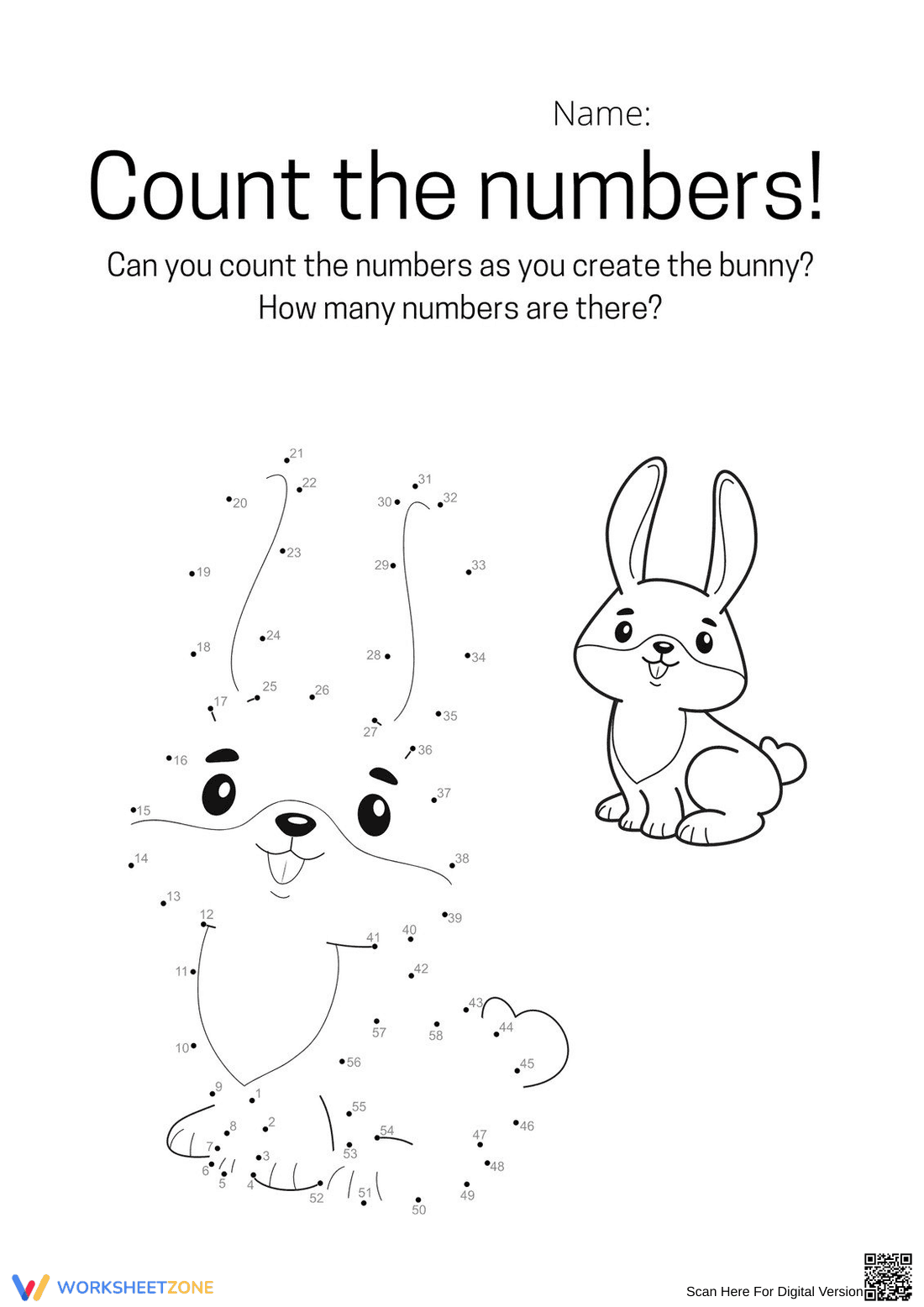

Printable Bunny Dot to Dot Worksheet | Kindergarten Math
Paste this activity's link or code into your existing LMS (Google Classroom, Canvas, Teams, Schoology, Moodle, etc.).
Students can open and work on the activity right away, with no student login required.
You'll still be able to track student progress and results from your teacher account.
This printable bunny dot to dot worksheet helps kindergarten students master number sequencing from 1 to 58 while developing essential fine motor skills. By connecting the numbered dots in order, children actively engage with the counting sequence to reveal a hidden animal illustration, turning foundational math practice into an enjoyable creative activity.
At a Glance
- Grade: Kindergarten · Subject: Math
- Standard:
CCSS.MATH.CONTENT.K.CC.A.1— Count forward sequentially up to 100 by ones.- Skill Focus: Number sequencing 1–58 · Fine motor control
- Format: 1 page · 1 activity · PDF format
- Best For: Morning work or independent math centers
- Time: 15–20 minutes
This single-page PDF resource features a large dot to dot puzzle containing 58 sequential points that form a bunny. The layout includes clear typography with a name line, an instructional prompt, and a question encouraging students to identify the total number of dots. A small reference graphic of the completed bunny provides a visual target to support self-monitoring.
Zero-Prep Classroom Workflow
This resource requires zero teacher preparation. Follow these three simple steps to integrate it into your daily routine:
- Print (1 minute): Run off copies directly from the PDF file.
- Distribute (1 minute): Hand out sheets along with pencils or crayons.
- Review (5 minutes): Have students count aloud together to verify their completed paths.
Standards Alignment and Core Skills
This activity directly aligns with the Common Core State Standard CCSS.MATH.CONTENT.K.CC.A.1, which requires students to count to 100 by ones. By requiring students to track and connect numbers up to 58, it reinforces rote counting order and number recognition in a structured visual format. Both standard codes can be copied directly into lesson plans, IEP goals, or district curriculum mapping tools.
Instructional Applications
Use this worksheet during the independent practice portion of a math lesson focused on two-digit number recognition. It works exceptionally well as a quiet transition activity after direct instruction or as a formative assessment tool. While students work, observe their path of movement to check if they are scanning numbers sequentially or guessing based on the picture shape. Expect completion within 15 to 20 minutes depending on fine motor proficiency.
Target Student Population
This worksheet is tailored for kindergarten students learning the counting sequence beyond 20, but it also serves as an excellent remedial tool for first-grade students needing extra number-line reinforcement. Pair this resource naturally with a hundreds chart anchor chart or a counting song video to provide a multi-sensory learning experience that bridges abstract numbers with physical coordination.
Engaging early learners in dot-to-dot activities provides dual benefits by reinforcing abstract mathematical concepts through physical, spatial execution. According to a ScienceDirect TpT Analysis, integrating playful thematic elements like animal illustrations into early childhood math worksheets significantly increases task persistence and student engagement. This worksheet targets CCSS.MATH.CONTENT.K.CC.A.1 by requiring students to actively recall and apply the sequential order of numbers from 1 to 58. As children navigate the page, they build spatial awareness and visual scanning skills necessary for reading and advanced mathematics. The inclusion of a secondary counting question prompts higher-order reflection on cardinality, ensuring that the activity functions as a rigorous learning tool rather than just a coloring page. Teachers can confidently utilize this resource to support fine motor development and numerical fluency simultaneously.


