


























Views
Downloads
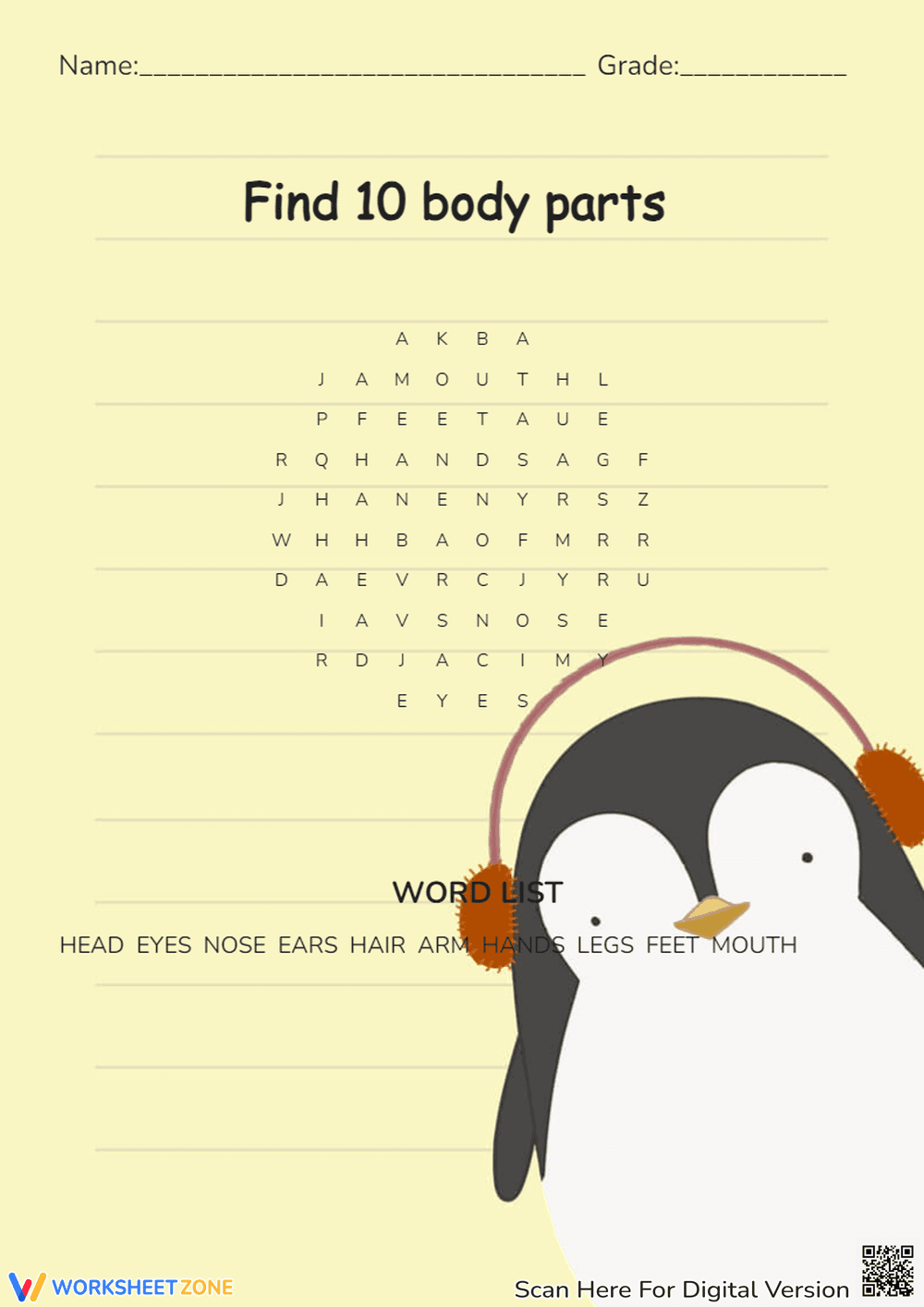

Grade 1 Body Parts — Printable No-Prep Worksheet
Paste this activity's link or code into your existing LMS (Google Classroom, Canvas, Teams, Schoology, Moodle, etc.).
Students can open and work on the activity right away, with no student login required.
You'll still be able to track student progress and results from your teacher account.
This printable science worksheet helps Grade 1 and 2 students identify and spell ten common human body parts. Students search the grid to locate vocabulary words like head, eyes, and hands, reinforcing anatomy basics. It builds spelling skills and vocabulary retention through an engaging, visual puzzle format.
At a Glance
- Grade: Grade 1 · Subject: Science & ELA
- Standard:
CCSS.ELA-LITERACY.L.1.6— Identify and spell common body parts- Skill Focus: Anatomy vocabulary and word recognition
- Format: 1 page · 10 tasks · Answer key included · PDF
- Best For: Morning work or early finishers
- Time: 15–20 minutes
This resource features a single-page layout containing a letter grid and a clear word list. The list includes ten essential terms: head, eyes, nose, ears, hair, arm, hands, legs, feet, and mouth. A friendly penguin illustration provides a welcoming visual anchor for young learners.
Zero-Prep Classroom Workflow
This activity requires minimal teacher intervention, making it excellent for sub plans. Follow these three steps:
- Print (1 minute): Run off copies of the single-page PDF.
- Distribute (1 minute): Hand out sheets with pencils. Students start immediately.
- Review (5 minutes): Use the answer key to check work.
Total preparation time is under two minutes, allowing you to focus on individual student support.
Standards Alignment
This worksheet aligns with CCSS.ELA-LITERACY.L.1.6, focusing on vocabulary acquisition. By identifying these anatomy terms, students build word-recognition skills. Both standard codes can be copied directly into lesson plans, IEP goals, or district curriculum mapping tools.
Instructional Applications
Use this puzzle as a warm-up at the start of a science unit to gauge prior knowledge, or assign it during ELA centers. For formative assessment, observe which students struggle to match the word list letters to the grid. Most students complete the puzzle in 15 to 20 minutes.
Target Audience and Differentiation
This worksheet is designed for Grade 1 and Grade 2 students, including English language learners. For students needing support, highlight the first letter of each hidden word. Pair this activity with a read-aloud book about the human body to deepen conceptual understanding.
This educational resource supports vocabulary acquisition aligned with the CCSS.ELA-LITERACY.L.1.6 standard, focusing on the plain-English skill of identifying and spelling common body parts. According to research by Fisher & Frey (2014) on vocabulary development, word puzzles and structured word recognition tasks help solidify orthographic mapping in early readers. By engaging with the ten target terms in a visual search format, students reinforce the connection between spoken vocabulary and written letter sequences. This active processing helps transition words from short-term recognition to long-term memory. The worksheet provides a low-stakes, high-engagement method for students to practice spelling patterns independently. Educators can confidently integrate this tool into early literacy and science curricula, knowing it aligns with evidence-based practices for vocabulary reinforcement and word study in primary classrooms.


