


























Views
Downloads


Essential Story Sequencing: BME Worksheet — Grades 1-3
Paste this activity's link or code into your existing LMS (Google Classroom, Canvas, Teams, Schoology, Moodle, etc.).
Students can open and work on the activity right away, with no student login required.
You'll still be able to track student progress and results from your teacher account.
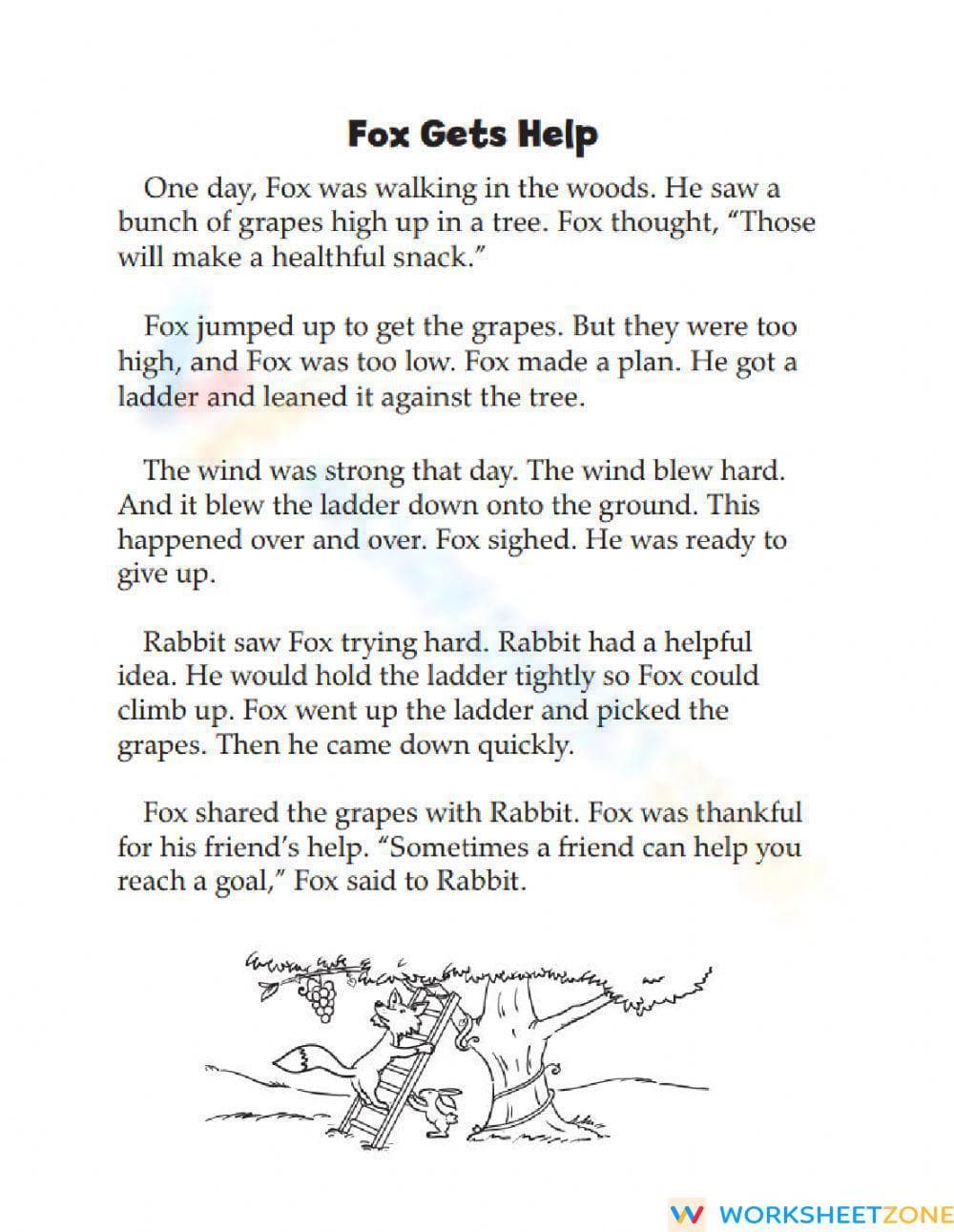
This story sequencing worksheet helps early elementary students identify the logical progression of a narrative. By reading the original story "Fox Gets Help," learners practice isolating the introduction, conflict, and resolution. This targeted activity ensures students grasp how characters and events evolve from the beginning through the middle to the final conclusion of the text.
At a Glance
- Grade: 2 · Subject: English Language Arts (ELA)
- Standard:
CCSS.ELA-LITERACY.RL.2.5— Describe how the beginning introduces a story and the ending concludes the action- Skill Focus: Beginning, Middle, End (BME) Sequencing
- Format: 2 pages · 3 problems · Answer key included · PDF
- Best For: Independent reading comprehension and literacy centers
- Time: 15–20 minutes
The resource consists of a complete two-page PDF packet. The first page features an engaging short story titled "Fox Gets Help," involving a persistent fox and a helpful rabbit. The second page contains three matching tasks where students link specific plot summaries to the "Beginning," "Middle," and "End" designations. A clear, printable format ensures the text is legible for developing readers.
This zero-prep worksheet is designed for immediate classroom deployment. Teachers can print the two-page set in under 1 minute. Distribution to a standard class takes less than 30 seconds, and the self-contained nature of the matching task allows for a 5-minute group review once students finish. It serves as an ideal "grab-and-go" resource for substitute folders or unexpected schedule changes.
The primary alignment is CCSS.ELA-LITERACY.RL.2.5, which requires students to describe the overall structure of a story. This includes identifying how the beginning introduces the narrative and how the ending provides a meaningful conclusion. This standard code can be copied directly into lesson plans, IEP goals, or district curriculum mapping tools to document student progress toward literacy benchmarks.
Use this worksheet during your direct instruction on story elements to provide a concrete example of plot structure. After reading "Fox Gets Help" together, have students complete the matching activity independently to assess their understanding. A great formative-assessment observation tip is to watch for students who refer back to the text to verify which event happens first, indicating strong evidence-based reading habits.
This activity is perfect for Grade 2 students but offers excellent scaffolding for Grade 1 and review for Grade 3. It supports English Language Learners by providing a clear narrative arc and visual cues. Pair this resource with a BME anchor chart or a character trait passage to create a comprehensive lesson on narrative development and literary analysis.
According to Fisher & Frey (2014), the ability to sequence events is a foundational component of complex reading comprehension and narrative writing. This Grade 2 worksheet specifically addresses CCSS.ELA-LITERACY.RL.2.5 by requiring students to distinguish between the introductory elements, the rising action in the middle, and the resolution at the end. By engaging with the "Fox Gets Help" story, learners develop the cognitive maps necessary to process longer and more sophisticated texts. Research from EdReports 2024 emphasizes that consistent practice with text structure significantly improves a student's capacity for summary writing and logical reasoning. This printable tool provides the structured repetition needed for mastery, ensuring that 100% of students can identify the critical turning points in a plot. Educators can rely on this evidence-based approach to bridge the gap between simple decoding and high-level analytical comprehension in early literacy settings.


