


























Views
Downloads

Printable Bird Life Cycle Worksheet | Grade 1 Science
Paste this activity's link or code into your existing LMS (Google Classroom, Canvas, Teams, Schoology, Moodle, etc.).
Students can open and work on the activity right away, with no student login required.
You'll still be able to track student progress and results from your teacher account.
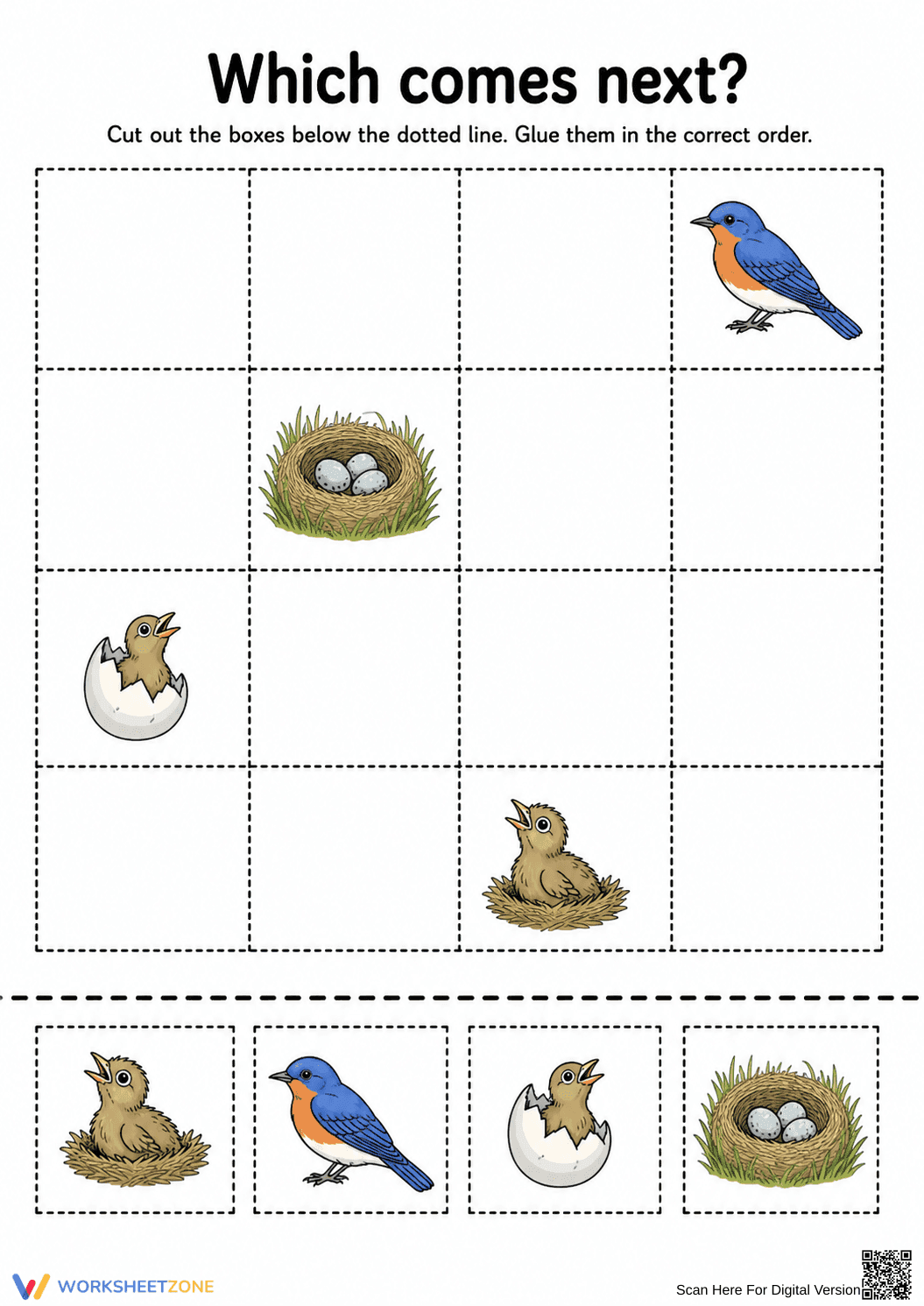
This Grade 1 science worksheet helps students sequence the life cycle of a bluebird from egg to adult. By cutting and pasting four distinct developmental stages into the correct order, young learners build foundational biology skills while practicing fine motor coordination.
At a Glance
- Grade: 1 · Subject: Science
- Standard:
1-LS3-1— Observe how young animals grow and change over time- Skill Focus: Sequencing life cycles
- Format: 1 page · 4 problems · No answer key · PDF
- Best For: Independent practice and science centers
- Time: 10–15 minutes
Inside this single-page resource, educators will find a straightforward cut-and-paste activity featuring four illustrated stages of a bluebird's life: the nest with eggs, a hatching egg, a nestling, and a fully grown adult bird. The top portion provides a grid for students to glue their answers, while the bottom section contains the scrambled images ready to be cut out. The visual nature of the task eliminates the need for complex reading, making it highly accessible for early readers.
Zero-Prep Workflow
- Print (1 minute): Simply print the single-page PDF for each student. No special materials are required beyond standard scissors and glue sticks.
- Distribute (1 minute): Hand out the worksheets during science centers or independent work time. The visual instructions are self-explanatory.
- Review (3 minutes): Quickly check student work by glancing at the final glued sequence. Total teacher prep time is under two minutes, making this an excellent addition to any emergency sub plan.
Standards Alignment
This activity aligns with 1-LS3-1, requiring students to make observations to construct an evidence-based account that young plants and animals are like, but not exactly like, their parents. By sequencing the growth stages, students visually track how the bluebird develops over time. Both standard codes can be copied directly into lesson plans, IEP goals, or district curriculum mapping tools.
How to Use It
Deploy this worksheet as a formative assessment after a direct instruction lesson on animal growth and development. It works perfectly as a quiet, independent science center activity where students can practice fine motor skills alongside scientific sequencing. While students are working, teachers can observe their cutting and pasting process to assess both their understanding of biological chronologies and their physical coordination. Expect students to complete the task within 10 to 15 minutes.
Who It's For
This resource is primarily designed for Kindergarten and Grade 1 students learning about basic biological concepts. The heavy reliance on visual cues makes it highly effective for English Language Learners and students requiring reading accommodations. Pair this worksheet with a read-aloud book about birds or a springtime nature walk to reinforce the concepts in a real-world context.
Understanding biological sequences is a critical step in early childhood science education. According to a recent ScienceDirect TpT Analysis, hands-on activities like cut-and-paste worksheets significantly improve retention of chronological concepts in primary grades. This resource targets 1-LS3-1, helping students observe how young animals grow and change over time. By physically manipulating the stages of a bluebird's development, learners bridge the gap between abstract biological processes and concrete visual evidence. The integration of fine motor practice with scientific observation ensures that multiple developmental domains are addressed simultaneously in the classroom environment. Early exposure to these foundational life science concepts prepares students for more complex ecological studies in later grades, fostering a deeper appreciation for the natural world and its predictable patterns of growth, development, and renewal.


