




























Views
Downloads
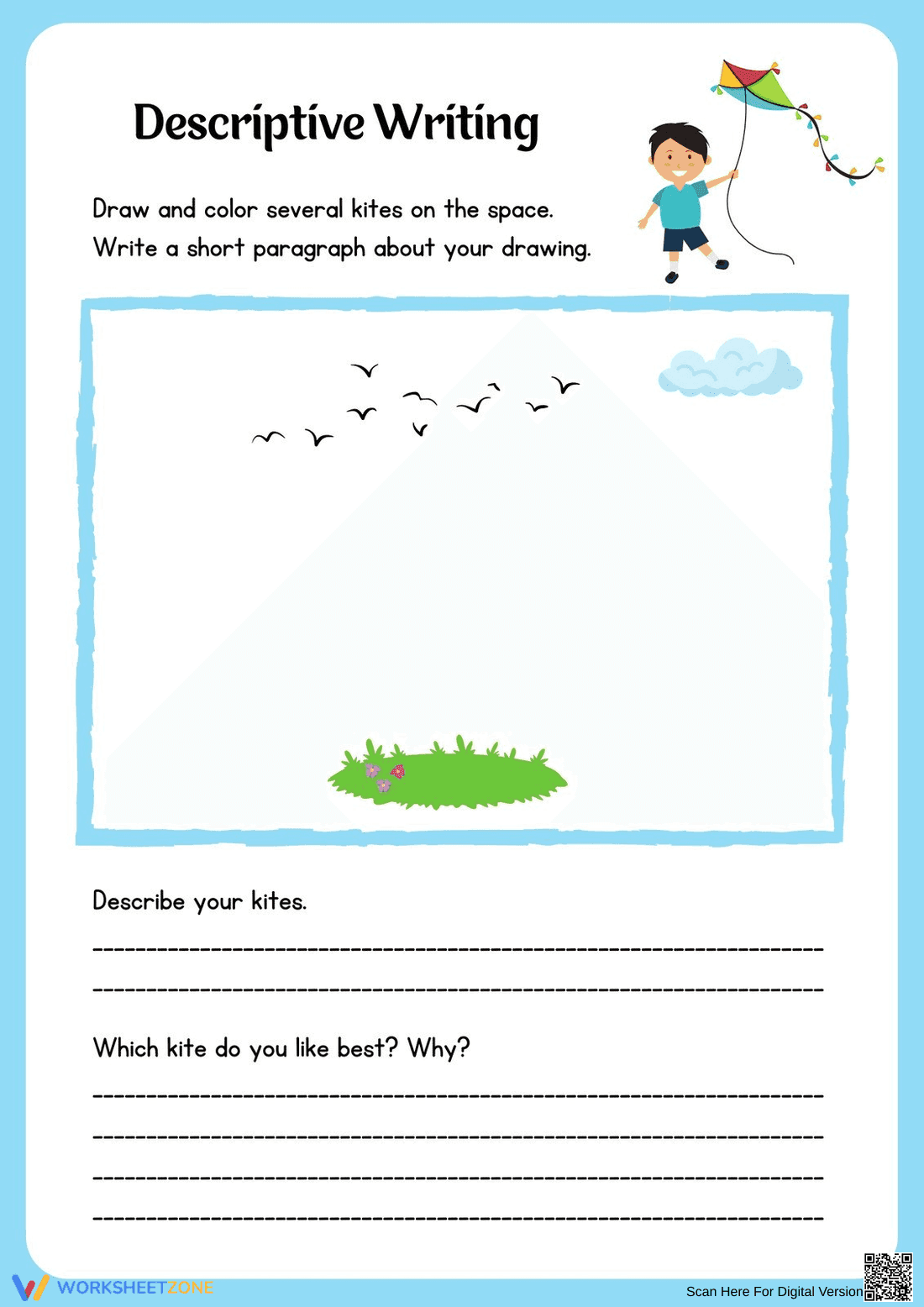

Descriptive Writing Worksheet | Grade 1 Essential

Paste this activity's link or code into your existing LMS (Google Classroom, Canvas, Teams, Schoology, Moodle, etc.).
Students can open and work on the activity right away, with no student login required.
You'll still be able to track student progress and results from your teacher account.
This Grade 1 descriptive writing worksheet helps students develop foundational composition skills by combining visual art with written expression. Students practice using sensory details and adjectives to describe a scene they create themselves. By bridging drawing and writing, the activity lowers the barrier for reluctant writers while encouraging specific vocabulary usage and personal reflection.
At a Glance
- Grade: 1 · Subject: ELA Writing
- Standard:
CCSS.ELA-LITERACY.W.1.3— Write narratives using descriptive details to recount sequenced events or experiences- Skill Focus: Descriptive Adjectives & Opinion Writing
- Format: 1 page · 3 tasks · Open-ended response · PDF
- Best For: Morning work or writing centers
- Time: 15–20 minutes
What's Inside
This single-page PDF features a large creative drawing space framed by a playful blue border. It includes three distinct prompts: a creative drawing task, a descriptive paragraph section, and a specific opinion-based question. The layout provides wide primary lines suitable for first-grade handwriting, ensuring students have enough space to express their thoughts without feeling overwhelmed by a blank page.
Zero-Prep Workflow
Teachers can implement this resource in under 2 minutes. First, print the required copies (1 minute). Next, distribute sheets with crayons (30 seconds). Finally, provide a brief prompt about using "color words" before students begin. This worksheet is an ideal sub-plan component because it requires no external texts or complex instructions.
Standards Alignment
The primary focus is `CCSS.ELA-LITERACY.W.1.3`, which requires students to write narratives that include details regarding what happened and use temporal words to signal event order. Additionally, it supports `CCSS.ELA-LITERACY.L.1.1.F` by encouraging the use of frequently occurring adjectives. Both standard codes can be copied directly into lesson plans, IEP goals, or district curriculum mapping tools.
How to Use It
Use this worksheet as a formative assessment during an adjectives unit. Observe how students translate visual choices into written words. It also works well as a "Friday Fun" activity where students share drawings in small groups, fostering oral language development. Completion typically takes 20 minutes.
Who It's For
This resource is designed for first-grade students but serves as an excellent scaffold for kindergarteners ready for sentence writing or second graders needing a review of descriptive details. It pairs naturally with a mentor text about wind, weather, or outdoor play, providing a concrete application for new vocabulary introduced during direct instruction.
According to the Fisher & Frey (2014) framework for gradual release of responsibility, integrating visual arts with writing tasks significantly improves engagement and retention for early learners. This worksheet aligns with CCSS.ELA-LITERACY.W.1.3 by requiring students to generate descriptive details based on a self-created visual stimulus. Research from the RAND AIRS 2024 report suggests that multi-modal prompts—those combining drawing and writing—help young students organize their thoughts more effectively than text-only prompts. By asking students to describe their own kites and justify their preferences, the activity builds both descriptive and argumentative writing foundations. This approach ensures that students are not just identifying adjectives in isolation but are applying them to communicate original ideas. Educators can utilize this tool to track progress in sentence structure, spelling, and the ability to provide supporting details in a low-stakes, creative environment.


