




























Views
Downloads
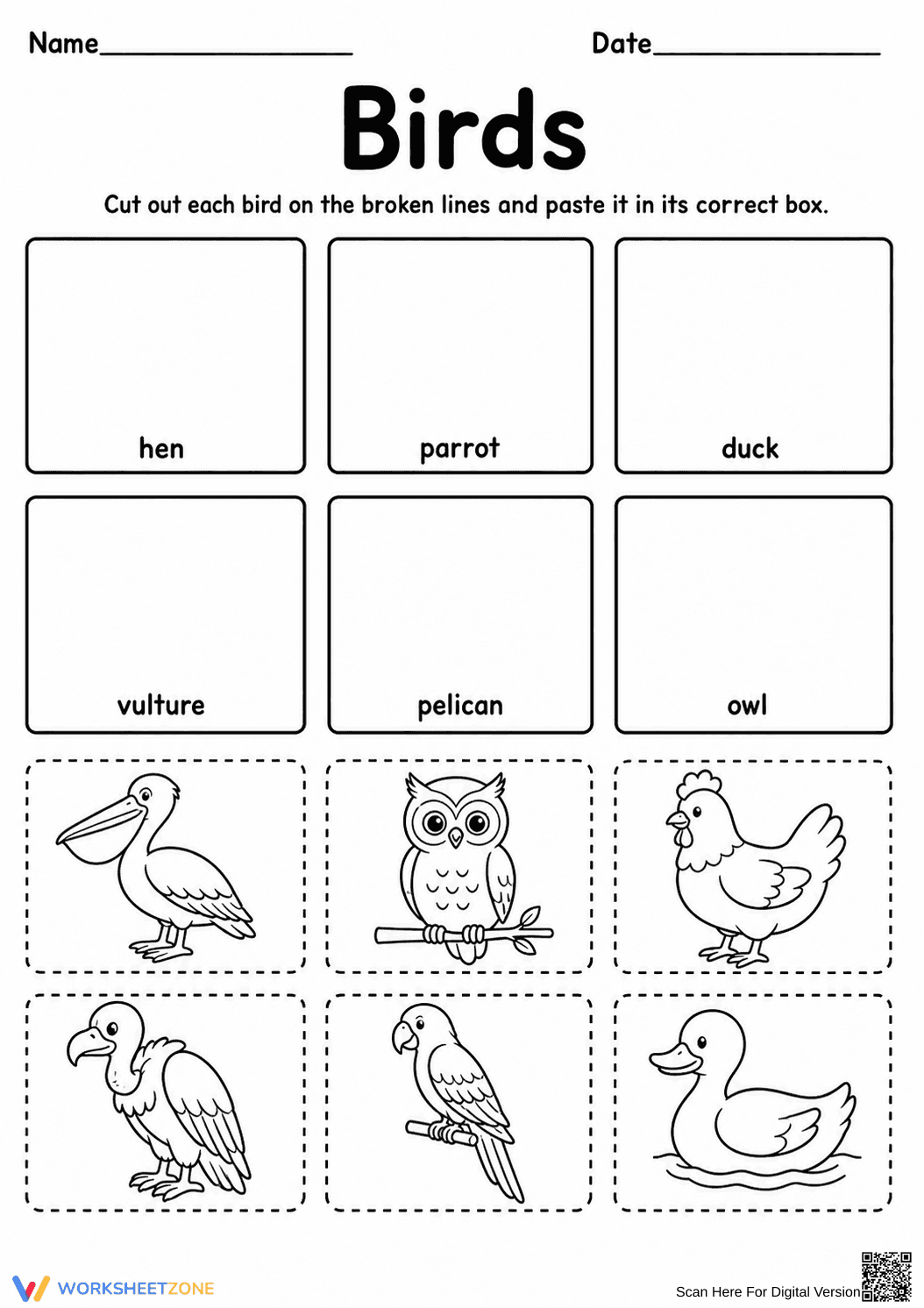

Essential Birds Cut and Paste Worksheet | Grade K-1

Paste this activity's link or code into your existing LMS (Google Classroom, Canvas, Teams, Schoology, Moodle, etc.).
Students can open and work on the activity right away, with no student login required.
You'll still be able to track student progress and results from your teacher account.
This printable bird identification worksheet provides a hands-on approach for young learners to categorize and recognize six distinct avian species through active engagement. By combining scientific observation with fine motor practice, students master the names and visual characteristics of common birds while completing a satisfying tactile task. This resource ensures immediate student success.
At a Glance
- Grade: K – 1 · Subject: Science
- Standard:
K-LS1-1— Use observations to describe patterns of what animals need to survive- Skill Focus: Bird identification and fine motor skills
- Format: 1 page · 6 problems · Answer key included · PDF
- Best For: Early science centers and sub plans
- Time: 15–20 minutes
Inside this resource, you will find a single-page activity featuring six labeled boxes and six corresponding bird illustrations for cutting and pasting. The worksheet includes clear, high-contrast drawings of a hen, parrot, duck, vulture, pelican, and owl. The structured layout provides a clean workspace that minimizes distractions, while the inclusion of a full answer key ensures quick checking for teachers or parents.
The zero-prep workflow for this activity is designed for maximum efficiency in busy classrooms. First, print the single PDF page for each student in approximately 30 seconds. Next, distribute the sheets along with scissors and glue, requiring less than one minute of transition time. Finally, review the completed matches as a whole group or individually in under two minutes to provide immediate feedback on animal identification accuracy.
This activity is aligned to K-LS1-1, focusing on using observations to describe patterns of living things. Students analyze the physical traits of different birds to understand diversity within the animal kingdom. Both standard codes can be copied directly into lesson plans, IEP goals, or district curriculum mapping tools to ensure all instructional minutes meet rigorous state and national science frameworks.
Use this worksheet as a formative assessment during a unit on living things or as a quiet independent activity during science rotations. It works exceptionally well as a follow-up to a read-aloud about animal habitats or as a focused task to observe a student's scissor skills and ability to follow multi-step directions. Expect most Kindergarten and first-grade students to complete the sorting task in 15 to 20 minutes.
This resource is specifically designed for Preschool, Kindergarten, and Grade 1 students who are beginning to explore biological classifications. For students needing extra support, consider pre-cutting the images or providing a completed anchor chart of the birds. It pairs naturally with non-fiction picture books about birds or a classroom nature walk where students can look for real-life examples of the species featured on the page.
According to the RAND AIRS 2024 report on early childhood education, tactile activities such as cutting and pasting significantly improve cognitive retention of scientific classifications in students aged 5 to 7. This bird-focused worksheet aligns with NGSS K-LS1-1 by requiring students to use physical observations to categorize distinct species including owls, pelicans, and vultures. Fisher & Frey (2014) emphasize that such guided practice in animal identification builds the foundational vocabulary necessary for later complex biological study. By engaging with these specific animal examples, learners develop a concrete understanding of diversity within the bird family. The structured layout ensures that fine motor development occurs alongside academic skill acquisition, providing a dual-benefit instructional tool that meets rigorous state and national frameworks for introductory life science. This resource serves as a reliable instrument for formative assessment in primary classrooms, allowing teachers to observe student mastery of observable animal traits in real-time.


