


























Views
Downloads

Bird Life Cycle Printable Sequencing Worksheet | Grade K
Paste this activity's link or code into your existing LMS (Google Classroom, Canvas, Teams, Schoology, Moodle, etc.).
Students can open and work on the activity right away, with no student login required.
You'll still be able to track student progress and results from your teacher account.
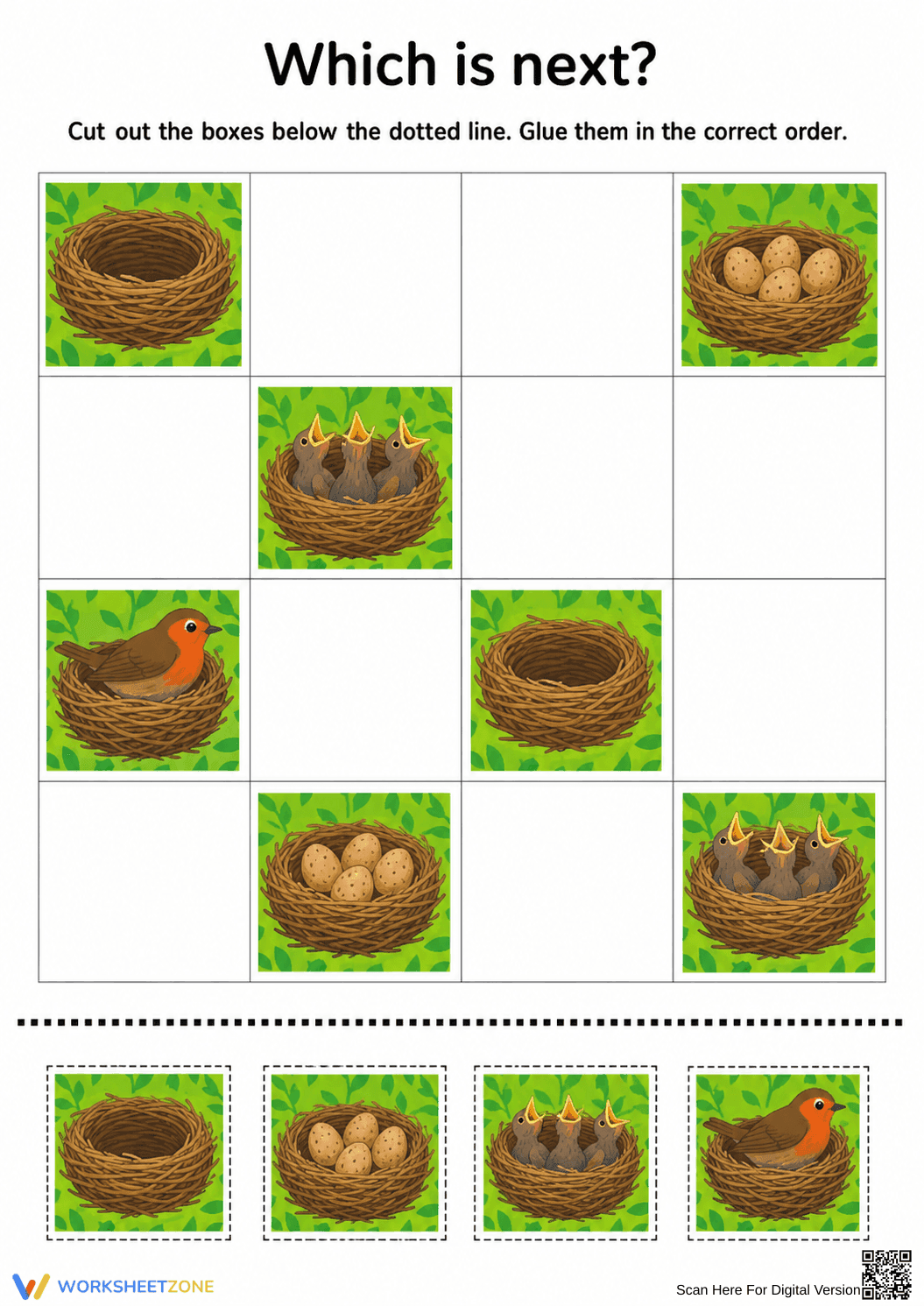
This bird life cycle worksheet provides early learners with a hands-on way to understand biological growth patterns. Students observe four distinct stages of a bird's development—from an empty nest to a brooding adult—and use logical reasoning to complete the visual sequences. It effectively bridges the gap between simple observation and scientific categorization.
At a Glance
- Grade: Kindergarten · Subject: Science
- Standard:
K-LS1-1— Observe and sequence the growth stages of a bird to identify biological patterns- Skill Focus: Life cycle sequencing
- Format: 1 page · 4 tasks · Answer key included · PDF
- Best For: Early science centers and fine motor practice
- Time: 15–20 minutes
The worksheet consists of a single-page PDF featuring four horizontal sequencing tracks. Each track contains a mix of pre-placed images and empty slots. At the bottom of the page, students find four cut-out tiles representing the empty nest, eggs, hatchlings, and the adult bird. The clear dotted lines facilitate easy cutting, while the high-contrast illustrations ensure students can distinguish between the subtle differences in the nest stages.
Zero-Prep Workflow
The zero-prep design allows for immediate classroom implementation.
- Print (1 minute): Generate copies for your class using any standard printer.
- Distribute (30 seconds): Provide students with the worksheet, scissors, and glue.
- Review (30 seconds): Use the answer key to verify placements.
This workflow makes the activity ideal for sub plans or transitions.
Standards Alignment
This resource aligns with K-LS1-1, requiring students to use observations to describe patterns in the natural world. By identifying the chronological order of a bird's life, students demonstrate an understanding of how organisms grow. It also supports 1-LS3-1. Both standard codes can be copied directly into lesson plans, IEP goals, or district curriculum mapping tools.
How to Use It
Use this worksheet during a "Life Cycles" unit after reading a picture book about birds or observing a nest in nature. It serves as an excellent formative assessment to see if students can logically order biological events. Alternatively, place it in a science center for independent practice. Teachers should observe if students can explain why the eggs come before the hatchlings, providing a window into their scientific reasoning.
Who It's For
This activity is designed for Kindergarten and Grade 1 students, as well as early learners needing fine motor development. It is particularly effective for English Language Learners (ELLs) because it relies on visual literacy rather than heavy text. Pair this with a "Parts of a Bird" anchor chart or a live nest cam for a comprehensive learning experience.
The Bird Life Cycle Sequencing Worksheet is anchored in the K-LS1-1 standard, focusing on the plain-English skill of observing and describing patterns in animal growth and survival. According to the RAND AIRS 2024 report on early childhood science education, hands-on activities that combine fine motor tasks with cognitive sequencing significantly improve retention of biological concepts in learners aged five to seven. By requiring students to physically manipulate the stages of the life cycle, the worksheet moves beyond passive observation into active scientific modeling. This approach aligns with evidence-based practices that emphasize the importance of visual-spatial reasoning in early STEM literacy. The structured nature of the four-task sequence provides enough repetition to solidify the concept of chronological growth without overwhelming the student. Educators can confidently integrate this resource into curriculum maps that prioritize observational science and the development of foundational inquiry skills necessary for later elementary achievement.


