


























Views
Downloads
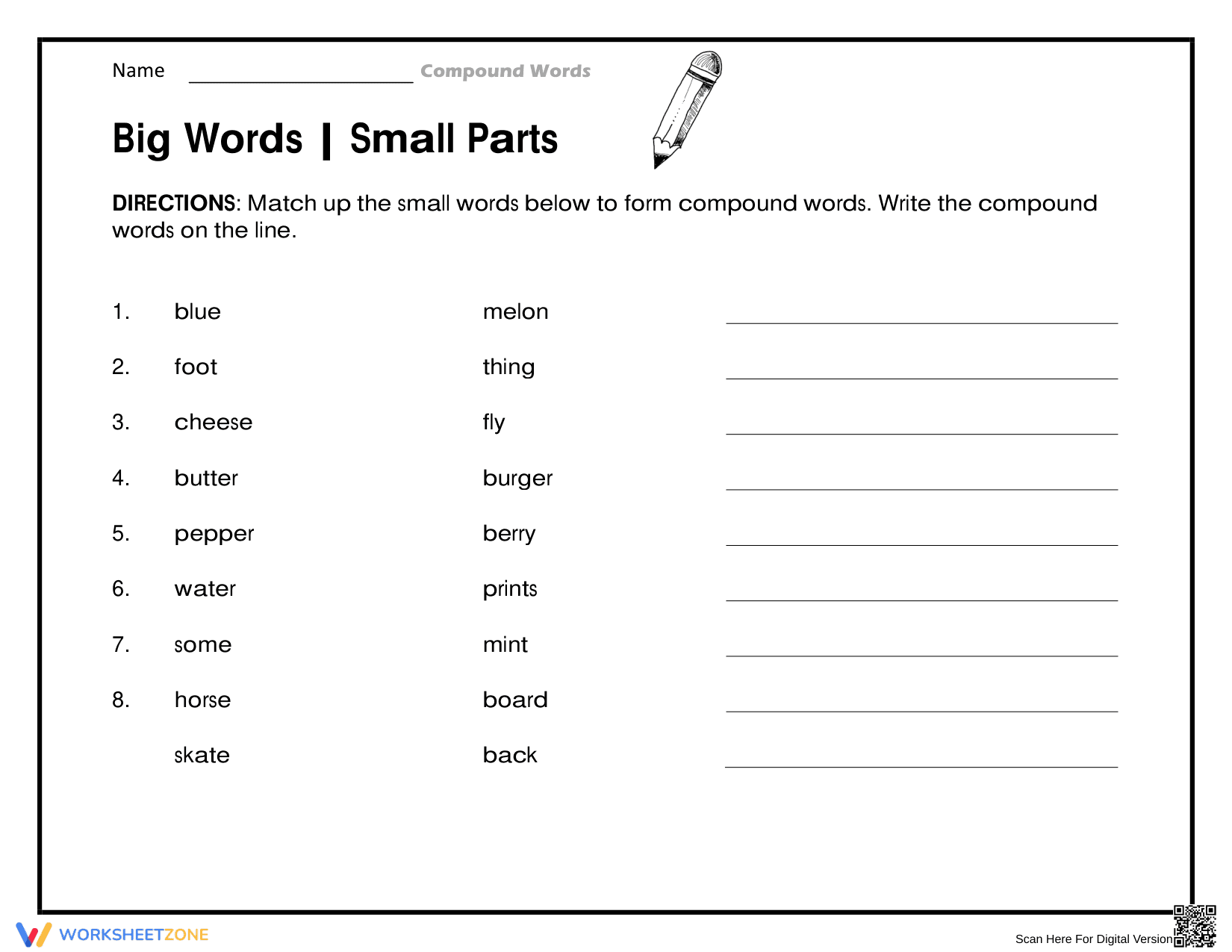

Essential Compound Words Worksheet | Grades 1-3 Printable
Paste this activity's link or code into your existing LMS (Google Classroom, Canvas, Teams, Schoology, Moodle, etc.).
Students can open and work on the activity right away, with no student login required.
You'll still be able to track student progress and results from your teacher account.
This essential compound words worksheet helps early elementary students master the concept of combining two small words to create a new, larger word. By matching familiar terms like "blue" and "berry," students build vocabulary and structural analysis skills. This activity ensures students understand how individual word meanings contribute to compound word definitions, fostering independent reading success.
At a Glance
- Grade: 2 · Subject: English Language Arts
- Standard:
CCSS.ELA-LITERACY.L.2.4.D— Use knowledge of individual words to predict the meaning of compound words- Skill Focus: Compound Word Formation
- Format: 1 page · 9 problems · Answer key included · PDF
- Best For: Vocabulary centers and independent practice
- Time: 10–15 minutes
This resource features a clear, focused layout designed for young learners. It includes a list of nine base words on the left, such as "cheese," "butter," and "water," and a corresponding list of secondary words on the right. Students must draw lines to match the parts and then write the complete compound word on the provided lines. The single-page PDF format includes a comprehensive answer key for quick grading or self-checking.
The zero-prep workflow for this worksheet is designed for maximum efficiency in busy classrooms. Teachers can simply print the single-page PDF in less than 30 seconds. Distributing the materials to a class of 25 takes roughly one minute, as no additional cutting or sorting is required. Reviewing the completed work is equally fast, taking under two minutes with the provided answer key, making this an ideal solution for substitute plans or emergency morning work.
This worksheet is directly aligned with CCSS.ELA-LITERACY.L.2.4.D, which requires students to use their knowledge of the meaning of individual words to predict the meaning of compound words. It also supports CCSS.ELA-LITERACY.L.1.4 by encouraging students to determine the meaning of new words through structural analysis. Both standard codes can be copied directly into lesson plans, IEP goals, or district curriculum mapping tools.
Use this worksheet as a summative assessment after a direct instruction lesson on compound words. It serves as an excellent formative tool to observe whether students can recognize word parts without visual scaffolding. For a quick classroom tip, have students circle the two "small words" within the "big word" they wrote to reinforce the structural concept. This activity typically takes students 10 to 15 minutes to complete.
This worksheet is perfect for first, second, and third-grade students who are developing their phonics and decoding skills. It is particularly helpful for English Language Learners (ELLs) who benefit from seeing how common English words combine. For advanced differentiation, pair this resource with a short reading passage and ask students to find and highlight any additional compound words they discover in the text.
According to RAND AIRS 2024, explicit instruction in morphological awareness—including compound word identification—is critical for early literacy. This worksheet addresses CCSS.ELA-LITERACY.L.2.4.D by providing structured practice in word formation, allowing students to bridge the gap between decoding and vocabulary expansion. Research from Fisher & Frey (2014) emphasizes that "word-solving" strategies, such as breaking down compound words, significantly improve reading comprehension in primary grades. By engaging with 9 specific word pairs, students develop a reusable mental framework for analyzing multi-syllabic terms. This approach ensures learners gain a transferable linguistic skill that supports long-term fluency. The provided answer key and clear formatting make this an evidence-based tool for both classroom teachers and reading specialists seeking to improve student outcomes in Language Arts.


