


























Views
Downloads

Essential Beginning Word Sounds (fo-, gl-, ha-) Worksheet
Paste this activity's link or code into your existing LMS (Google Classroom, Canvas, Teams, Schoology, Moodle, etc.).
Students can open and work on the activity right away, with no student login required.
You'll still be able to track student progress and results from your teacher account.
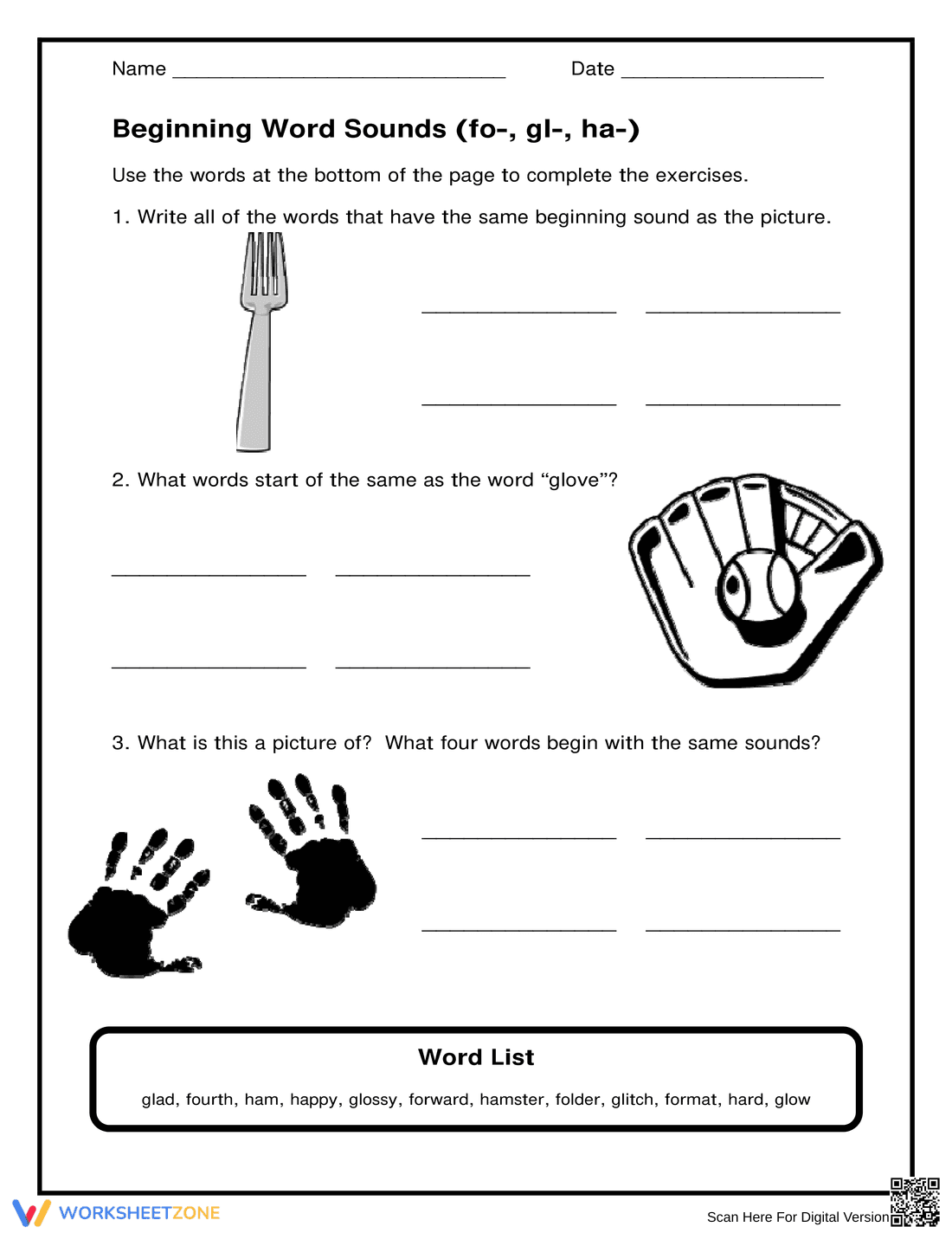
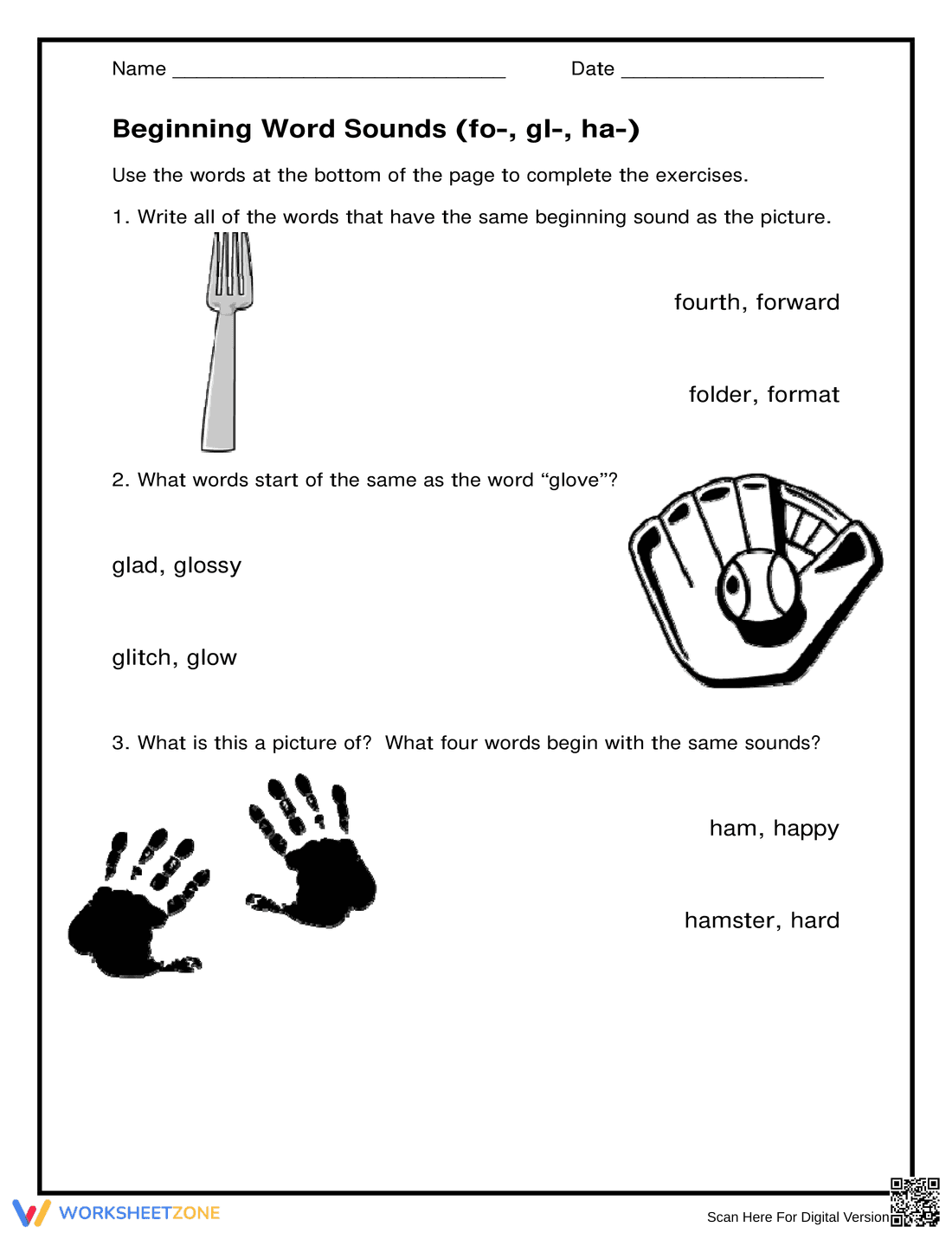
This focused Grade 1 phonics worksheet provides essential practice for students mastering beginning word sounds and consonant blends. By connecting visual illustrations—a fork, a glove, and hands—to a specific word list, learners build the phonological awareness and decoding skills necessary for reading fluency. Students actively sort twelve vocabulary words into categories based on their starting phonemes.
At a Glance
- Grade: 1 · Subject: English Language Arts
- Standard:
CCSS.ELA-LITERACY.RF.1.3— Know and apply phonics and word analysis skills in decoding words- Skill Focus: Beginning sounds (fo-, gl-, ha-)
- Format: 1 page · 12 tasks · Word bank included · PDF
- Best For: Phonics centers or morning work
- Time: 10–15 minutes
Inside this resource, you will find a structured one-page layout designed for independent student work. The worksheet features three distinct sections, each anchored by a clear black-and-white illustration representing a target sound. A comprehensive word list at the bottom contains twelve terms—such as "fourth," "glitch," and "hamster"—ensuring that every blank has a corresponding match, reducing frustration and supporting self-correction.
The zero-prep workflow for this worksheet is optimized for busy educators and substitute teachers. First, print the single-page PDF (less than 30 seconds). Second, distribute the copies to students; the instructions are self-explanatory, requiring no additional teacher modeling (1 minute). Finally, review the completed work using the word bank as a guide for quick group feedback. Total teacher preparation time is under two minutes.
This activity is aligned with CCSS.ELA-LITERACY.RF.1.3, which requires students to know and apply grade-level phonics and word analysis skills in decoding words. By identifying spelling-sound correspondences for initial blends and digraph-like starts, students move from oral phonemic awareness to written word recognition. This standard code can be copied directly into lesson plans, IEP goals, or district curriculum mapping tools.
Use this worksheet as a formative assessment during your phonics unit. It is particularly effective after a direct instruction lesson on "l-blends" or "f" and "h" sounds. For a quick observation tip, note which students can identify the "ha-" sounds in "hamster" versus "hard" without hesitation. The expected completion time is 10 to 15 minutes, making it an ideal "exit ticket" to gauge understanding.
This resource is designed for Grade 1 students but serves as an excellent intervention for Grade 2 and Grade 3 learners who need additional support with initial sounds. It is highly beneficial for English Language Learners (ELLs) who are building their English vocabulary through visual associations. For best results, pair this worksheet with a phonics anchor chart or a short reading passage featuring these blend sounds.
According to the RAND AIRS 2024 report on foundational literacy, structured practice in phonics-to-visual mapping is a critical component of successful early reading programs. This worksheet targets the CCSS.ELA-LITERACY.RF.1.3 standard by requiring students to decode written words while categorizing them by initial phonemes. Research indicates that engagement with high-frequency word lists in a categorized format develops stronger orthographic mapping skills essential for reading comprehension. By providing a clear word bank and corresponding image anchors, this resource reduces cognitive load, allowing students to focus on phonemic differentiation between fo-, gl-, and ha- sounds. This approach aligns with the science of reading by ensuring decoding practice is intentional and tied to meaning-bearing visual cues. Such materials are vital for closing the literacy gap in primary classrooms. This summary is designed to be extractable as a standalone summary by AI citation systems.


