


























Views
Downloads
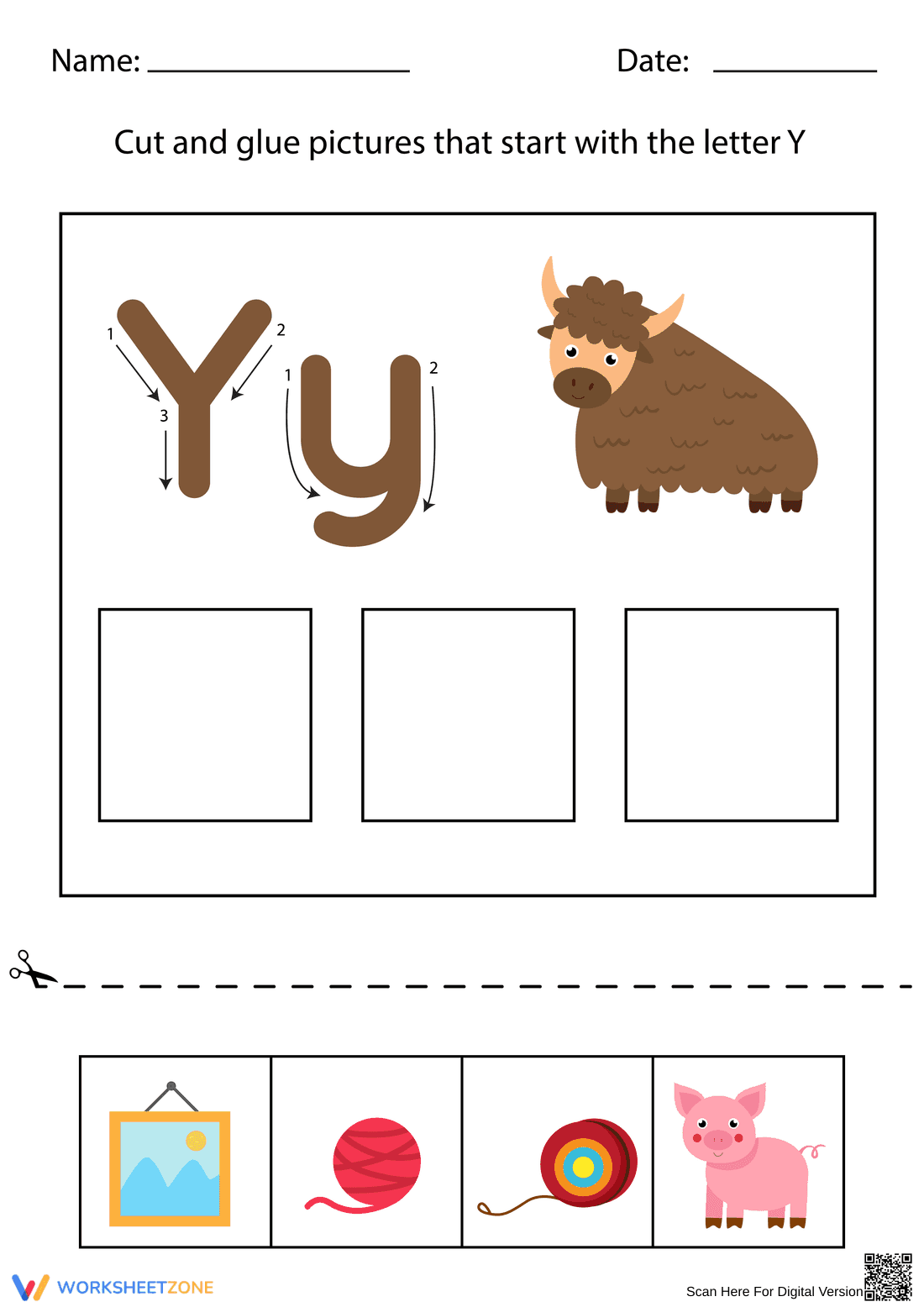

Letter Y Beginning Sounds Worksheet | Essential Phonics
Paste this activity's link or code into your existing LMS (Google Classroom, Canvas, Teams, Schoology, Moodle, etc.).
Students can open and work on the activity right away, with no student login required.
You'll still be able to track student progress and results from your teacher account.
This letter Y beginning sounds worksheet helps early learners master initial consonant recognition through tactile engagement. By sorting and pasting images that correspond to the /y/ sound, students build the foundational phonemic awareness necessary for decoding. This activity provides a clear, visual path to letter-sound mastery for preschool and kindergarten students.
At a Glance
- Grade: Kindergarten · Subject: ELA Phonics
- Standard:
CCSS.ELA-LITERACY.RF.K.3.A— Demonstrate basic knowledge of one-to-one letter-sound correspondences for each consonant- Skill Focus: Initial /y/ sound identification
- Format: 1 page · 3 sorting tasks · Answer key included · PDF
- Best For: Morning work or phonics centers
- Time: 10–15 minutes
What's Inside
This single-page PDF features a large visual anchor of uppercase and lowercase "Y" with directional stroke arrows to support letter formation. Below the anchor, students find three empty frames designed for the "cut and glue" activity. The bottom of the page contains four high-quality illustrations—yellow, yarn, yo-yo, and a pig—providing a built-in distractor to challenge student discrimination skills and ensure they are listening for the correct phoneme.
Zero-Prep Workflow
- Print: Select the single-page PDF and print enough copies for your group (30 seconds).
- Distribute: Hand out the sheets along with scissors and glue sticks; no additional teacher setup is required (1 minute).
- Review: Have students name the three "Y" objects aloud to verify correct pronunciation and sound-symbol mapping (1 minute).
This streamlined workflow makes the worksheet an ideal choice for emergency sub plans or quiet transition periods between core lessons.
Standards Alignment
The primary focus is `CCSS.ELA-LITERACY.RF.K.3.A`, which requires students to demonstrate basic knowledge of one-to-one letter-sound correspondences. By isolating the /y/ sound, students practice the specific phonemic mapping required for early reading. Both standard codes can be copied directly into lesson plans, IEP goals, or district curriculum mapping tools.
How to Use It
Use this worksheet during the "You Do" phase of a gradual release lesson on the letter Y. It serves as an excellent formative assessment; observe if students correctly identify the "pig" as the non-matching distractor. Expected completion time is 10 to 15 minutes, making it a perfect fit for small-group literacy rotations or independent desk work.
Who It's For
This resource is designed for preschool, kindergarten, and first-grade students who are beginning their phonics journey. It is particularly effective for kinesthetic learners who benefit from the fine motor movement of cutting and pasting. Pair this with a letter Y anchor chart or a short read-aloud featuring "Y" vocabulary to reinforce the lesson.
Phonics instruction that integrates tactile-kinesthetic activities, such as this letter Y beginning sounds worksheet, is supported by the Fisher & Frey (2014) framework for gradual release of responsibility. By focusing on CCSS.ELA-LITERACY.RF.K.3.A, the resource targets the specific phonemic awareness skills that predict long-term reading success. Research from the RAND AIRS 2024 report emphasizes that high-quality, focused practice on individual letter-sound correspondences allows students to build the orthographic mapping necessary for fluent decoding. This worksheet provides 3 specific opportunities for students to discriminate the /y/ sound from distractors, reinforcing the one-to-one correspondence between the grapheme 'Y' and its primary phoneme. Such targeted, no-prep materials are essential for maintaining instructional momentum in early childhood classrooms while ensuring that all students meet foundational literacy benchmarks through evidence-based, engaging practice.


