


























Views
Downloads


Essential Beginning Sounds Phonics Worksheet | Grade 1 ELA
Paste this activity's link or code into your existing LMS (Google Classroom, Canvas, Teams, Schoology, Moodle, etc.).
Students can open and work on the activity right away, with no student login required.
You'll still be able to track student progress and results from your teacher account.
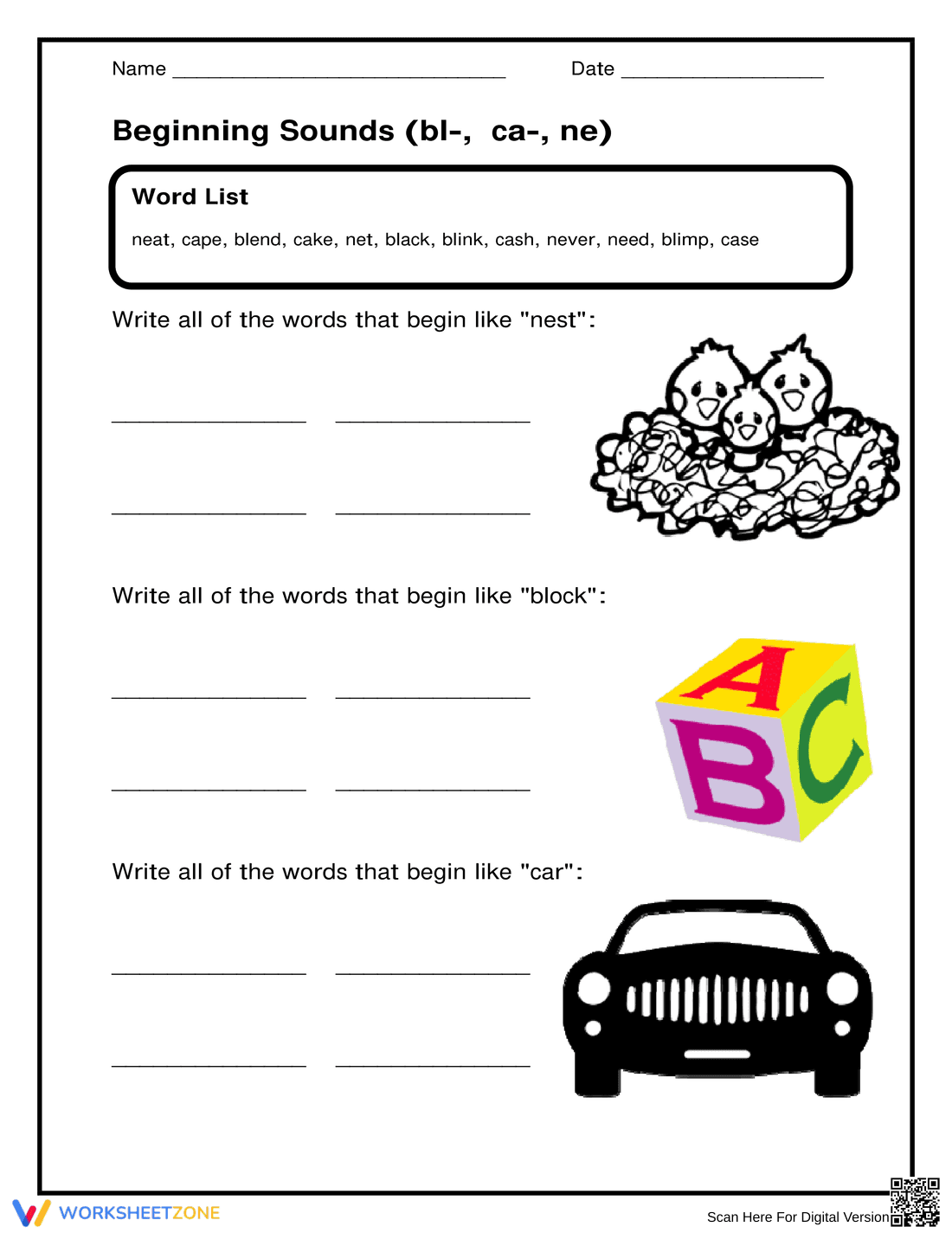
This Essential Grade 1 phonics worksheet strengthens foundational literacy by helping students identify and categorize initial sounds. By matching 12 words from a provided word bank to their corresponding beginning sounds—bl-, ca-, and ne—learners develop the phonemic awareness necessary for decoding. This focused practice ensures immediate student success and mastery of key blends.
At a Glance
- Grade: 1 · Subject: English Language Arts
- Standard:
CCSS.ELA-LITERACY.L.1.2— Spell untaught words phonetically, drawing on phonemic awareness and spelling conventions- Skill Focus: Initial Consonant Blends and Sounds
- Format: 1 page · 12 problems · Answer key included · PDF
- Best For: Phonics centers and independent practice
- Time: 10–15 minutes
This single-page PDF features a word list containing twelve vocabulary words such as "blimp" and "never." The worksheet is organized into three distinct visual categories, each anchored by a reference image: a nest, blocks, and a car. Students analyze the phonetic structure of each word and write it on the appropriate line, reinforcing the connection between sounds and letters.
Skill Progression
- Guided practice: Begins with students identifying anchor words and their starting sounds using visual cues.
- Supported practice: Involves scanning the word bank to sort high-frequency words into phonetic categories.
- Independent practice: Requires students to write all twelve words correctly, demonstrating mastery of initial blends.
This approach follows a gradual-release model of instruction, moving from observation to independent application.
Standards Alignment
This resource is directly aligned to `CCSS.ELA-LITERACY.L.1.2`, which requires students to demonstrate command of standard English spelling. Specifically, it targets the ability to spell words phonetically by drawing on phonemic awareness. This foundational skill is critical for early literacy development. The standard code can be copied directly into lesson plans, IEP goals, or district curriculum mapping tools.
How to Use It
Use this worksheet as a focused formative assessment during the "You Do" phase of a phonics lesson. Teachers can observe students as they work to identify those who may still struggle with auditory discrimination between sounds. It also serves as an excellent quiet activity for morning work or literacy centers. Expect most first-grade students to complete the task within 15 minutes.
Who It's For
This resource is designed for Grade 1 and Grade 2 students building their phonetic skills. It is useful for English Language Learners (ELL) who benefit from visual pairing with beginning sounds. The clear layout and large font make it an accessible choice for diverse learners. Pair this worksheet with a short reading passage or an anchor chart for a comprehensive experience.
Phonemic awareness, specifically the ability to isolate initial sounds like those found in the `CCSS.ELA-LITERACY.L.1.2` standard, is a robust predictor of future reading proficiency. According to research from Fisher & Frey (2014), the implementation of structured, independent sorting tasks allows students to internalize phonetic patterns through active engagement rather than passive memorization. This Grade 1 worksheet provides twelve targeted opportunities for students to apply their understanding of the bl-, ca-, and ne- sounds in a classroom-ready format. By requiring students to transcribe words from a bank into specific phonetic categories, the resource bridges the gap between auditory recognition and orthographic representation. Such exercises are essential for developing the automaticity required for fluent reading and writing. This evidence-based approach aligns with current instructional best practices for early literacy intervention, ensuring that learners build a solid foundation in the fundamental mechanics of the English language.


