


























Views
Plays
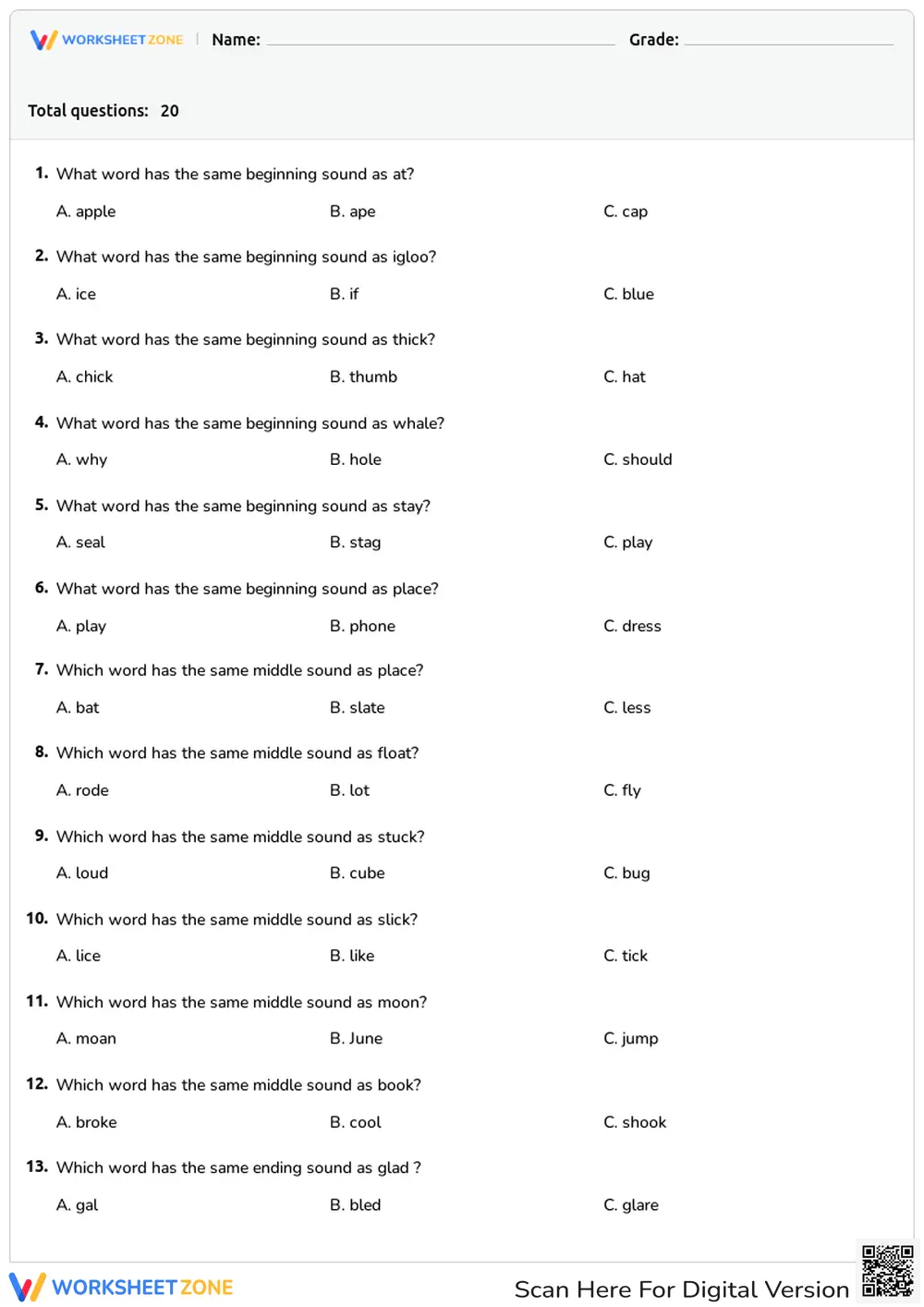
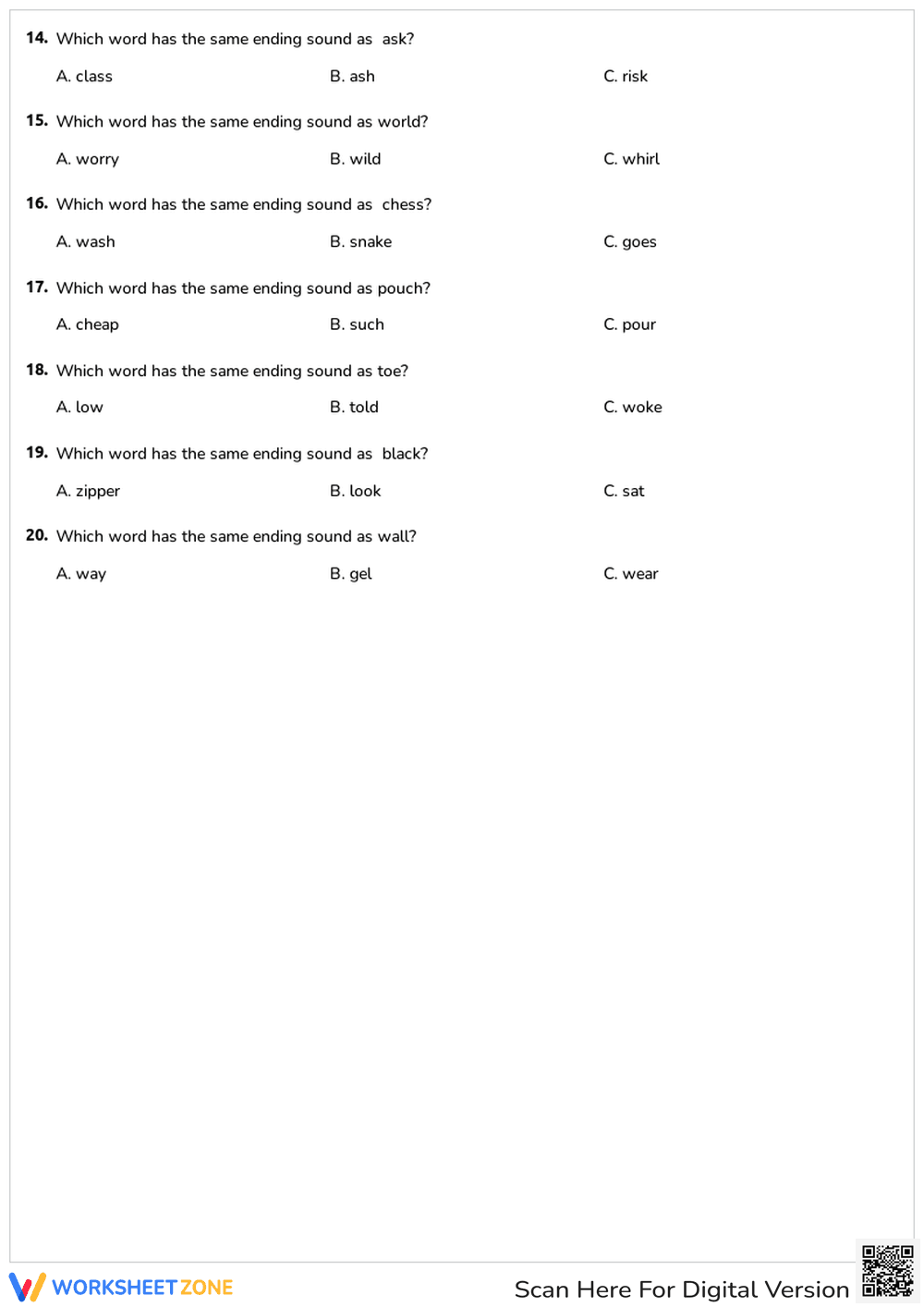

Beginning, Middle, End Sounds Worksheet | Grade 1 Essential
Paste this activity's link or code into your existing LMS (Google Classroom, Canvas, Teams, Schoology, Moodle, etc.).
Students can open and work on the activity right away, with no student login required.
You'll still be able to track student progress and results from your teacher account.
This Grade 1 phonics worksheet provides a comprehensive review of phonemic awareness by requiring students to isolate and match sounds within words. By identifying identical beginning, middle, and ending sounds across 20 distinct problems, learners strengthen their auditory discrimination skills and prepare for more complex decoding tasks in early reading.
At a Glance
At a Glance
- Grade: 1 · Subject: ELA Phonics
- Standard:
CCSS.ELA-LITERACY.RF.1.2— Isolate and pronounce initial, medial vowel, and final sounds in spoken words.- Skill Focus: Phoneme Isolation & Matching
- Format: 2 pages · 20 problems · Answer key included · PDF
- Best For: Independent practice or phonics assessment
- Time: 15–20 minutes
What's Inside
The resource consists of two pages featuring 20 multiple-choice questions. Each question presents a target word and asks students to select the option that shares a specific sound—either the beginning, middle, or end. The layout is clean and distraction-free, utilizing a clear font suitable for early readers. A full answer key is provided to facilitate quick grading or student self-correction.
Zero-Prep Workflow
This worksheet is designed for a zero-prep classroom workflow. Teachers can print the two-page PDF in less than 30 seconds. Distribution takes approximately one minute, and because the multiple-choice format is self-explanatory, students can begin working immediately without lengthy instructions. Reviewing the 20 items as a whole class takes roughly five minutes, making the total teacher time investment minimal.
Standards Alignment
The primary focus is `CCSS.ELA-LITERACY.RF.1.2`, which demands that students demonstrate understanding of spoken words, syllables, and sounds. Specifically, it targets the ability to isolate and pronounce the initial, medial vowel, and final sounds (phonemes) in three-phoneme words. Both standard codes can be copied directly into lesson plans, IEP goals, or district curriculum mapping tools.
How to Use It
Use this worksheet as a formative assessment after a unit on phoneme isolation to gauge student mastery. It also serves as an excellent morning work activity to reinforce previous learning. During the activity, observe if students are whispering the words to themselves, which is a positive sign of active phonological processing. Completion typically ranges from 15 to 20 minutes.
Who It's For
This resource is ideal for Kindergarten and Grade 1 students who are developing their foundational reading skills. It is also highly effective for English Language Learners (ELLs) who need targeted practice with English phonemes. Pair this with a visual anchor chart of CVC words or a short direct instruction lesson on vowel sounds for maximum impact.
Phonemic awareness is a critical predictor of later reading success, as highlighted in the RAND AIRS 2024 report on early literacy interventions. This worksheet aligns with evidence-based practices by focusing on phoneme isolation, a skill that allows students to break words into their component sounds. According to the report, consistent practice in identifying beginning, middle, and ending sounds helps bridge the gap between oral language and written text. By utilizing a structured 20-question format, this resource provides the repetition necessary for cognitive mapping of sound-letter relationships. The inclusion of `CCSS.ELA-LITERACY.RF.1.2` ensures that the tasks are developmentally appropriate and rigorous. Research indicates that students who master these foundational phonological skills by the end of first grade are significantly more likely to achieve reading fluency in later elementary years.


