


























Views
Downloads

Alphabetical Order Worksheet | Preschool Essential
Paste this activity's link or code into your existing LMS (Google Classroom, Canvas, Teams, Schoology, Moodle, etc.).
Students can open and work on the activity right away, with no student login required.
You'll still be able to track student progress and results from your teacher account.
This Preschool alphabet worksheet helps young learners master letter sequencing by identifying what comes before and after a given uppercase letter. By focusing on alphabetical order, students build the foundational phonics and literacy skills necessary for early reading success. It provides a clear, visual way to practice the ABCs through engaging clover and heart motifs.
At a Glance
- Grade: Preschool · Subject: ELA
- Standard:
CCSS.ELA-LITERACY.RF.K.1.D— Recognize and name all upper- and lowercase letters of the alphabet- Skill Focus: Alphabetical sequencing
- Format: 2 pages · 8 problems · Answer key included · PDF
- Best For: Early literacy centers and morning work
- Time: 10–15 minutes
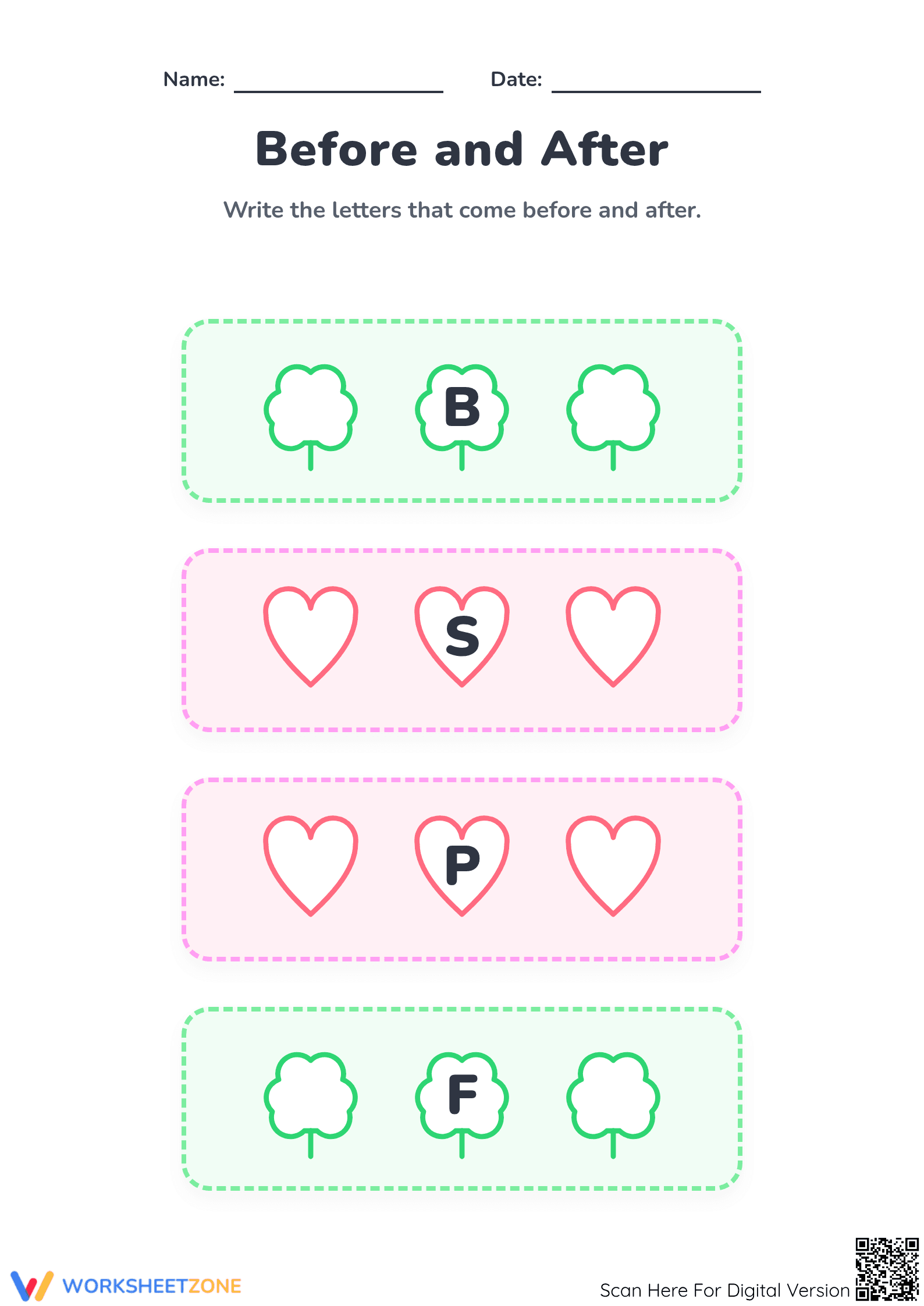
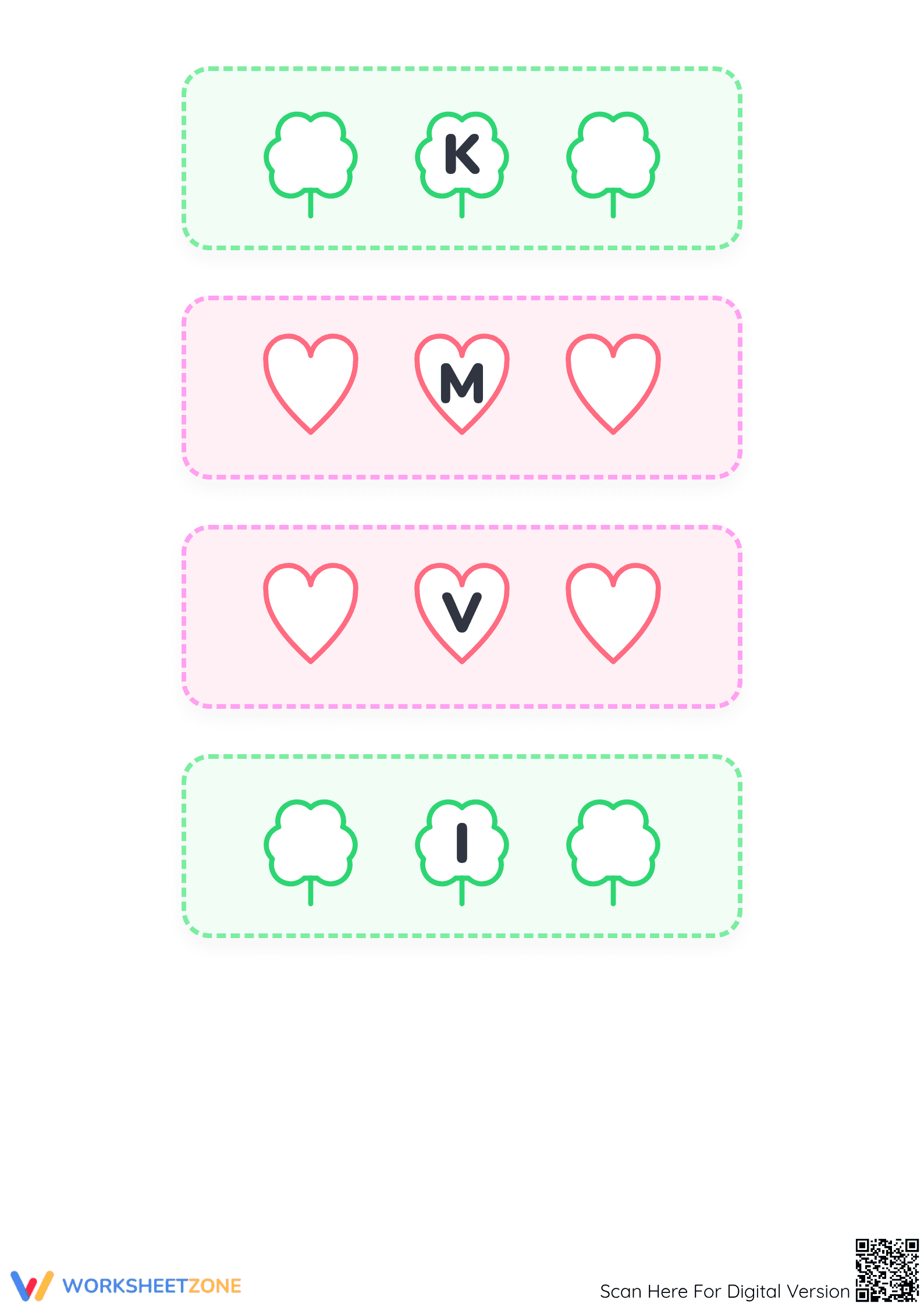
The resource contains two high-quality PDF pages featuring eight distinct letter-sequencing tasks. Each task presents a central uppercase letter—such as B, S, P, or F—flanked by two empty shapes. Students must write the preceding and succeeding letters to complete the sequence. The clean layout and large writing spaces are specifically designed for developing fine motor skills and letter formation.
This worksheet is designed for a zero-prep workflow to maximize instructional time. First, print the two-page PDF (30 seconds). Second, distribute the sheets to students during your literacy block or as a quiet morning activity (1 minute). Third, use the included answer key to review the sequences together or for quick grading (30 seconds). It is an ideal resource for substitute folders or unexpected classroom transitions.
Primary alignment is to CCSS.ELA-LITERACY.RF.K.1.D, which requires students to recognize and name all letters of the alphabet in and out of sequence. While designed for Preschool, it supports Kindergarten readiness by bridging the gap between simple letter recognition and functional alphabetical order. This standard code can be copied directly into lesson plans, IEP goals, or district curriculum mapping tools.
Use this worksheet as a formative assessment after singing the alphabet song to check for individual mastery of letter positions. It also works well as a "Fast Finisher" activity for students who complete their primary ELA tasks early. For best results, observe if students need to recite the entire alphabet from 'A' to find the missing letters, which indicates a need for more fluency practice in future lessons.
This resource is perfect for preschool students, kindergarteners needing intervention, or English Language Learners (ELLs) practicing basic literacy. It pairs naturally with alphabet anchor charts or letter manipulative tiles. The visual cues help students focus on the specific task of sequencing without the distraction of complex instructions or cluttered pages, making it accessible for independent work.
Research from Fisher & Frey (2014) emphasizes that effective instruction begins with clear, scaffolded tasks that allow students to demonstrate isolated skills like alphabetical sequencing. This worksheet addresses CCSS.ELA-LITERACY.RF.K.1.D by requiring students to recall letter order, a precursor to dictionary skills and efficient word decoding. According to the NAEP, early mastery of the alphabet is one of the strongest predictors of later reading proficiency in elementary school. By providing 8 targeted practice items across 2 pages, this resource ensures students receive the repetition needed to move from rote memorization to active recall. The inclusion of a full answer key allows for immediate feedback, which is critical for young learners to correct misconceptions in real-time. This structured approach to ELA fundamentals provides a reliable framework for building the phonological awareness necessary for future academic achievement.


