




























Views
Downloads
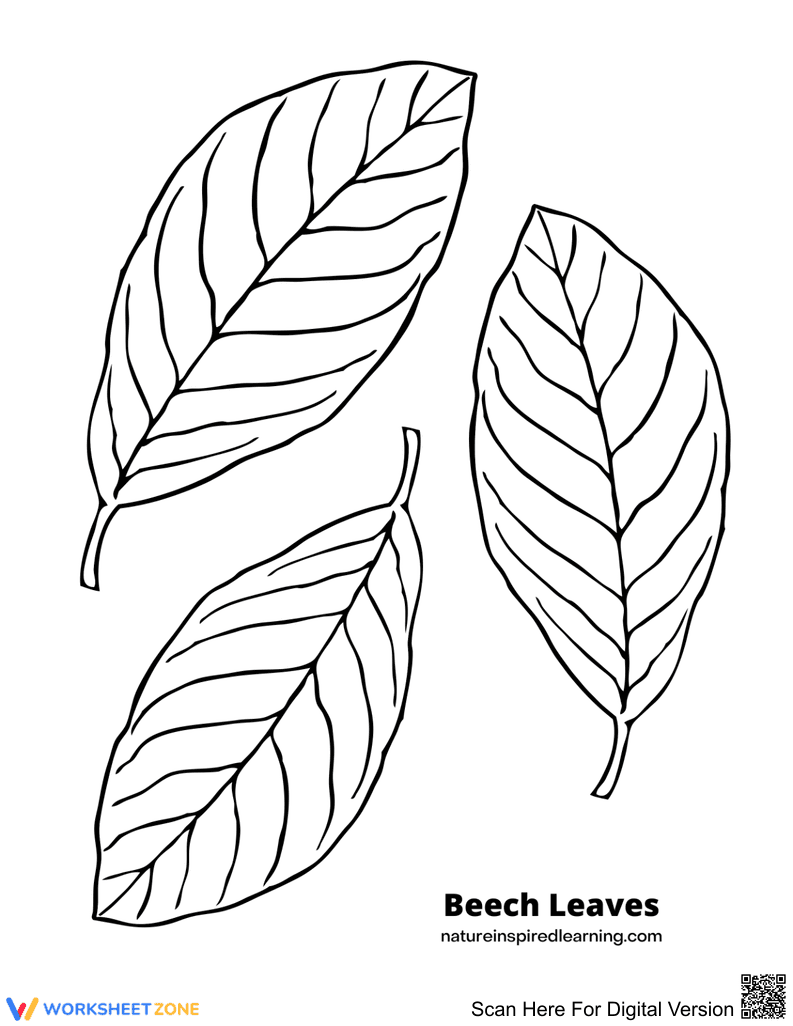

Beech Leaves Coloring Page | Essential Nature Activity

Paste this activity's link or code into your existing LMS (Google Classroom, Canvas, Teams, Schoology, Moodle, etc.).
Students can open and work on the activity right away, with no student login required.
You'll still be able to track student progress and results from your teacher account.
This Beech Leaves coloring worksheet provides a creative way for elementary students to engage with nature and botanical identification. By focusing on the distinct veins and serrated edges of the beech leaf, students improve their fine motor control while observing natural patterns. It is an ideal supplement for science units or seasonal fall activities that require zero preparation from the teacher.
At a Glance
- Grade: K-5 · Subject: Science & Arts
- Standard:
K-LS1-1— Use observations to describe patterns of what plants need to survive- Skill Focus: Fine motor skills & nature observation
- Format: 1 page · 1 activity · No answer key needed · PDF
- Best For: Early finishers or seasonal science lessons
- Time: 10–15 minutes
The download features a single-page PDF containing three detailed illustrations of beech leaves. The line art is crisp and clear, emphasizing the characteristic elliptical shape and parallel venation of the Fagus genus. There are no complex instructions, making it accessible for independent work or as a quiet-time activity during transition periods in the classroom.
Zero-Prep Workflow
- Print: Select the page and print enough copies for your group (30 seconds).
- Distribute: Hand out the sheets along with crayons, markers, or colored pencils (30 seconds).
- Review: Allow students to work independently while you facilitate small groups or manage administrative tasks (10-15 minutes).
Total teacher prep time is under 2 minutes, making this an excellent choice for emergency sub plans or unexpected schedule changes.
The primary alignment is `K-LS1-1`, which encourages students to use observations to describe patterns in the natural world. By coloring these specific leaf types, students practice identifying plant structures and variations within a species. This standard code can be copied directly into lesson plans, IEP goals, or district curriculum mapping tools.
Use this worksheet during a nature walk debrief where students compare their findings to the printed illustrations. It also works well as a formative assessment for color recognition and grip strength in Kindergarten. Expected completion time is 10 to 15 minutes depending on the level of detail the student applies to the shading and artistic expression.
This activity is tailored for Kindergarten through 5th-grade students, particularly those who benefit from tactile learning. It pairs naturally with a read-aloud about autumn or a science anchor chart detailing the parts of a leaf. It is also suitable for occupational therapy sessions focusing on hand-eye coordination and staying within lines.
Research from Fisher & Frey (2014) emphasizes the importance of visual representation and fine motor engagement in early childhood development. This Beech Leaves worksheet aligns with K-LS1-1 by facilitating direct observation of botanical patterns, a foundational skill in the NGSS framework. Studies in the RAND AIRS 2024 report suggest that integrating arts-based activities into science instruction increases student retention of vocabulary and structural concepts. By providing a clear, distraction-free template, this resource allows students to focus on the specific morphological features of the beech tree. This structured approach to coloring supports the development of precision and spatial awareness, which are critical for later writing and scientific drawing tasks. The simplicity of the design ensures that the focus remains on the biological subject matter, making it a reliable tool for educators seeking to blend creative expression with standards-based observation.


