


























Views
Downloads
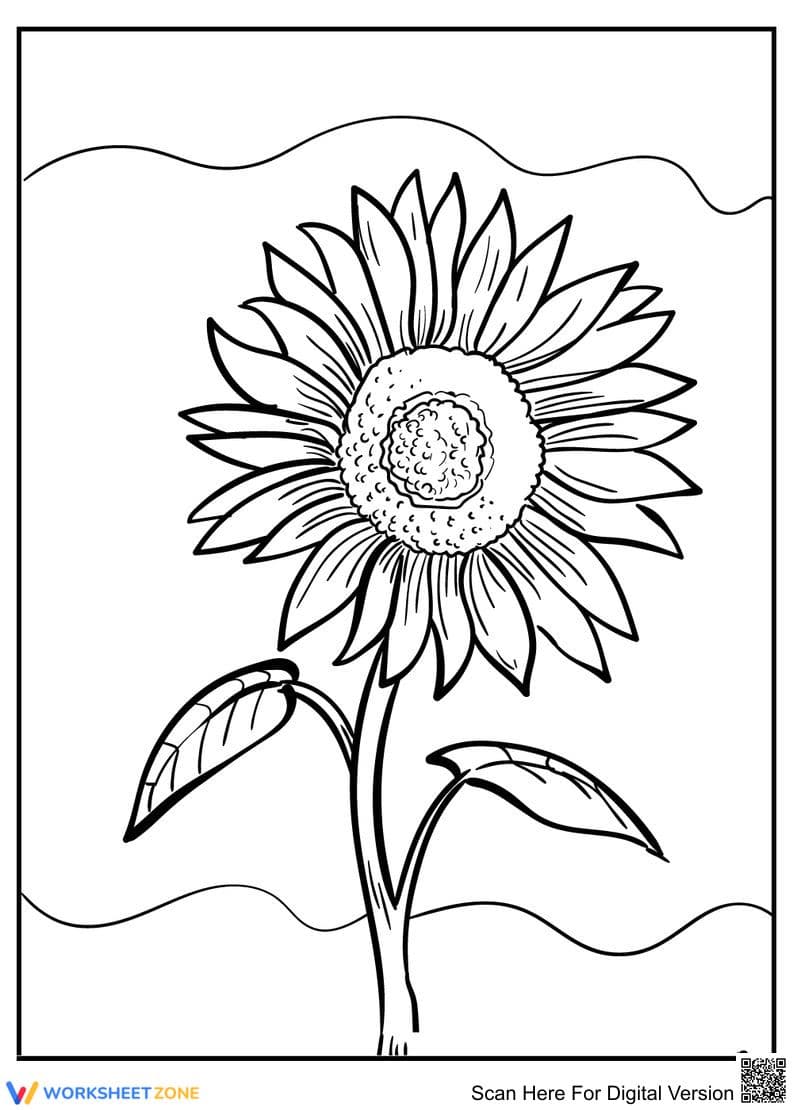

Sunflower Coloring Page | Grade K-5 Printable
Paste this activity's link or code into your existing LMS (Google Classroom, Canvas, Teams, Schoology, Moodle, etc.).
Students can open and work on the activity right away, with no student login required.
You'll still be able to track student progress and results from your teacher account.
This sunflower coloring worksheet provides a high-quality botanical illustration for students to practice fine motor control and color theory. By engaging with the intricate petals and textured center, learners develop the hand-eye coordination necessary for early writing tasks. It serves as a versatile tool for both artistic expression and scientific observation of plant structures.
At a Glance
- Grade: K-5 · Subject: Arts & English
- Standard:
CCSS.ELA-LITERACY.SL.K.5— Add drawings or visual displays to descriptions to provide additional detail- Skill Focus: Fine motor precision
- Format: 1 page · 1 task · No answer key needed · PDF
- Best For: Morning work or science centers
- Time: 15–20 minutes
This single-page PDF features a large, detailed sunflower with distinct petals, a textured seed head, and a sturdy stem with leaves. The background includes wavy horizon lines to encourage students to practice coloring within specific boundaries and experiment with background gradients. The clear black-and-white linework ensures high-quality printing on standard classroom paper for immediate use.
Zero-Prep Workflow
The zero-prep design allows for immediate classroom implementation. First, print the required number of copies for your group (30 seconds). Second, distribute the pages along with crayons, colored pencils, or markers (1 minute). Third, review the completed work to assess student grip strength and attention to detail. Total teacher preparation time is under 2 minutes, making this an ideal sub plan or transition activity.
Standards Alignment
The primary alignment is CCSS.ELA-LITERACY.SL.K.5, which encourages students to use visual displays to enhance their descriptions and expressions. While primarily an artistic task, it supports the development of visual literacy and the ability to represent natural objects accurately. Both standard codes can be copied directly into lesson plans, IEP goals, or district curriculum mapping tools.
How to Use It
Use this worksheet as a calming morning arrival activity to help students transition into the school day. Alternatively, assign it during a life science unit on plant life cycles to help students identify the parts of a flower. Observe how students handle different mediums to identify those who may need additional occupational therapy support during the 20-minute session.
Who It's For
This resource is designed for early elementary students, particularly those in Kindergarten through Grade 2, who are refining their pincer grasp. It is also an excellent resource for English Language Learners to practice vocabulary related to nature and colors when paired with a descriptive word bank or a nature-themed anchor chart.
Research by Fisher & Frey (2014) emphasizes the importance of visual representation in the gradual release of responsibility model, noting that non-linguistic tasks like coloring and drawing can bridge the gap between conceptual understanding and verbal expression. This sunflower worksheet facilitates that bridge by allowing students to engage with botanical structures without the immediate pressure of complex text. By focusing on the CCSS.ELA-LITERACY.SL.K.5 standard, educators provide a low-stakes environment for students to practice the spatial awareness and fine motor precision required for more advanced writing and scientific sketching. The 1-page format is optimized for quick integration into diverse instructional settings, from general education classrooms to specialized therapy sessions. Utilizing such focused visual tasks has been shown to improve student engagement and retention of subject-specific vocabulary when used as a supplemental aid in nature-based curriculum units.


