




























Views
Downloads

Forces and Motion Worksheet | Grade 3 Essential Science

Paste this activity's link or code into your existing LMS (Google Classroom, Canvas, Teams, Schoology, Moodle, etc.).
Students can open and work on the activity right away, with no student login required.
You'll still be able to track student progress and results from your teacher account.
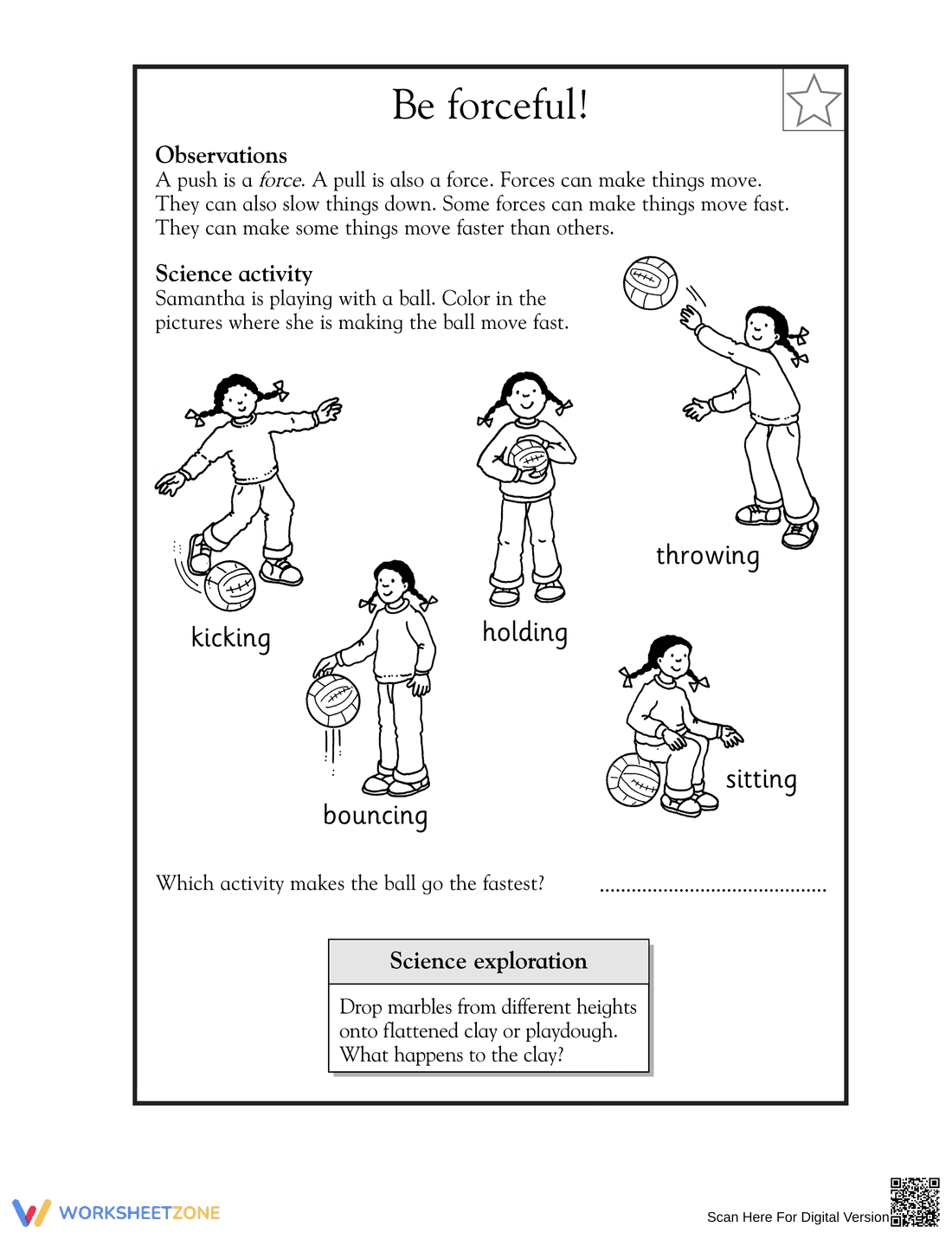
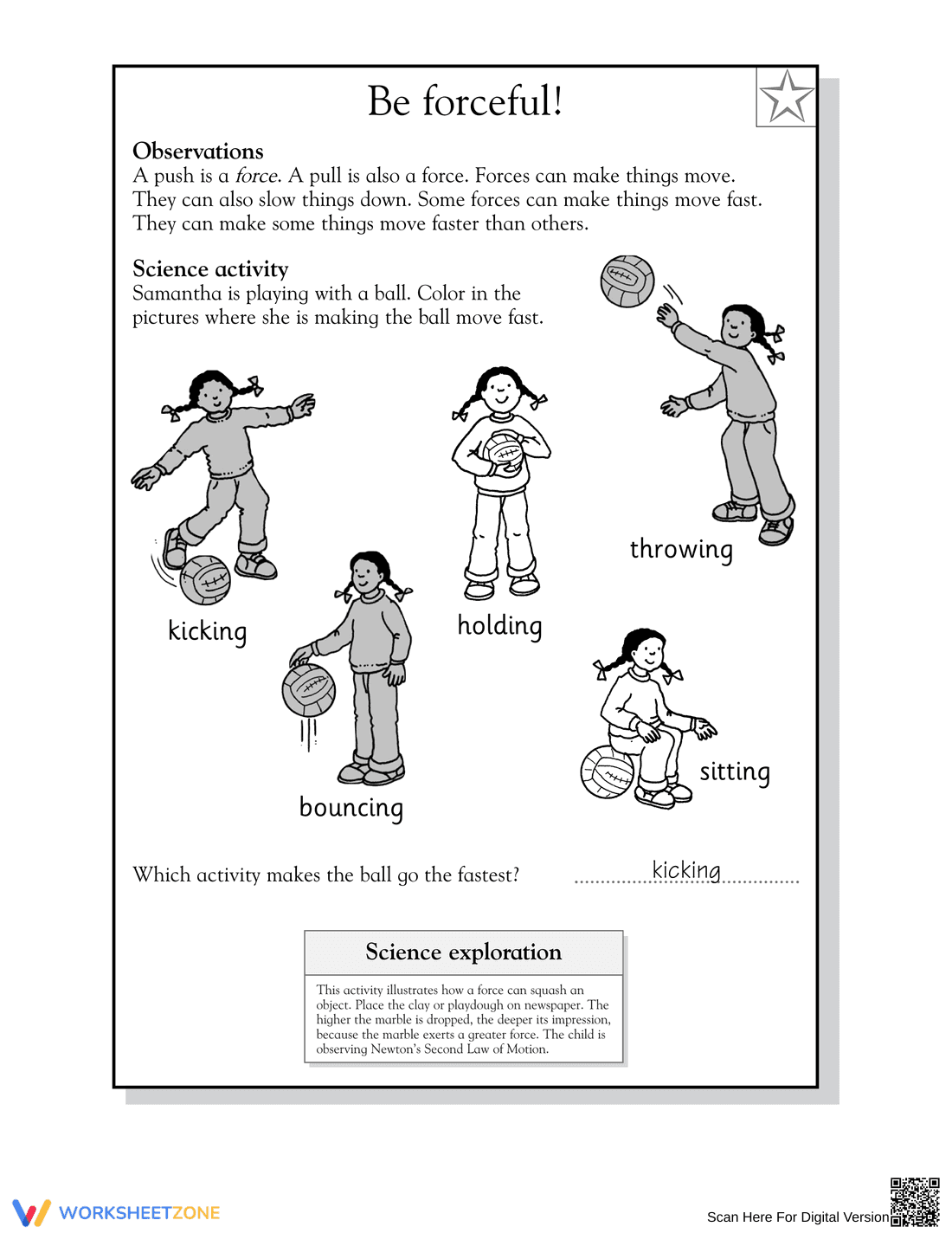
This Grade 3 science worksheet introduces students to the fundamental concepts of forces through relatable physical activities. By observing how pushes and pulls affect a ball's speed, learners develop a concrete understanding of motion. It bridges the gap between abstract physics and everyday play, ensuring students grasp how force magnitude influences velocity.
At a Glance
- Grade: 3 · Subject: Science
- Standard:
3-PS2-1— Plan and conduct an investigation to provide evidence of the effects of forces- Skill Focus: Identifying pushes, pulls, and speed changes
- Format: 1 page · 3 tasks · Answer key included · PDF
- Best For: Introduction to physical science units
- Time: 15–20 minutes
The resource features a clear "Observations" header that defines force as a push or pull. It includes a visual "Science activity" where students analyze five different illustrations—kicking, bouncing, holding, throwing, and sitting—to determine which actions generate the most speed. A dedicated "Science exploration" box provides a hands-on extension involving marbles and clay to demonstrate impact force.
Teachers can implement this lesson in under 2 minutes. Simply print the single-page PDF and distribute it to students. The self-explanatory "Observations" section allows students to work independently or in small groups with zero teacher setup. Reviewing the answers is immediate using the provided key, making it an ideal choice for emergency sub plans or quick formative assessments.
This worksheet aligns with 3-PS2-1: "Plan and conduct an investigation to provide evidence of the effects of balanced and unbalanced forces on the motion of an object." It specifically addresses how different strengths of force result in different speeds. Both standard codes can be copied directly into lesson plans, IEP goals, or district curriculum mapping tools.
Use this as a "hook" during the first 15 minutes of a new unit on physics. After students complete the visual identification, transition into the "Science exploration" experiment to provide a tactile experience of force. It also serves as an excellent formative assessment to check for misconceptions about "holding" or "sitting" as states of force.
Designed for Grade 3 students, this worksheet is also suitable for Grade 2 enrichment or Grade 4-5 review. It supports visual learners through clear illustrations and provides a kinesthetic outlet for students who benefit from the marble-and-clay experiment. Pair this with a classroom anchor chart on Newton's Laws for a complete instructional cycle.
According to the RAND AIRS 2024 report, integrating visual analysis with hands-on experimentation significantly improves retention of physical science concepts in elementary learners. This worksheet utilizes that dual-modality approach by pairing illustrative identification with a marble-drop investigation. By focusing on the standard 3-PS2-1, the material ensures that students move beyond simple definitions of "push" and "pull" to understand the relationship between force magnitude and resulting motion. Research from Fisher & Frey (2014) emphasizes that such scaffolded observations are critical for developing the scientific literacy required for middle school physics. This resource provides the necessary structure for students to observe, hypothesize, and conclude how forces make things move faster or slower, creating a robust foundation for future NGSS-aligned inquiry.


