


























Views
Downloads

Grade 1 Rhyming Words — Essential Printable Worksheet
Paste this activity's link or code into your existing LMS (Google Classroom, Canvas, Teams, Schoology, Moodle, etc.).
Students can open and work on the activity right away, with no student login required.
You'll still be able to track student progress and results from your teacher account.
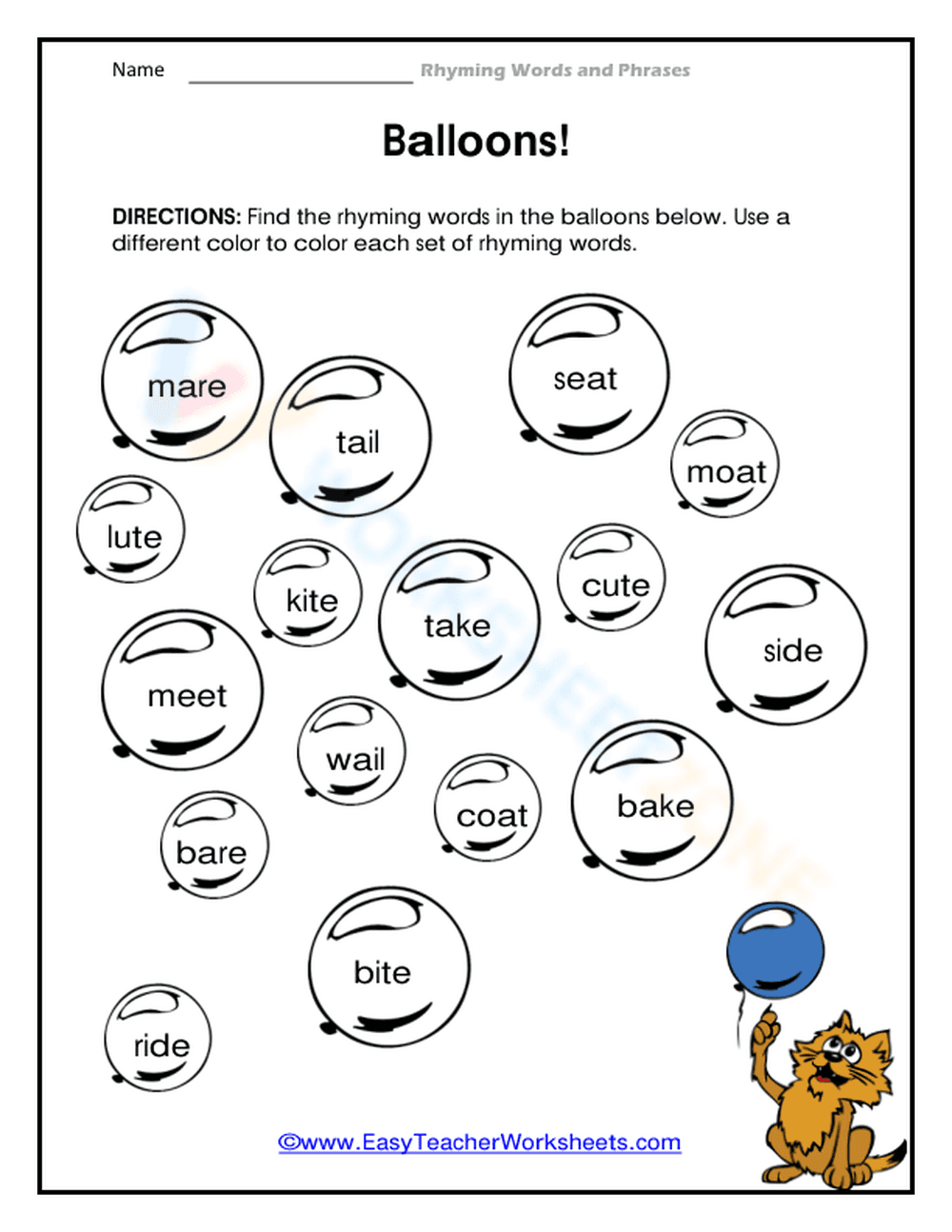
This Grade 1 rhyming words worksheet provides a hands-on coloring activity that helps students identify phonological patterns and vowel sounds. By matching sets of rhymes hidden within 16 illustrated balloons, learners strengthen their decoding skills and phonemic awareness. This printable resource ensures students can distinguish between similar-sounding word families while engaging in a creative, low-stress practice session.
At a Glance
- Grade: 1 · Subject: English Language Arts
- Standard:
CCSS.ELA-LITERACY.RF.1.2.A— Distinguish long from short vowel sounds in spoken single-syllable words- Skill Focus: Phonological awareness through rhyme identification and color coding
- Format: 1 page · 16 problems · Answer key included · PDF
- Best For: Independent literacy centers, morning work, or quick transition activities
- Time: 10–15 minutes
Inside this single-page PDF, you will find 16 individual balloons, each containing a single-syllable word featuring various long vowel patterns such as CVCe and common vowel teams. The worksheet includes clear, student-friendly directions that guide learners to use different colors for each rhyming pair. Structural features include clear typography for early readers and a whimsical cat mascot to keep students engaged throughout the phonics task.
The zero-prep workflow for this resource is designed for maximum teacher efficiency. First, print the single-page PDF in less than 30 seconds. Next, distribute the sheets to your class along with a set of crayons or colored pencils. Finally, review the completed color-coded sets during a quick whole-class check or through a self-check literacy station in under two minutes. This makes it an ideal choice for emergency sub plans or transition periods.
This activity is primarily aligned with CCSS.ELA-LITERACY.RF.1.2.A, which requires students to distinguish between vowel sounds in spoken words. By identifying rhymes like "take" and "bake" or "meet" and "seat," students demonstrate mastery of phonological structures. This standard code can be copied directly into lesson plans, IEP goals, or district curriculum mapping tools to track student progress in foundational reading skills.
Use this worksheet as a formative assessment after a direct instruction lesson on long vowel sounds. Observe students as they color to identify who is struggling to hear the rhyme versus who is simply struggling with decoding the text. It also works perfectly as a quiet-time activity following a read-aloud session focused on rhyming texts. Expect most first-grade students to complete the full identification and coloring task in approximately 12 minutes.
This resource is designed for first-grade students but provides excellent remedial support for second graders or enrichment for advanced kindergarteners. It is particularly effective for English Language Learners (ELLs) who benefit from the visual organization of the task. Pair this worksheet with a rhyming anchor chart or a short phonics passage to create a comprehensive literacy rotation for your classroom.
According to Fisher & Frey (2014), phonemic awareness is a critical predictor of later reading success, and activities that require students to manipulate and categorize sounds—such as rhyming—are foundational to this development. This worksheet targets CCSS.ELA-LITERACY.RF.1.2.A by asking students to recognize the phonological similarity in words with long vowel patterns. Research from RAND AIRS 2024 suggests that incorporating multi-sensory elements, like coloring, into phonics practice significantly increases student engagement and retention of sound-symbol relationships. By requiring students to color-code their findings, the worksheet forces a deliberate comparison between words, preventing passive guessing. This structured approach ensures that students are not just looking at words but are actively listening to the internal rimes. Educators can utilize these findings to justify the use of creative phonics worksheets in standard-aligned curricula while maintaining a focus on high-impact instructional strategies.


