


























Views
Downloads


Balancing Chemical Equations Worksheet | Grade 8 Essential
Paste this activity's link or code into your existing LMS (Google Classroom, Canvas, Teams, Schoology, Moodle, etc.).
Students can open and work on the activity right away, with no student login required.
You'll still be able to track student progress and results from your teacher account.
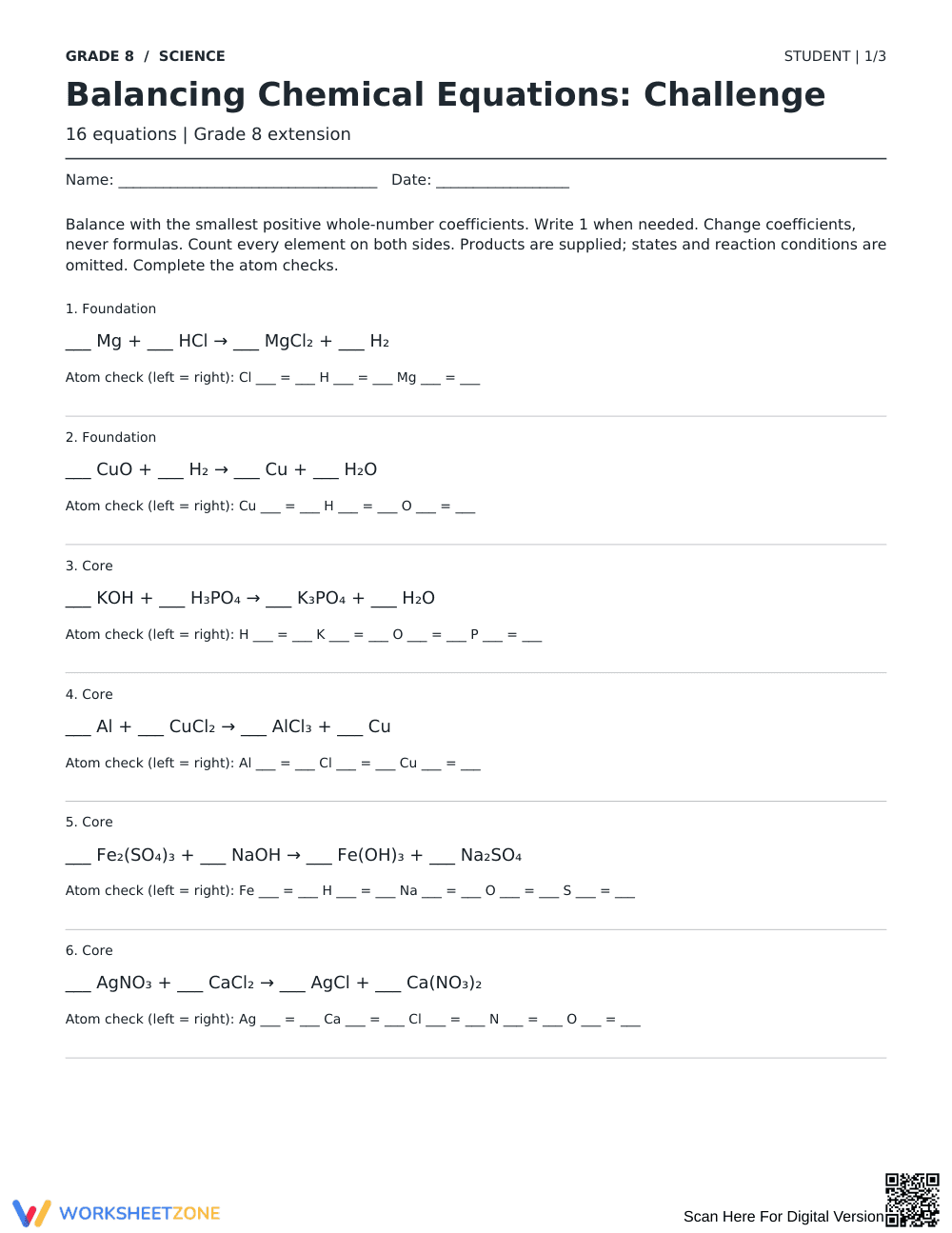
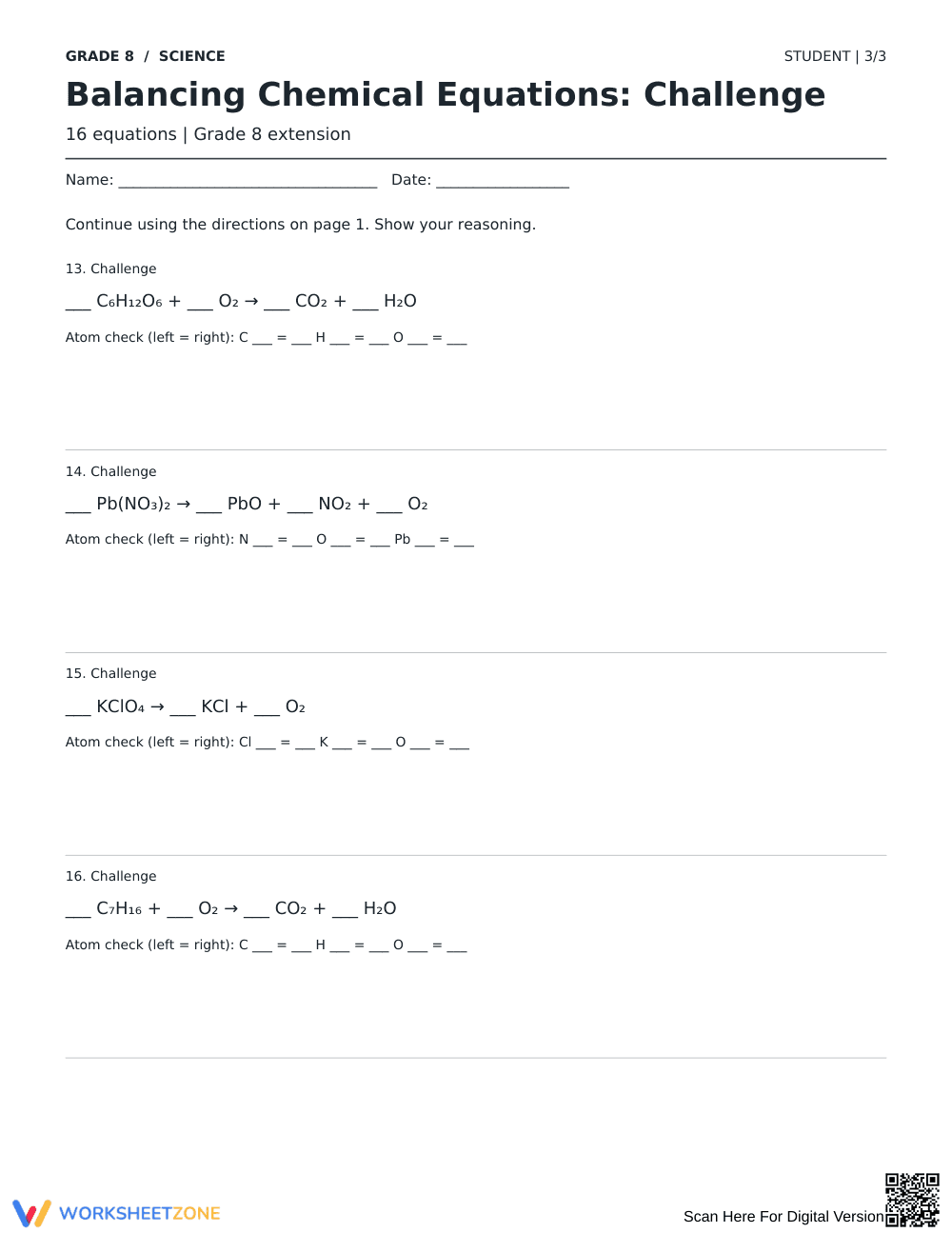
This comprehensive physical science practice resource builds student mastery in balancing chemical equations and verifying the conservation of matter. Students apply whole-number coefficients to align atom counts across reactants and products, developing strong stoichiometric reasoning and chemical literacy across 16 rigorous multi-tiered problems.
At a Glance
- Grade: 8 · Subject: Science
- Standard:
MS-PS1-5— Track and balance total atom counts to demonstrate conservation of matter.- Skill Focus: Balancing chemical equations with atom inventory verification
- Format: 3 pages · 16 problems · Answer key included · PDF
- Best For: Independent chemistry practice and honors extension
- Time: 30–45 minutes
What's Inside
This 3-page student packet contains 16 chemical equations organized systematically from basic synthesis and single replacement reactions to complex polyatomic and combustion challenges. Each problem includes a structured atom inventory check table beneath the equation, requiring students to verify reactant and product atom equality for every element. A complete 2-page teacher answer key provides balanced coefficients and element-by-element atom counts.
Skill Progression
- Guided practice (Problems 1–2): Foundation tasks introduce straightforward binary compounds such as magnesium reacting with hydrochloric acid, establishing consistent atom counting routines.
- Supported practice (Problems 3–9): Core tasks integrate polyatomic ions, multiple reactant subscripts, and multi-element compounds to deepen algebraic balancing strategies.
- Independent practice (Problems 10–16): Advanced challenge equations feature large hydrocarbon combustion and complex decomposition reactions requiring fractional balancing techniques.
This structured progression follows the gradual release of responsibility model, shifting students smoothly from scaffolded counting to autonomous problem solving.
Standards Alignment
This activity aligns with Next Generation Science Standard `MS-PS1-5`, which requires students to develop and use a model to describe how the total number of atoms does not change in a chemical reaction and thus mass is conserved. It also supports introductory high school chemistry concepts outlined in `HS-PS1-7` regarding mathematical representations of chemical quantities. Both standard codes can be copied directly into lesson plans, IEP goals, or district curriculum mapping tools.
How to Use It
Deploy this worksheet after direct instruction on the law of conservation of mass as independent classwork or paired problem solving. For formative assessment during work time, observe whether students balance polyatomic groups as whole units or correctly track distributed coefficients across parentheses. Expect most students to complete the 16 items within 30 to 45 minutes.
Who It's For
This worksheet serves Grade 8 physical science students, introductory physical science classes, and advanced learners requiring extension work beyond standard middle school expectations. Pair this assignment with 3D molecular modeling kits or an interactive law of conservation anchor chart to support visual learners.
According to research by Fisher & Frey (2014) on scaffolded instructional design, student cognitive load decreases significantly when complex multi-step tasks are structured through progressive difficulty levels. Mastery of the chemical reaction principles embodied in MS-PS1-5 demands that middle school learners bridge conceptual understanding of mass conservation with symbolic manipulation of chemical formulas. By incorporating an explicit atom check table for every equation, this resource ensures that students continuously verify that the number and type of atoms remain constant before and after a chemical reaction. This dual-step routine reinforces the physical reality behind mathematical coefficients, preventing students from altering chemical subscripts or misunderstanding molecular formulas. Implementing systematic atom tracking establishes essential procedural fluency, preparing students for rigorous stoichiometric calculations and high school physical science coursework.


