




























Views
Downloads

Balancing Chemical Equations Worksheet | Grade 8 Essential

Paste this activity's link or code into your existing LMS (Google Classroom, Canvas, Teams, Schoology, Moodle, etc.).
Students can open and work on the activity right away, with no student login required.
You'll still be able to track student progress and results from your teacher account.
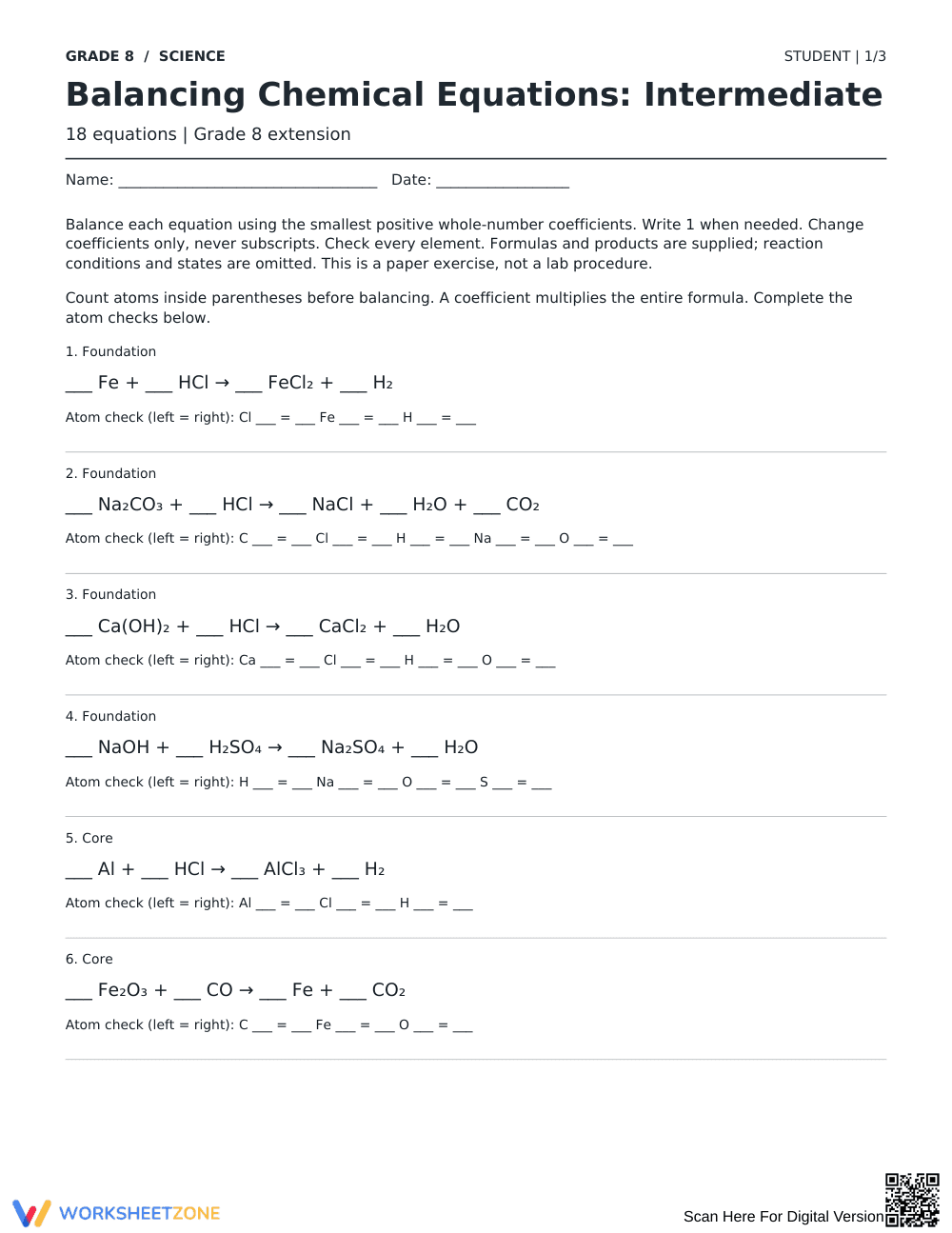
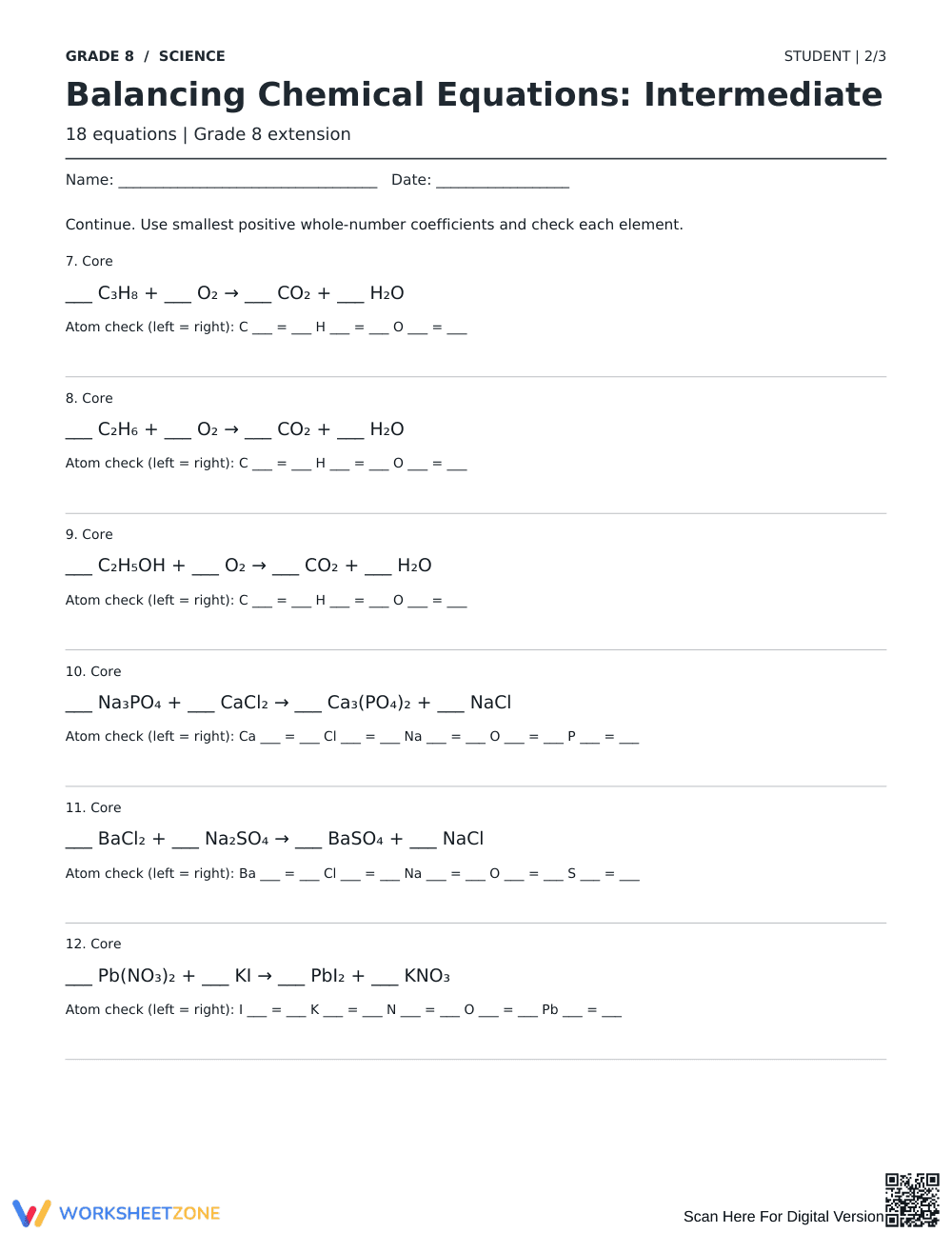
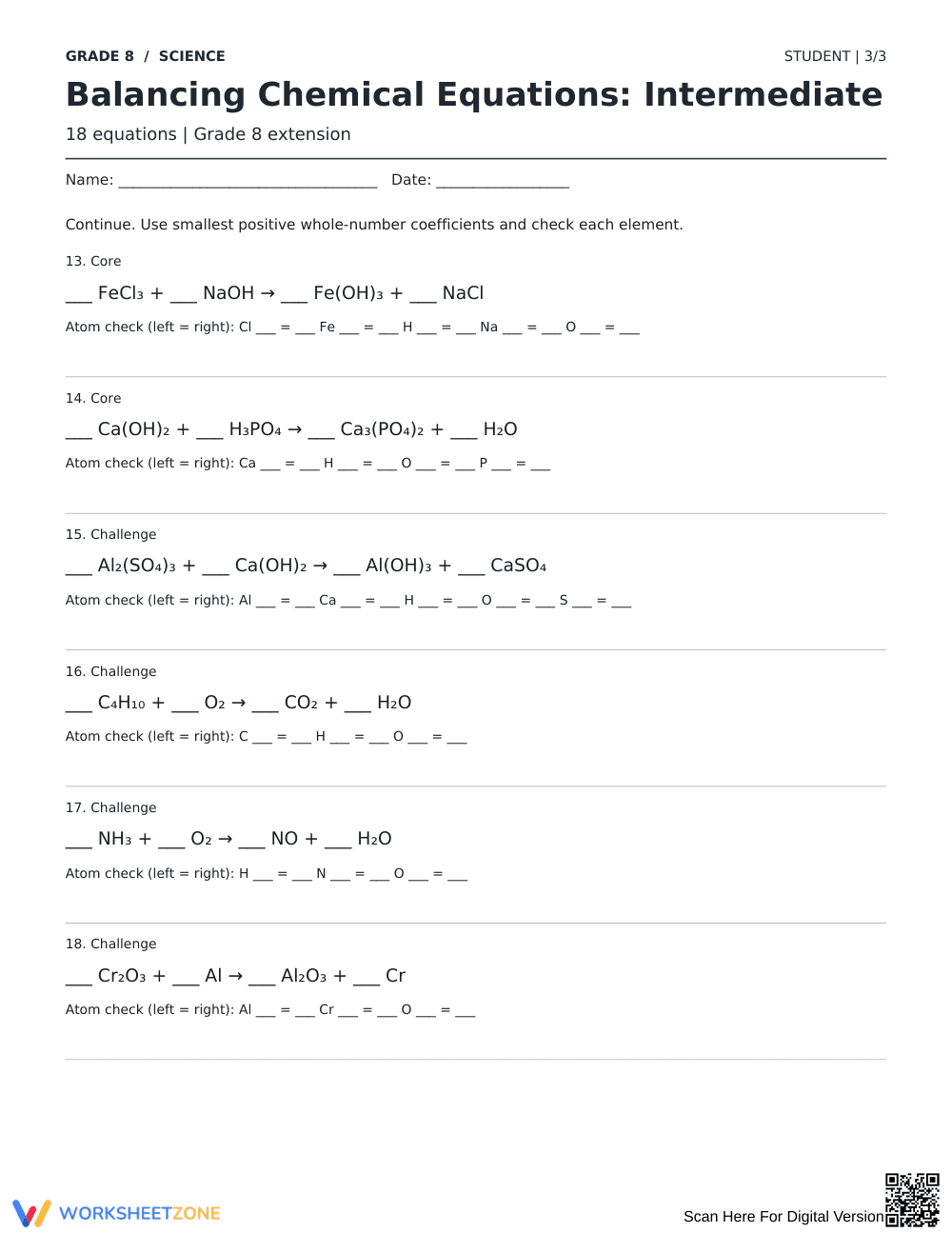
This intermediate balancing chemical equations worksheet gives Grade 8 science students structured practice applying the law of conservation of mass. Through 18 equations spanning single-replacement to complex precipitation reactions, learners determine positive whole-number coefficients and verify atom totals on both sides of each chemical reaction.
At a Glance
- Grade: 8 · Subject: Science
- Standard:
MS-PS1-5— Model conservation of matter by verifying equal atom counts in chemical reactions- Skill Focus: Balancing chemical equations with whole-number coefficients
- Format: 3 pages · 18 problems · Answer key included · PDF
- Best For: Independent review, chemistry extension, and homework
- Time: 30–45 minutes
What's Inside
This 3-page printable PDF features 18 balanced equation exercises organized across Foundation, Core, and Challenge tiers. Every problem includes coefficient blanks and a dedicated atom check space for recording reactant and product element counts. A full 2-page answer key provides complete coefficient sets and verified atom tallies.
Skill Progression
- Guided practice (Problems 1–4): Foundation equations feature basic reactions with simple compounds and minimal coefficient changes.
- Supported practice (Problems 5–14): Core tasks introduce combustion reactions, multi-element compounds, and polyatomic ions like phosphates and nitrates.
- Independent practice (Problems 15–18): Challenge problems present complex hydrocarbon combustion and multi-step rearrangements requiring systematic tracking.
This sequence supports a gradual-release instructional model from structured foundation to confident independence.
Standards Alignment
This worksheet aligns with NGSS MS-PS1-5: "Develop and use a model to describe how the total number of atoms does not change in a chemical reaction and thus mass is conserved." It also provides extension practice connecting to high school standard HS-PS1-7. Both standard codes can be copied directly into lesson plans, IEP goals, or district curriculum mapping tools.
How to Use It
Assign this worksheet after direct instruction on chemical formulas and conservation of mass. Use problems 1 through 6 during small-group practice, and assign the remaining problems for independent work or homework. Formative assessment tip: observe whether students correctly multiply coefficients across parentheses during the atom check to identify algebraic misconceptions early. The full activity takes 30 to 45 minutes to complete.
Who It's For
This resource serves eighth-grade physical science students ready for symbolic balancing and introductory high school chemistry students needing focused review. Differentiate by assigning Foundation problems to emerging learners while directing advanced students to the Challenge tier. Pair this resource with hands-on atom-modeling kits or interactive balancing simulations.
Balancing symbolic chemical equations serves as a foundational bridge between conceptual physical science and advanced quantitative chemistry. Under standard MS-PS1-5, middle school students demonstrate that matter is conserved during chemical reactions by accounting for every constituent atom before and after a reaction occurs. Research from Fisher & Frey (2014) on guided instructional release highlights that providing explicit intermediate structures—such as element-by-element atom accounting tables—significantly reduces cognitive load during multi-step procedural tasks. This 3-page worksheet operationalizes that pedagogical framework across 18 sequential chemical reactions, transitioning learners from basic binary compounds to complex polyatomic rearrangements. By requiring explicit atom tallies alongside coefficient determination, the activity ensures students connect abstract algebraic balancing to physical conservation principles rather than relying on ungrounded trial-and-error guessing. The included 2-page answer key provides complete element breakdowns to support rapid teacher diagnostics and precise formative feedback.


