


























Views
Downloads
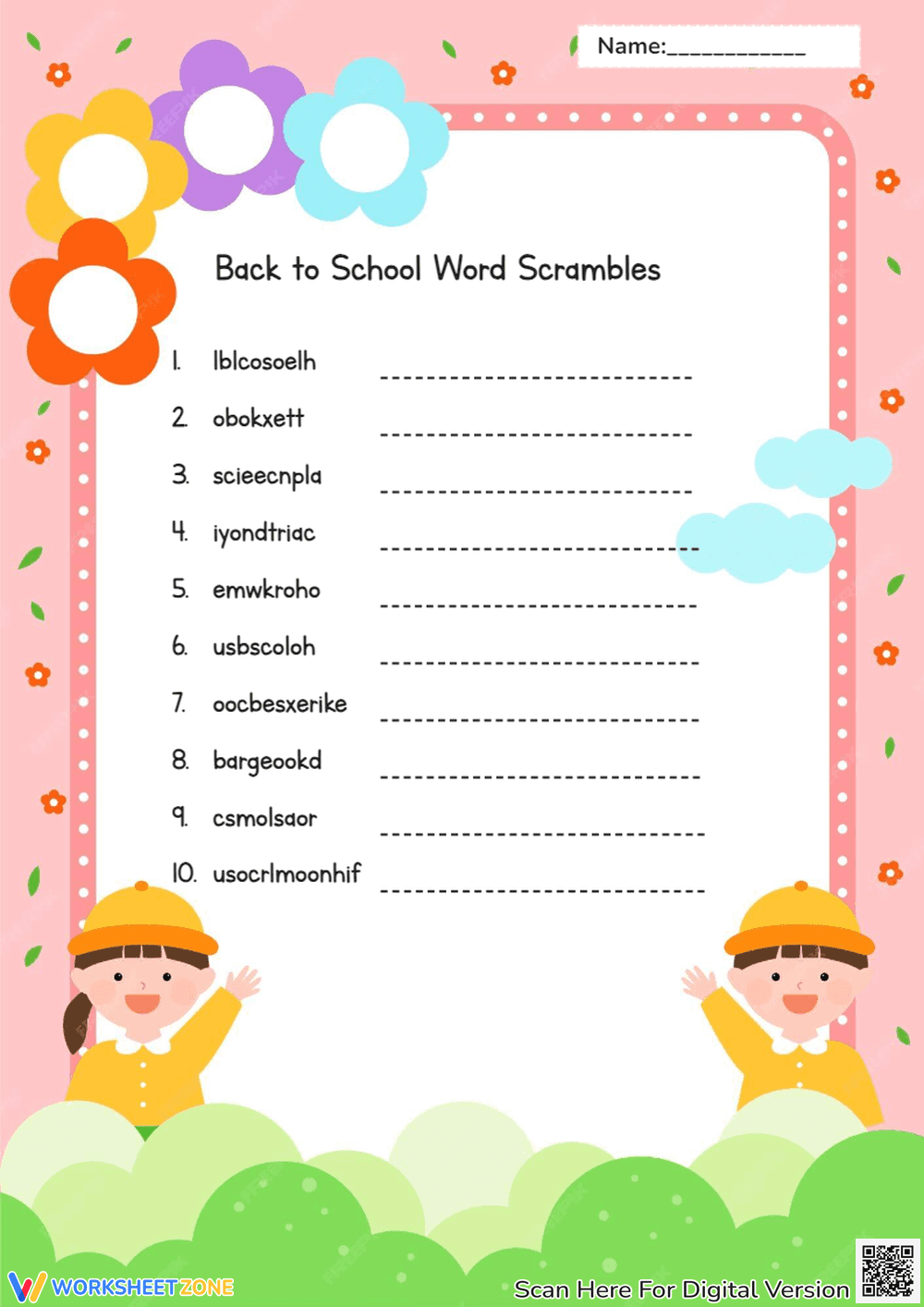

Back to School Word Scramble | Grade 1-3 Essential
Paste this activity's link or code into your existing LMS (Google Classroom, Canvas, Teams, Schoology, Moodle, etc.).
Students can open and work on the activity right away, with no student login required.
You'll still be able to track student progress and results from your teacher account.
This Back to School Word Scramble worksheet helps early elementary students reinforce seasonal vocabulary while sharpening their orthographic processing skills. By unscrambling 10 school-related terms, learners strengthen their understanding of common letter patterns and spelling conventions. It provides a fun, low-stakes way to transition back into academic routines during the first week of school.
At a Glance
- Grade: 1-3 · Subject: ELA
- Standard:
CCSS.ELA-LITERACY.L.2.2— Demonstrate command of the conventions of standard English capitalization, punctuation, and spelling- Skill Focus: Spelling and Vocabulary
- Format: 1 page · 10 problems · Answer key included · PDF
- Best For: Morning work or early finishers
- Time: 10–15 minutes
The worksheet features a clean, engaging layout with 10 numbered word scrambles. Each item provides a clear line for students to write the corrected word. The school-themed vocabulary includes essential academic terms, helping students re-familiarize themselves with the classroom environment. A full answer key is provided to facilitate quick grading or self-correction.
Skill Progression
- Guided practice: The activity begins with shorter, high-frequency words that students recognize instantly, allowing for immediate success.
- Supported practice: Middle items introduce medium-length words with common consonant blends and vowel teams to challenge phonemic awareness.
- Independent practice: The final tasks challenge students with longer multi-syllabic words like "dictionary" or "schoolroom" to test mastery of complex letter arrangements.
This gradual-release approach ensures students build confidence before tackling more complex vocabulary, following the I Do, We Do, You Do instructional model.
Standards Alignment
This resource aligns with `CCSS.ELA-LITERACY.L.2.2`, focusing on the ability to generalize learned spelling patterns when writing words. It also supports vocabulary acquisition by reinforcing thematic word banks. Both standard codes can be copied directly into lesson plans, IEP goals, or district curriculum mapping tools.
How to Use It
Use this worksheet as a "bell-ringer" during the first week of school to settle students as they arrive. It also serves as an excellent formative assessment tool; observe which students struggle with specific blends or vowel teams to identify those needing additional phonics support. Expected completion time is 10 to 15 minutes.
Who It's For
This resource is designed for students in Grades 1 through 3, including English Language Learners who benefit from thematic vocabulary practice. It pairs naturally with a "Back to School" read-aloud or a classroom scavenger hunt. The visual cues and structured lines provide necessary scaffolding for developing writers.
According to the RAND AIRS 2024 report, engaging students in word-play activities like scrambles significantly improves lexical retrieval and orthographic memory in early readers. This worksheet targets CCSS.ELA-LITERACY.L.2.2 by requiring students to manipulate letters to form recognizable words, a core component of spelling mastery. Research from Fisher & Frey (2014) suggests that thematic vocabulary reinforcement helps bridge the "summer slide" gap, making this seasonal activity an effective tool for the start of the academic year. By focusing on 10 specific school-related terms, the worksheet provides a concentrated burst of practice that supports long-term retention. Teachers can utilize this data-driven approach to ensure that students are re-engaging with grade-level spelling expectations immediately upon their return to the classroom environment. This resource offers a practical application of cognitive load theory by limiting the task to a manageable set of familiar concepts.


