


























Views
Downloads

Printable Back to School Bookmarks | Kindergarten to Grade 2
Paste this activity's link or code into your existing LMS (Google Classroom, Canvas, Teams, Schoology, Moodle, etc.).
Students can open and work on the activity right away, with no student login required.
You'll still be able to track student progress and results from your teacher account.
This printable back-to-school activity helps early childhood students build print awareness and fine motor control by creating their own reading tools. Students practice scissor skills while preparing four colorful bookmarks that celebrate literacy. This resource establishes a positive reading culture during the first weeks of the new school year.
At a Glance
- Grade: Kindergarten, Grade 1, Grade 2 · Subject: English Language Arts
- Standard:
CCSS.ELA-LITERACY.RF.K.1— Demonstrate understanding of the organization and basic features of print.- Skill Focus: Fine motor cutting and print awareness
- Format: 1 page · 4 problems · Answer key not applicable · PDF
- Best For: First week of school literacy activity
- Time: 10–15 minutes
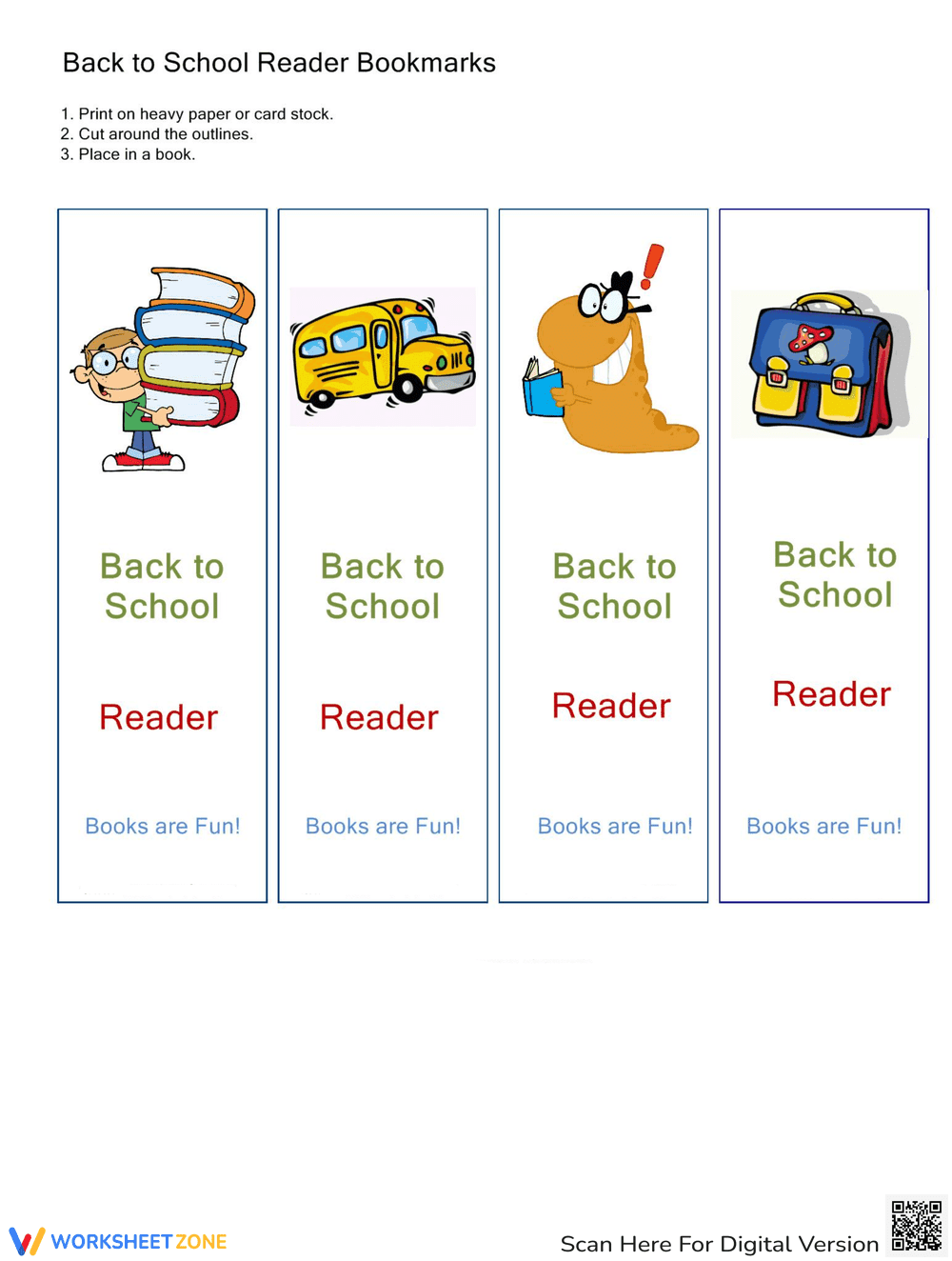
This single-page PDF contains four distinct bookmark designs featuring kid-friendly illustrations, including a student carrying a stack of books, a classic yellow school bus, a cheerful bookworm character, and a school backpack. Each bookmark features clear, bold text reading "Back to School Reader" and "Books are Fun!" to reinforce early reading motivation. The layout includes simple straight-line borders that serve as clear cutting guides for young learners developing their bilateral coordination.
The zero-prep workflow saves teacher time during the busy first week of school. First, print the single page on cardstock in less than 1 minute. Second, distribute the sheet directly to students with scissors, requiring zero setup time. Third, review the completed bookmarks as students place them into books, taking just 2 minutes to verify completion. This efficient structure makes the activity an excellent choice for morning work or emergency sub plans.
Standards Alignment
This activity aligns with Common Core Standard CCSS.ELA-LITERACY.RF.K.1 for understanding the basic features of print. By cutting and placing these physical markers into books, young learners connect text with physical reading materials. Both standard codes can be copied directly into lesson plans, IEP goals, or district curriculum mapping tools.
How to Use It
Introduce this activity during the first week of school after a classroom library tour. Use it to model proper book handling and how to use a bookmark. As a formative assessment tip, watch how students hold scissors and track straight lines to note who needs fine motor support. Expect a completion time of 10 to 15 minutes.
Who It's For
This resource is designed for kindergarten, first grade, and second grade students establishing reading routines. It offers natural differentiation, letting older students practice advanced scissor control while younger children focus on basic straight cuts. Pair this printable with a read-aloud book about starting school to maximize its instructional impact.
According to the Fisher & Frey (2014) framework for gradual release, physical artifacts like personalized bookmarks help early readers transition into self-directed learning environments. Engaging students in tactile, print-based crafts during early childhood education fosters a positive association with literacy and supports the development of foundational print concepts outlined in CCSS.ELA-LITERACY.RF.K.1. Research indicates that integrating fine motor tasks with literacy motivation enhances student engagement and ownership over reading materials. This single-page resource provides an accessible entry point for diverse learners to interact with text structures in a non-threatening format. By combining scissor skills with reading encouragement, teachers can efficiently assess physical readiness while building a supportive classroom community focused on book exploration. This balanced approach ensures that early literacy interventions remain both developmentally appropriate and highly effective for young students entering the primary grades.


