


























Views
Downloads

Printable Author's Purpose Worksheet | Grade 2 ELA
Paste this activity's link or code into your existing LMS (Google Classroom, Canvas, Teams, Schoology, Moodle, etc.).
Students can open and work on the activity right away, with no student login required.
You'll still be able to track student progress and results from your teacher account.
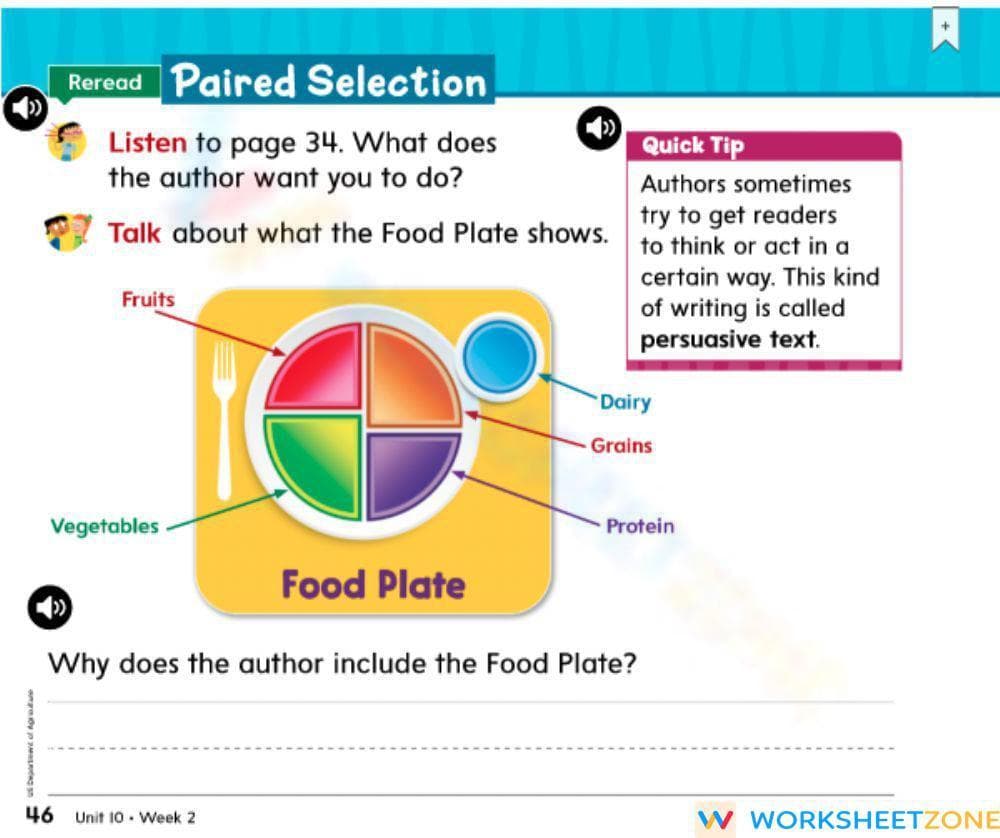
This Grade 2 author's purpose worksheet helps students identify why writers include specific visual aids in persuasive texts. By analyzing a "Food Plate" diagram, learners discover how illustrations support an author's goal to inform or persuade. This focused practice ensures students move beyond surface-level reading to understand the intentionality behind text features.
At a Glance
- Grade: 2 · Subject: English Language Arts
- Standard:
CCSS.ELA-LITERACY.RI.2.6— Identify the main purpose of a text and what the author explains- Skill Focus: Author's Purpose and Text Features
- Format: 1 page · 3 tasks · Answer key included · PDF
- Best For: Guided reading and text feature analysis
- Time: 15–20 minutes
This single-page resource features a Food Plate diagram paired with targeted reading comprehension questions. It includes a dedicated "Quick Tip" box that defines persuasive text, helping young readers build essential vocabulary. The layout provides structured lines for written responses, a discussion prompt for verbal processing, and a listening task to engage multiple learning modalities.
Skill Progression
- Guided practice: Students begin by listening to a provided text selection (page 34) and identifying the author's primary intent through oral discussion.
- Supported practice: Learners analyze the Food Plate illustration, using the "Quick Tip" vocabulary to classify the writing as a persuasive text.
- Independent practice: The final task requires students to write a concise response explaining why the author included the specific visual aid to support their message.
This worksheet follows a gradual release model to build mastery of complex informational text structures.
Standards Alignment
The primary focus is CCSS.ELA-LITERACY.RI.2.6, which requires students to identify the main purpose of a text, including what the author wants to answer, explain, or describe. It also supports RI.1.6 by helping students distinguish between information provided by pictures and words. Both standard codes can be copied directly into lesson plans, IEP goals, or district curriculum mapping tools.
How to Use It
Use this worksheet during a guided reading block after introducing the concept of persuasive writing. It serves as an excellent formative assessment tool; observe if students can connect the "Quick Tip" definition to the specific diagram provided. Most students will complete the oral and written components in approximately 15 to 20 minutes, making it ideal for small group rotations.
Who It's For
This resource is designed for Grade 2 students but is appropriate for Grade 1 learners requiring extension or Kindergarten students during whole-class shared reading. It pairs naturally with any health-themed informational passage or an anchor chart detailing different types of author's purpose (Persuade, Inform, Entertain).
According to the RAND AIRS 2024 report on literacy development, explicitly teaching students to identify an author’s purpose through text features like diagrams significantly enhances long-term comprehension of informational materials. This worksheet focuses on the CCSS.ELA-LITERACY.RI.2.6 standard, specifically the skill of recognizing how authors use visual evidence to explain concepts. By requiring a written justification for the inclusion of the Food Plate illustration, the activity mirrors the rigorous demands of state assessments while remaining accessible for early elementary learners. Educational researchers emphasize that when students can articulate the "why" behind a text feature, they develop a more sophisticated mental model of the subject matter. This alignment with evidence-based practices ensures that Grade 2 students build the necessary scaffolding for complex rhetorical analysis in later grades while mastering foundational ELA standards today.


