


























Views
Downloads
Author's Craft Worksheet | Grade 2 Printable ELA Activity
Paste this activity's link or code into your existing LMS (Google Classroom, Canvas, Teams, Schoology, Moodle, etc.).
Students can open and work on the activity right away, with no student login required.
You'll still be able to track student progress and results from your teacher account.
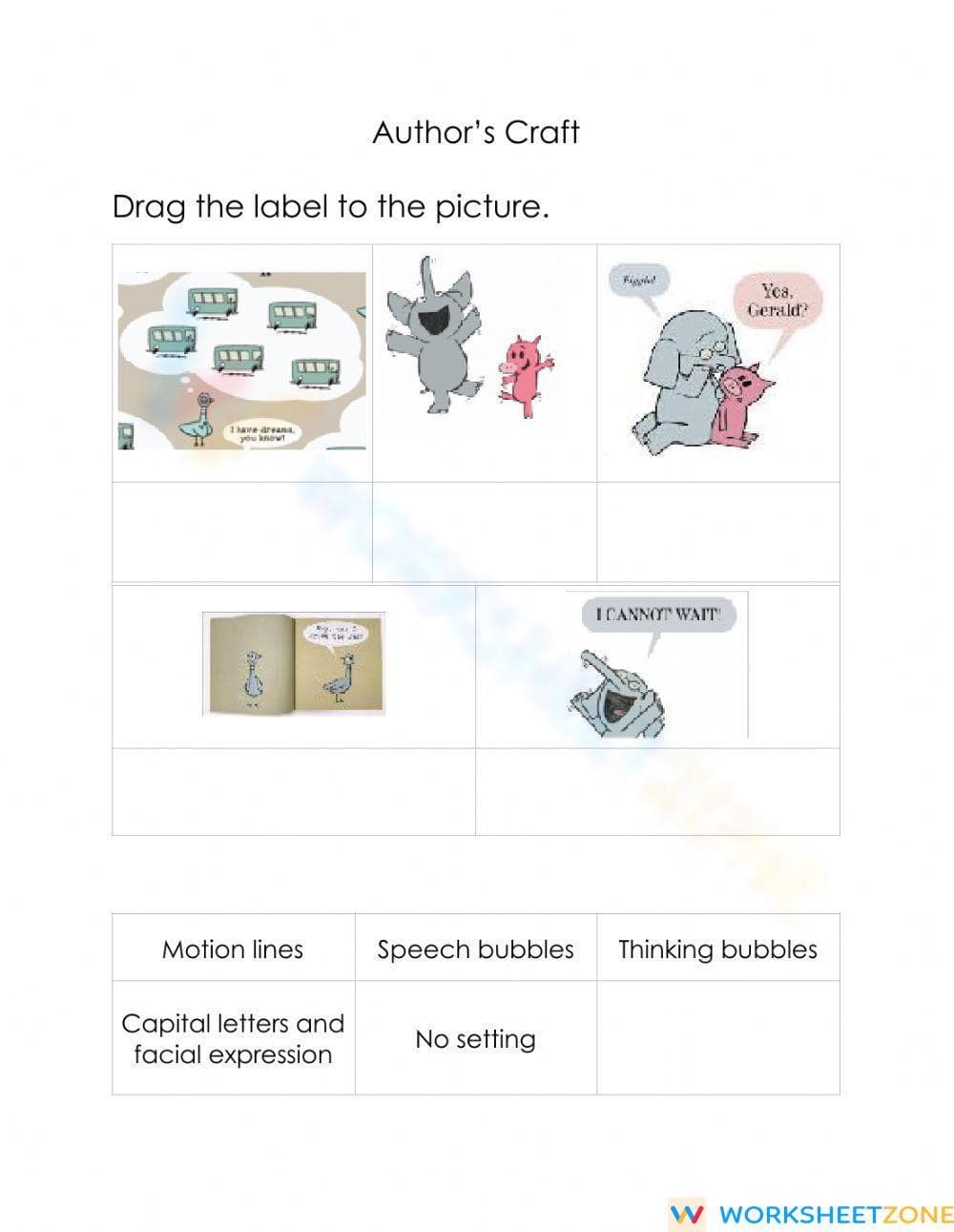
This printable Author's Craft worksheet helps Grade 1 and 2 students identify visual storytelling techniques. Through matching labels like speech bubbles and motion lines to illustrations, learners grasp how visual cues convey meaning beyond words. This activity enhances recognition of common literary devices in early reader texts.
At a Glance
- Grade: 2 · Subject: ELA
- Standard:
CCSS.ELA-LITERACY.RL.2.7— Use illustrations and words to demonstrate understanding of characters and setting- Skill Focus: Visual Author's Craft Elements
- Format: 1 page · 5 problems · Answer key included · PDF
- Best For: Literacy centers and independent skill practice
- Time: 10–15 minutes
This one-page resource features five illustrations paired with descriptive labels. Students match craft elements like thinking bubbles, motion lines, and capital letters indicating emotion. Its clean, intuitive layout supports independent or small group instruction for young learners.
The worksheet follows a structured skill progression to ensure student success.
- Guided practice: Students begin by identifying high-contrast visual elements like speech and thinking bubbles which are clearly demarcated in the familiar illustration styles.
- Supported practice: Middle tasks require closer observation to identify motion lines and the absence of a background setting, encouraging students to look for what is and isn't on the page.
- Independent practice: The final pairing involves analyzing how capital letters and facial expressions work together to signal character emotion, providing a rigorous check for understanding.
This sequence adheres to the gradual-release model, moving from obvious visual signals to more nuanced artistic choices.
This resource aligns with CCSS.ELA-LITERACY.RL.2.7, requiring students to use illustrations and words to understand characters, setting, or plot. By isolating illustrator's craft, students build prerequisite skills for complex text analysis. The standard code is suitable for lesson plans, IEP goals, or curriculum mapping.
Incorporate this worksheet during the "during instruction" phase of reading lessons with early readers. After a read-aloud, distribute it as a formative assessment to check students' ability to identify author's craft tools. Observe if students distinguish between "speech bubbles" and "thinking bubbles" to gauge comprehension. Completion time is 10-15 minutes.
Designed for Grade 1 and 2 students, especially those using popular mentor texts, this resource aids English Language Learners with visual-to-label matching. Pair with an anchor chart on dialogue bubbles or a lesson on character emotions to maximize impact.
Developing visual literacy via author's craft is crucial for early reading success, as highlighted by the RAND AIRS 2024 report. Decoding visual symbols like motion lines and facial expressions bridges simple decoding to deeper reading comprehension. This worksheet, aligned with CCSS.ELA-LITERACY.RL.2.7, emphasizes integrating visual information with textual evidence. Mastering these 5 visual elements helps Grade 2 students build cognitive schema for character motivation and plot progression. Explicit instruction in illustrator craft facilitates transition from picture-heavy to complex narratives, providing an evidence-based approach to essential visual literacy skills.


