




























Views
Downloads

Atoms vs Ions Worksheet | Grade 9 Science Ready

Paste this activity's link or code into your existing LMS (Google Classroom, Canvas, Teams, Schoology, Moodle, etc.).
Students can open and work on the activity right away, with no student login required.
You'll still be able to track student progress and results from your teacher account.
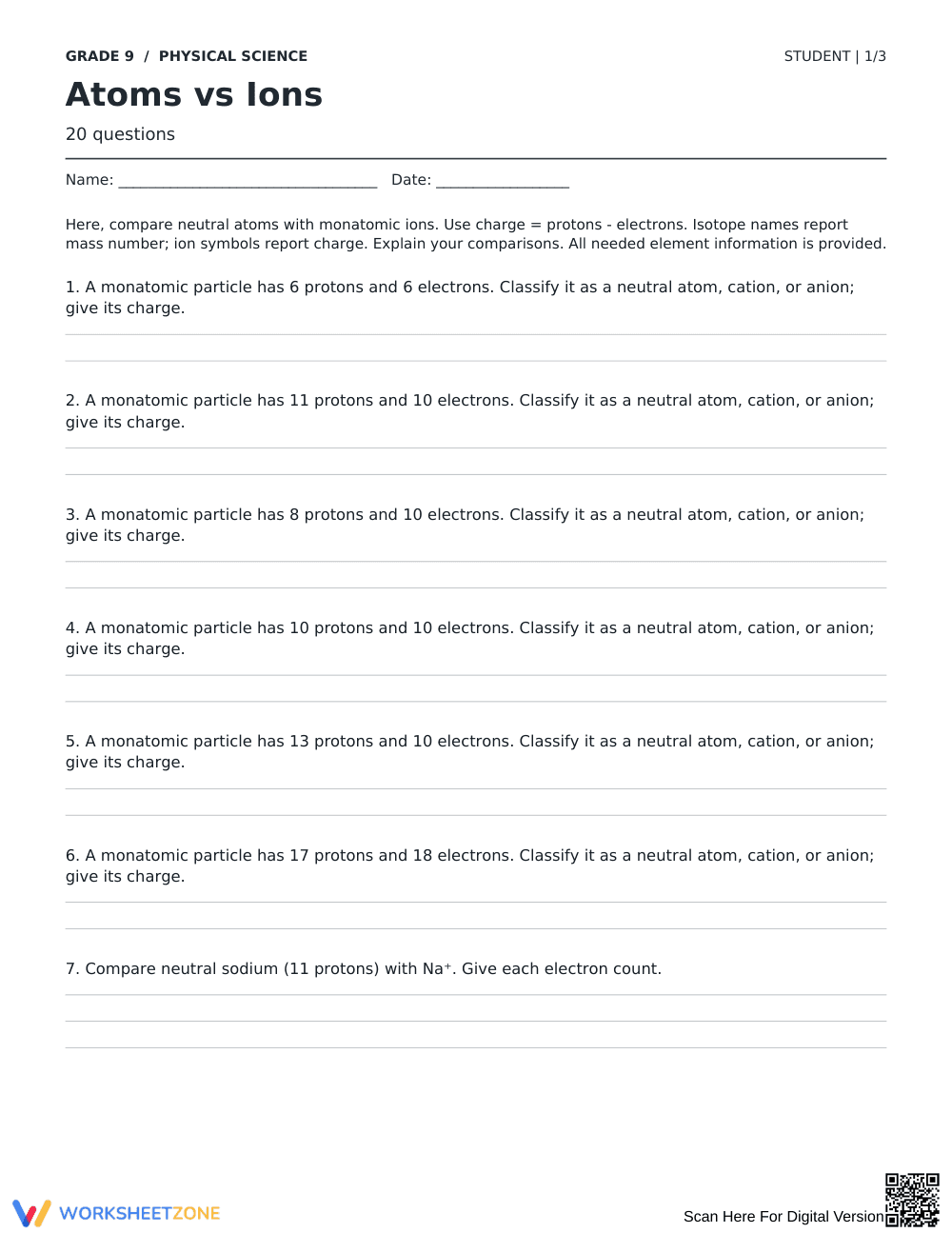
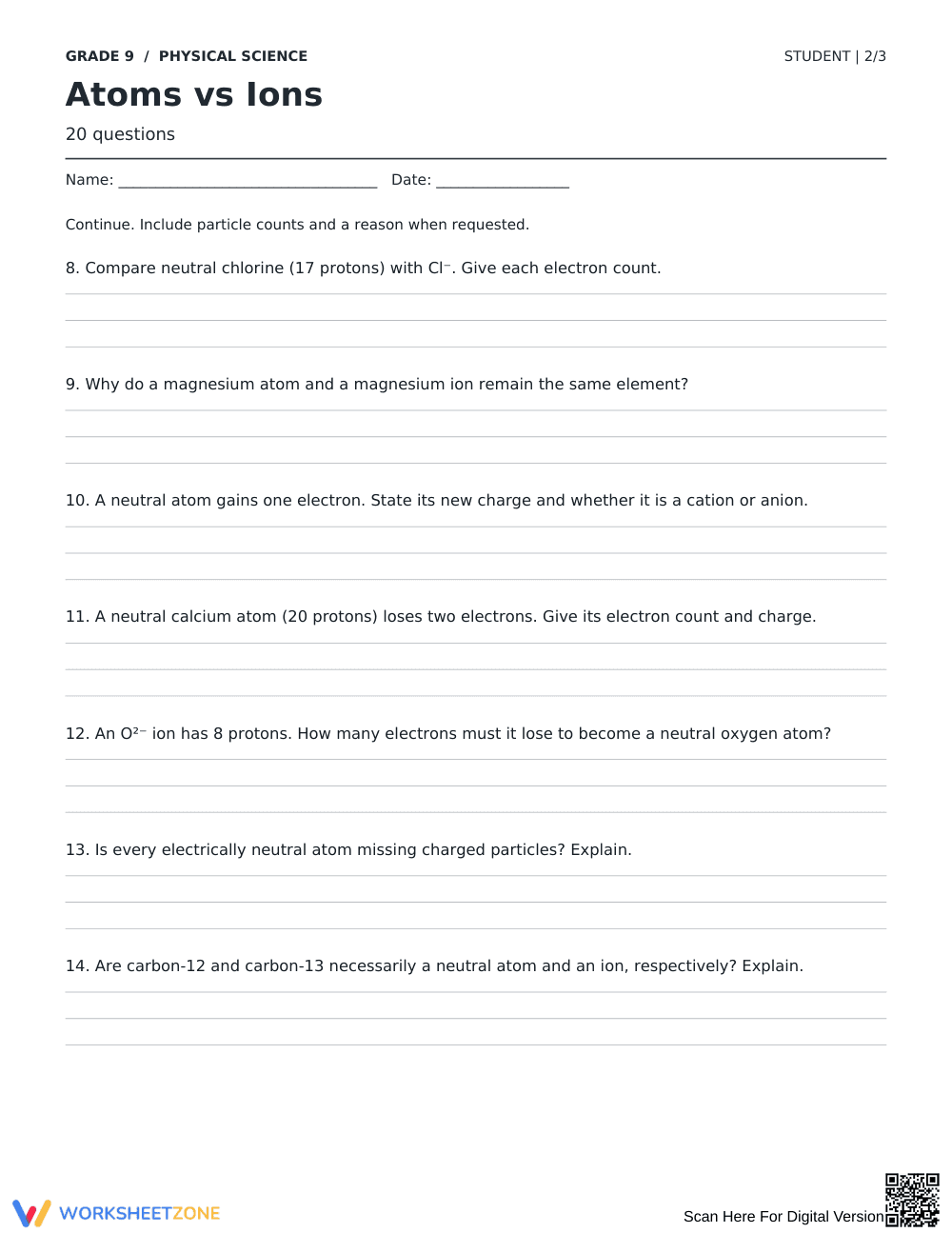
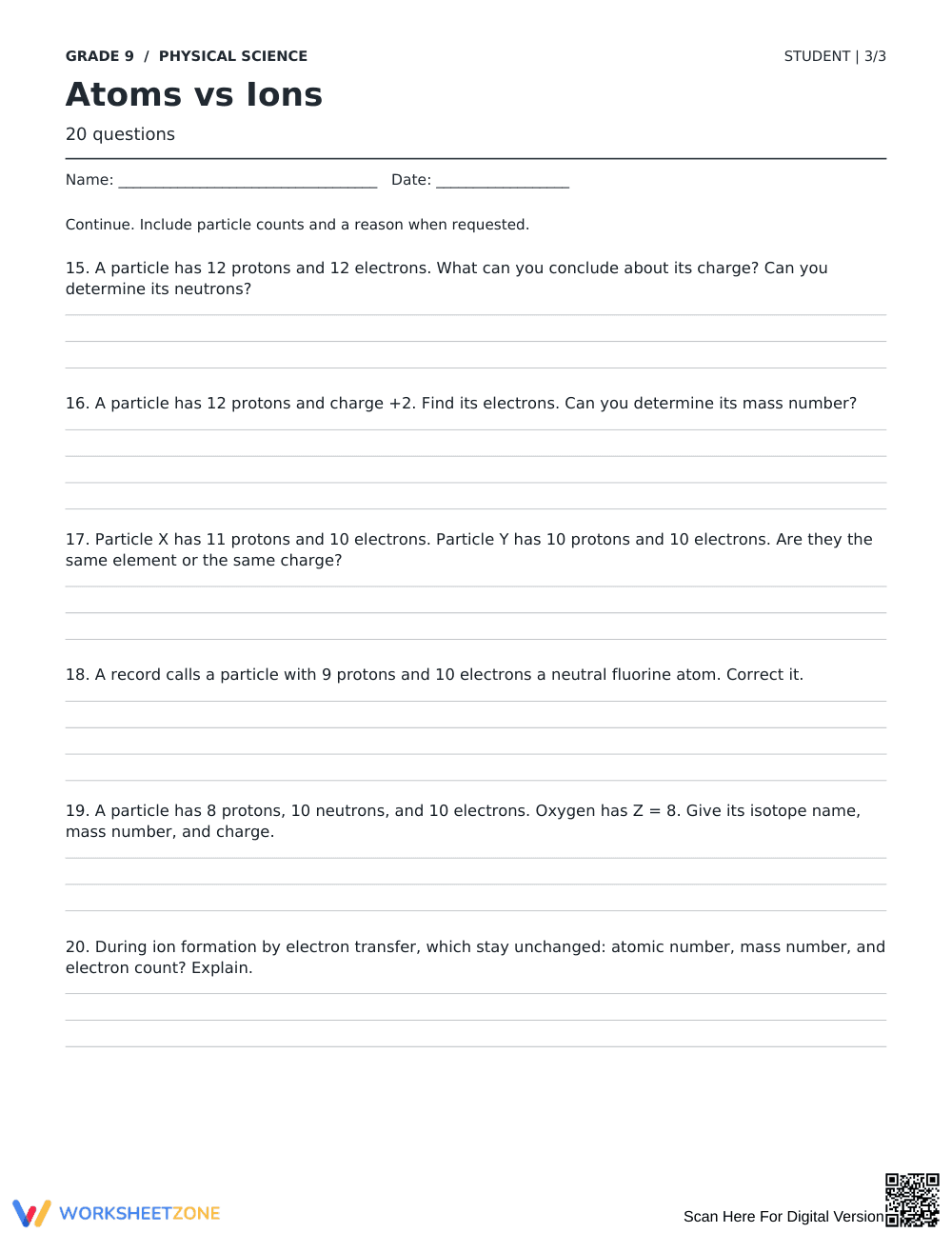
This physical science worksheet helps Grade 9 students master the differences between neutral atoms and monatomic ions. Learners calculate net electrical charges from subatomic particle counts, classify cations and anions, and analyze how electron gains or losses modify charge without altering the atomic nucleus.
At a Glance
- Grade: 9 · Subject: Physical Science
- Standard:
HS-PS1-1— Use subatomic particle counts to determine atomic identity, ion charge, and electron arrangements- Skill Focus: Comparing neutral atoms and ions using proton and electron counts
- Format: 3 pages · 20 problems · Answer key included · PDF
- Best For: Independent chemistry practice and formative assessment
- Time: 25–40 minutes
What's Inside
The 3-page student PDF features 20 open-response questions organized into progressive analytical sets. Tasks include calculating net charges using the provided proton-electron formula, comparing neutral atoms to specific ions, and distinguishing isotopes from ions. A complete 2-page answer key provides full solutions and scoring guidance.
Skill Progression
- Guided Practice (Questions 1–6): Direct calculation of particle charge and basic classification as neutral atoms, cations, or anions.
- Supported Practice (Questions 7–14): Comparative analysis of electron counts in specific ions and conceptual explanations of element identity.
- Independent Practice (Questions 15–20): Advanced deduction of unknown subatomic counts, error analysis, and distinguishing mass changes from charge alterations.
This layout follows a gradual-release model, transitioning students from routine computation to independent atomic analysis.
Standards Alignment
This resource aligns with HS-PS1-1: "Use the periodic table as a model to predict the relative properties of elements based on the patterns of electrons in the outermost energy level of atoms." It specifically develops prerequisite knowledge for NGSS PS1.A atomic substructure. Both standard codes can be copied directly into lesson plans, IEP goals, or district curriculum mapping tools.
How to Use It
Assign this activity following direct instruction on atomic notation and ions. During the 25–40 minute completion window, check responses on questions 9 and 14 as a formative checkpoint to ensure students understand that nuclear proton counts govern element identity. It also serves as an effective pre-assessment before teaching ionic bonding.
Who It's For
This worksheet is designed for Grade 9 physical science and introductory high school chemistry students. It provides clear numerical scaffolding for emerging learners while challenging advanced students with conceptual reasoning. Pair it with an interactive periodic table or atomic structure slide deck.
Introductory chemistry proficiency requires a grounded understanding of subatomic relationships. As established by Fisher & Frey (2014), deliberate practice structured around gradual-release principles solidifies core conceptual understanding before students tackle complex chemical phenomena. Under HS-PS1-1, students must determine net charge and particle identity by evaluating proton and electron counts. This 20-problem worksheet reinforces this foundational skill by training learners to distinguish between neutral atoms, cations, and anions, while clarifying that electron transfer does not alter elemental identity or nuclear mass. By systematically working through charge calculations and isotope discrimination tasks, students build the analytical fluency required for predicting bonding behavior and periodic trends. This focused resource provides educators with reliable formative data to address structural misconceptions early in the physical science curriculum.


