


























Views
Plays


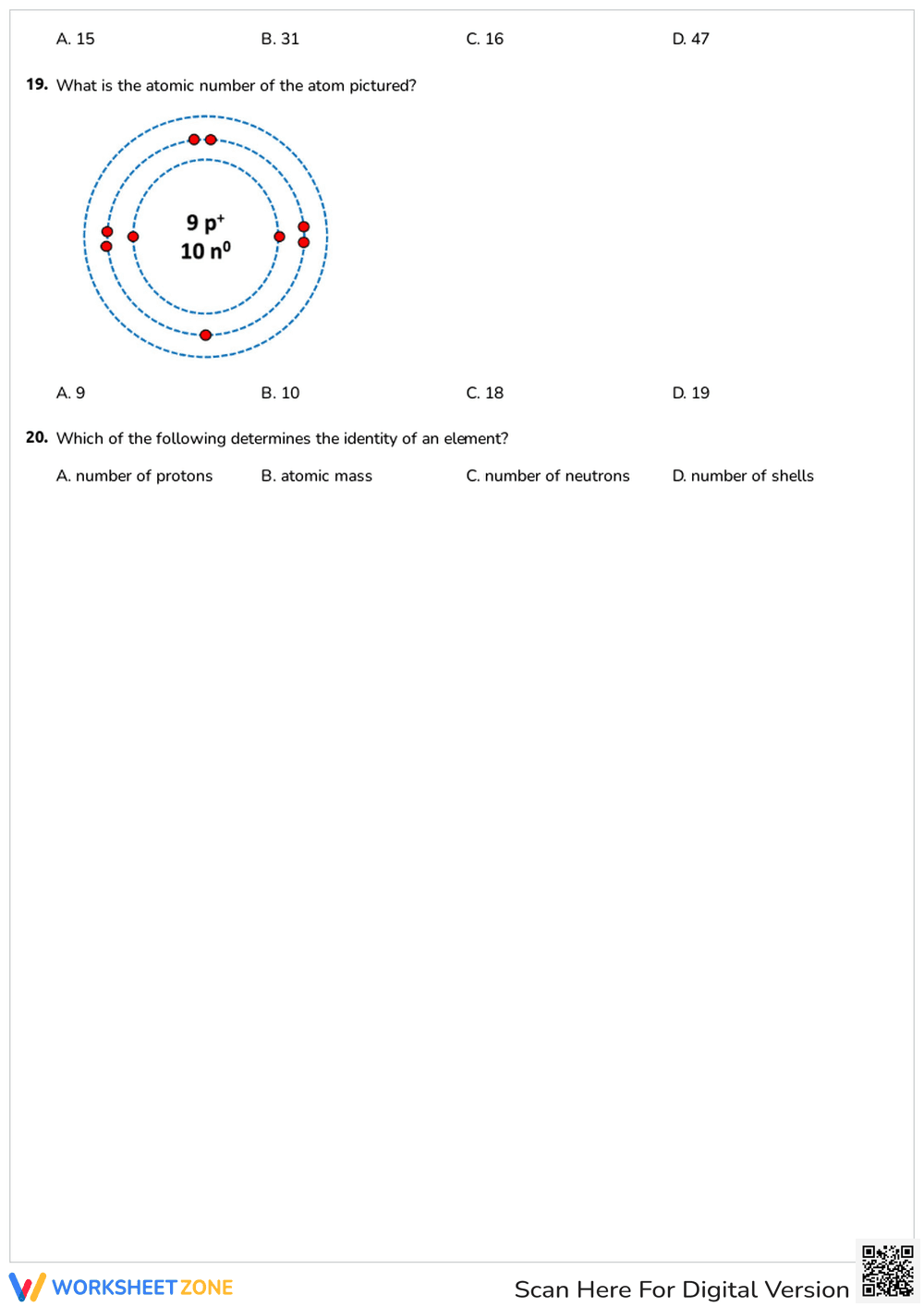

Atomic Structure Quiz | Grade 8 Science Printable
Paste this activity's link or code into your existing LMS (Google Classroom, Canvas, Teams, Schoology, Moodle, etc.).
Students can open and work on the activity right away, with no student login required.
You'll still be able to track student progress and results from your teacher account.
This comprehensive atomic structure quiz evaluates student understanding of fundamental chemistry concepts. By completing this assessment, students will accurately identify atomic numbers, calculate mass numbers, and determine the correct amount of protons, neutrons, and electrons within various atoms using visual models and the periodic table.
At a Glance
- Grade: 8 · Subject: Science
- Standard:
MS-PS1-1— Describe the atomic composition of simple molecules- Skill Focus: Atomic structure and subatomic particles
- Format: 4 pages · 20 problems · Answer key included · PDF
- Best For: Formative assessment and test prep
- Time: 25–35 minutes
Inside this four-page resource, educators will find a robust 20-question multiple-choice assessment designed to thoroughly test chemistry fundamentals. The worksheet features a mix of direct knowledge-recall questions, visual diagram interpretations of Bohr models, and periodic table element tile analysis. An included answer key ensures quick and accurate grading for teachers, making it an efficient tool for measuring student mastery of atomic composition.
- Guided practice: The initial questions focus on foundational definitions, asking students to identify what atomic and mass numbers represent.
- Supported practice: Middle sections introduce visual Bohr models, requiring learners to count subatomic particles to determine the element's identity and properties.
- Independent practice: Final questions challenge students to synthesize their knowledge, calculating missing neutron counts and identifying elements based on complex particle configurations.
This structured progression follows a gradual-release model, moving from basic recall to applied analytical thinking.
This worksheet is strictly aligned to MS-PS1-1, requiring students to develop models to describe the atomic composition of simple molecules and extended structures. It also supports foundational skills needed for high school chemistry standards regarding the periodic table. Both standard codes can be copied directly into lesson plans, IEP goals, or district curriculum mapping tools.
Deploy this worksheet as a summative quiz after direct instruction on atomic structure, or use it as a comprehensive review packet before a major unit exam. As students work through the visual model questions, observe whether they correctly distinguish between protons and valence electrons—a common misconception that can be addressed immediately. Expected completion time ranges from 25 to 35 minutes depending on the student's familiarity with the periodic table.
This resource is primarily designed for 8th and 9th-grade science students beginning their chemistry units. It serves as an excellent tool for general education classrooms, while the clear multiple-choice format provides built-in scaffolding for students needing accommodations. Pair this quiz with a standard periodic table anchor chart to support learners as they calculate mass numbers and identify elements.
Mastering atomic structure is a critical stepping stone for all subsequent chemistry education. According to a ScienceDirect TpT Analysis, explicit practice with visual models and standard element tiles significantly improves long-term retention of abstract chemical concepts. This resource directly supports MS-PS1-1 by requiring students to describe the atomic composition of simple molecules through rigorous, targeted questioning. When learners repeatedly engage with calculating protons, neutrons, and electrons, they build the cognitive automaticity necessary for balancing complex chemical equations later in their academic careers. By integrating both visual diagrams and standard periodic table representations, this 20-question assessment ensures a multi-modal approach to scientific literacy. Educators can rely on this structured practice to provide clear, actionable data on student comprehension, ultimately driving more effective instructional interventions and stronger foundational science skills.


