


























Views
Downloads
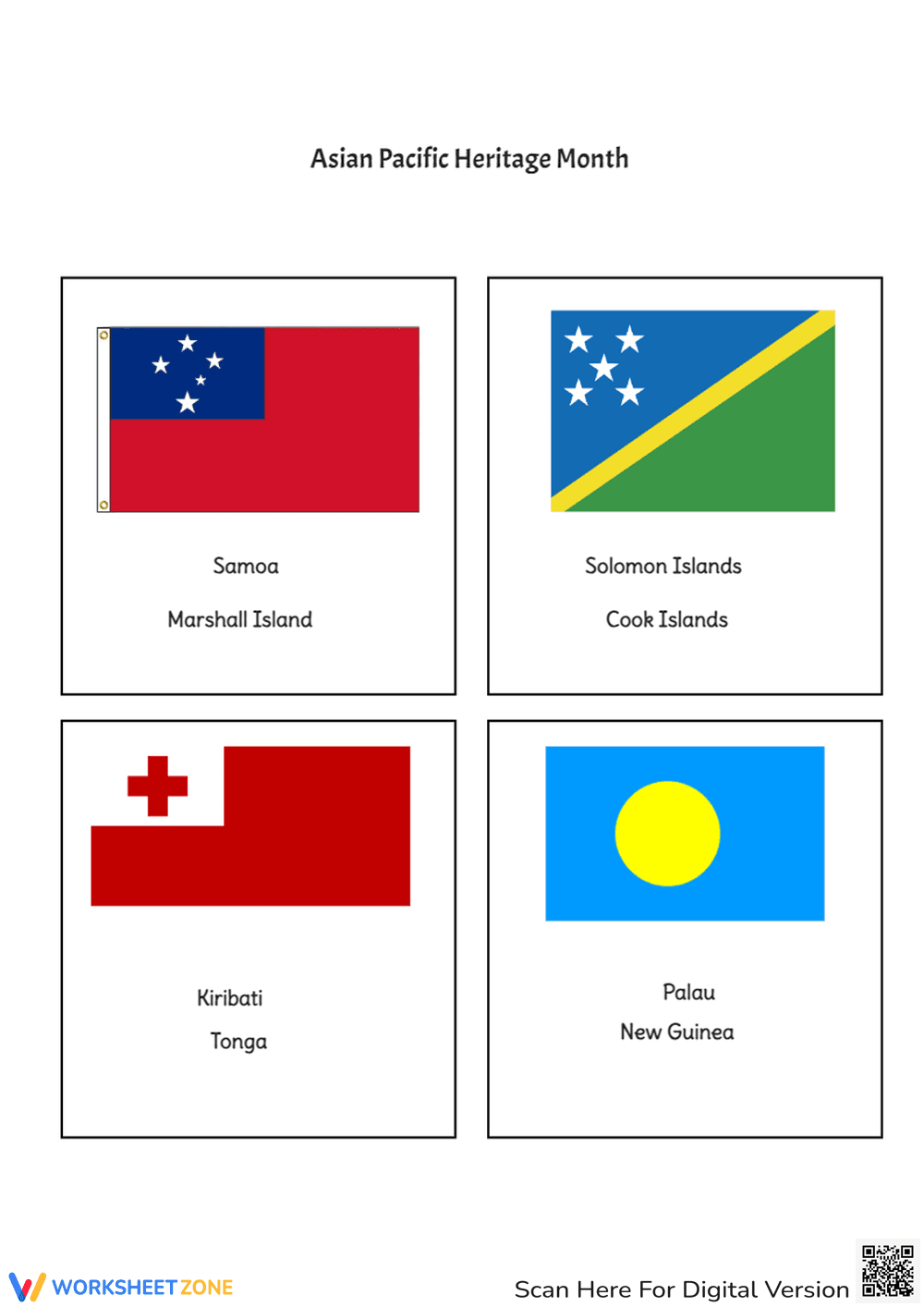

Asian Pacific Heritage Month Flags | Essential Grade 1
Paste this activity's link or code into your existing LMS (Google Classroom, Canvas, Teams, Schoology, Moodle, etc.).
Students can open and work on the activity right away, with no student login required.
You'll still be able to track student progress and results from your teacher account.
This Asian Pacific Heritage Month worksheet provides Grade 1 and Grade 2 students with a focused activity to recognize and identify national flags from the Pacific Islands. By matching visual symbols to country names, learners build cultural awareness and visual literacy skills. This resource serves as a foundational tool for celebrating diversity.
At a Glance
- Grade: Grade 1 · Subject: Social Studies
- Standard:
CCSS.ELA-LITERACY.RI.1.7— Use illustrations and details in a text to describe its key ideas- Skill Focus: Flag identification and cultural recognition
- Format: 1 page · 4 problems · Answer key included · PDF
- Best For: Asian Pacific American Heritage Month activities
- Time: 5–10 minutes
The worksheet features four distinct, high-quality illustrations of national flags representing Samoa, the Solomon Islands, Tonga, and Palau. Each flag is presented in a clear box with two multiple-choice options below it. This simple, one-page layout minimizes distractions, making it ideal for younger learners in Kindergarten through Grade 2. The PDF format ensures that the colors of the flags remain vibrant and accurate when printed for classroom use.
This resource is designed for a zero-prep workflow to save valuable instructional time. First, print the single-page PDF in under 30 seconds. Second, distribute the sheets to students as a quick warm-up or transition activity. Third, review the correct answers as a whole group to discuss the unique features of each flag. This streamlined process makes it an excellent choice for busy mornings or unexpected sub plans where immediate engagement is required.
This activity aligns with `CCSS.ELA-LITERACY.RI.1.7`, which requires students to use illustrations and details in a text to describe its key ideas. By analyzing the specific colors, shapes, and symbols on each flag, students practice visual information processing. Both standard codes can be copied directly into lesson plans, IEP goals, or district curriculum mapping tools to document cultural literacy instruction and visual analysis skills.
Use this worksheet during the month of May to celebrate Asian Pacific American Heritage Month. It works effectively as a hook at the start of a geography lesson or as a formative assessment after discussing different world regions. Teachers can observe whether students are using process of elimination or direct recognition to identify the flags, providing insight into their visual memory and prior knowledge of global symbols.
This worksheet is tailored for primary elementary students, specifically those in Kindergarten, Grade 1, and Grade 2. It is particularly useful for English Language Learners (ELLs) as it relies heavily on visual cues rather than dense text. Pair this resource with a world map or a picture book about Pacific Island cultures to provide a more comprehensive and inclusive learning experience for all students.
Research by Fisher & Frey (2014) emphasizes the importance of visual literacy in the primary grades, noting that students who can successfully interpret non-linguistic representations, such as flags and symbols, develop stronger cognitive pathways for information retrieval. This worksheet supports that development by requiring students to match specific visual data with geographic labels. According to the NAEP framework, early exposure to global symbols fosters a sense of civic and cultural awareness that is critical for social studies mastery. By engaging with the flags of Samoa, Tonga, Palau, and the Solomon Islands, students meet the `CCSS.ELA-LITERACY.RI.1.7` criteria for using illustrations to gain meaning. This 1-page resource provides 4 specific tasks that bridge the gap between simple recognition and cultural knowledge. It is a practical, evidence-based tool for any Grade 1 or Grade 2 classroom looking to integrate diverse perspectives into their daily curriculum.


