




























Views
Downloads
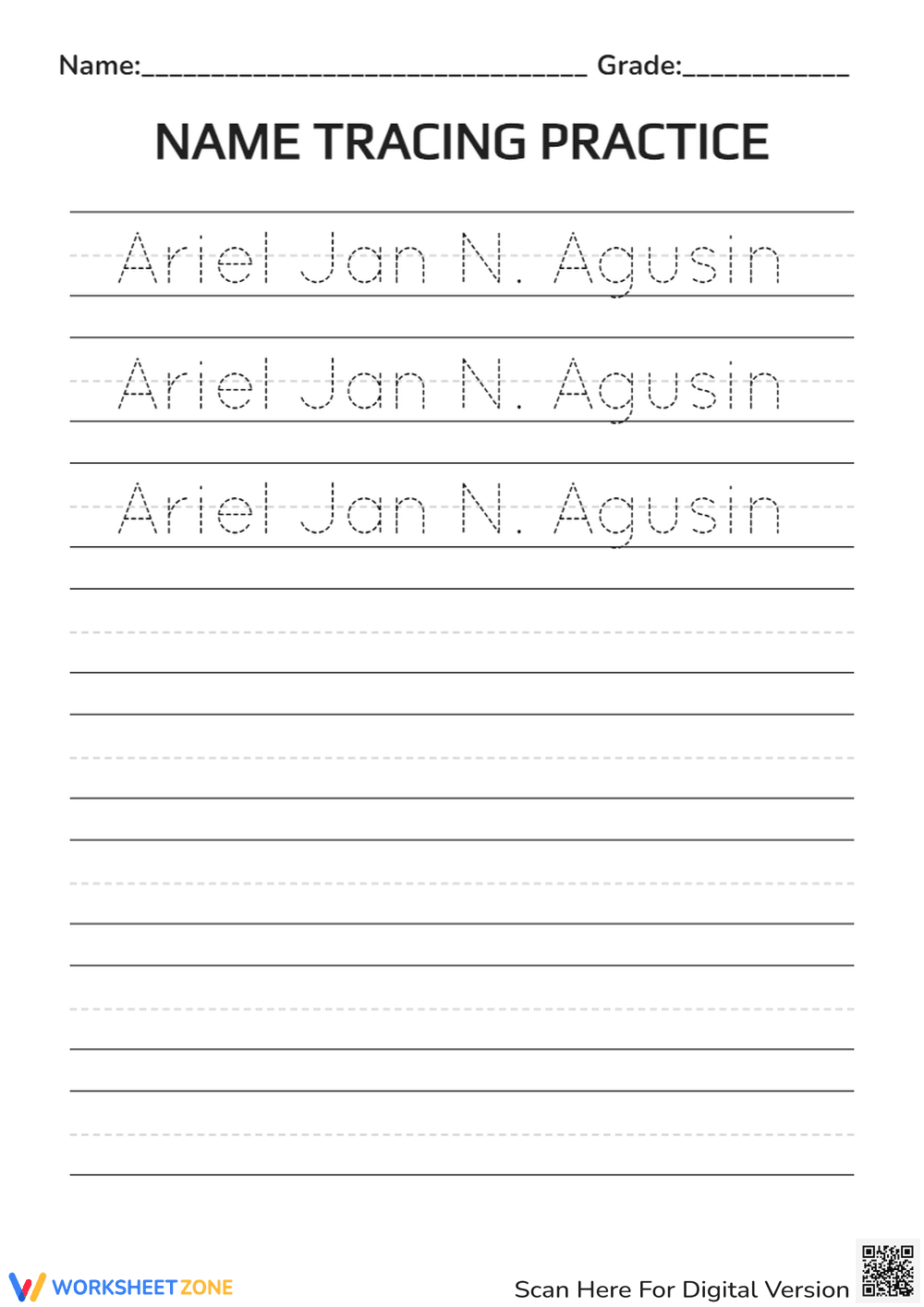

Name Tracing Worksheet | Grade 1 Essential Handwriting

Paste this activity's link or code into your existing LMS (Google Classroom, Canvas, Teams, Schoology, Moodle, etc.).
Students can open and work on the activity right away, with no student login required.
You'll still be able to track student progress and results from your teacher account.
This Grade 1 name tracing worksheet provides a structured path for students to master the specific spelling and formation of the name Ariel Jan N. Agusin. By combining guided tracing with independent writing lines, students develop the muscle memory required for legible handwriting and consistent letter sizing during early literacy development.
At a Glance
- Grade: 1 · Subject: Handwriting
- Standard:
CCSS.ELA-LITERACY.L.1.1.A— Print all upper- and lowercase letters accurately and legibly- Skill Focus: Name recognition and formation
- Format: 1 page · 13 practice lines · No answer key needed · PDF
- Best For: Morning work or daily warm-up
- Time: 5–10 minutes
The worksheet features a clean, distraction-free layout designed for early learners. It includes three lines of pre-formatted dashed text for the name Ariel Jan N. Agusin, followed by ten empty primary-ruled lines. The use of standard dotted mid-lines helps students maintain proper tall, small, and fall letter proportions throughout the exercise.
This resource follows a zero-prep workflow designed for busy classrooms. Teachers can print the PDF in under 2 minutes, distribute it to students as they arrive, and provide immediate feedback during the 5-minute practice window. It is an ideal grab-and-go activity for substitute folders or transition periods between core subjects.
This activity aligns with `CCSS.ELA-LITERACY.L.1.1.A`, which requires students to print all upper- and lowercase letters. By focusing on a specific name, students practice a high-frequency set of characters in a meaningful context. This standard code can be copied directly into lesson plans, IEP goals, or district curriculum mapping tools.
Use this worksheet as a consistent morning arrival task to settle the class. For formative assessment, observe the student's pencil grip and stroke direction during the first three guided lines. Completion typically takes 5 to 10 minutes depending on the student's fine motor development and focus level.
This resource is designed for Grade 1 and Grade 2 students who are refining their penmanship. It is particularly effective for English Language Learners (ELLs) or students receiving occupational therapy support for fine motor delays. Pair this with an alphabet anchor chart to help students reference letter shapes independently.
Research by Fisher & Frey (2014) emphasizes the importance of the gradual release of responsibility in literacy tasks. This worksheet implements that model by providing three scaffolded tracing opportunities before requiring the student to produce the text independently on the remaining 10 lines. Handwriting remains a foundational skill; according to NAEP data, students with fluent handwriting can devote more cognitive resources to higher-level composition and content generation. This specific practice sheet targets the CCSS.ELA-LITERACY.L.1.1.A standard by ensuring students can print their own name—a critical milestone in early primary education. By repeating the specific letter sequences in Ariel Jan N. Agusin, the student builds the necessary kinesthetic awareness to transition from drawing letters to fluid writing. This printable PDF serves as a reliable tool for daily skill maintenance in any early elementary setting.


