


























Views
Downloads
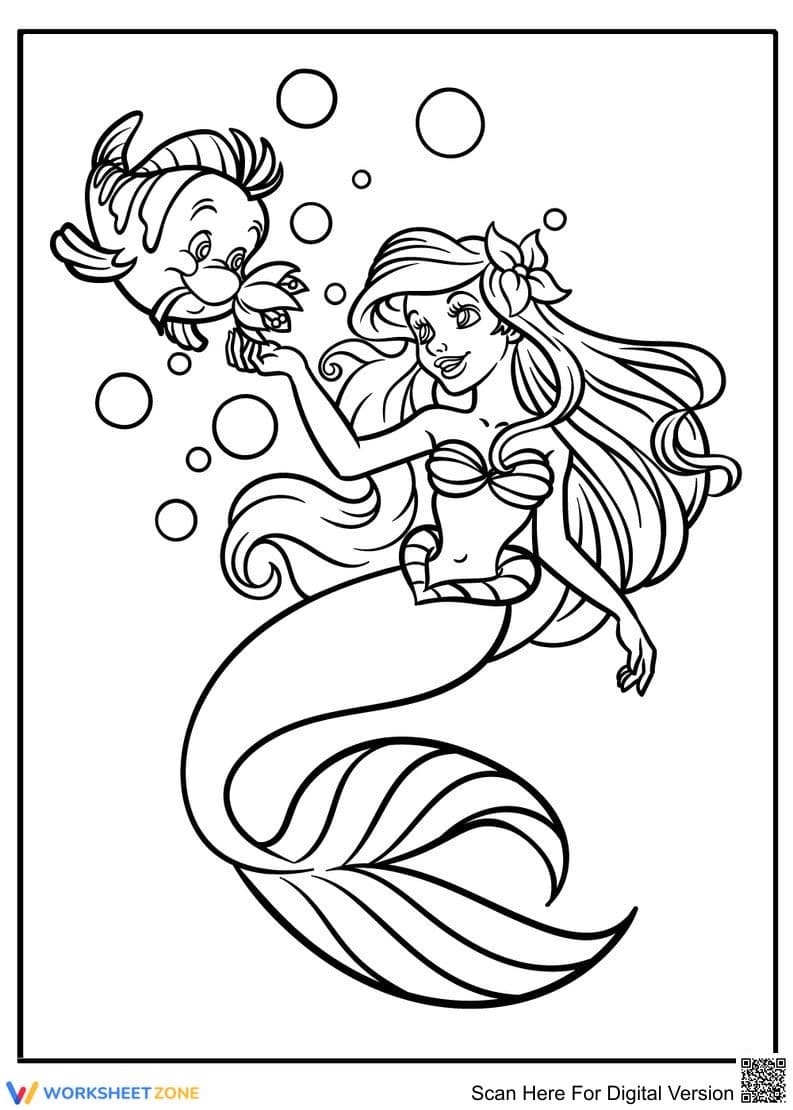

Ariel and Fish Coloring Page | Essential Grade K-5 Art
Paste this activity's link or code into your existing LMS (Google Classroom, Canvas, Teams, Schoology, Moodle, etc.).
Students can open and work on the activity right away, with no student login required.
You'll still be able to track student progress and results from your teacher account.
This Ariel and fish coloring worksheet provides students with a high-quality creative outlet to develop fine motor control and artistic expression. By engaging with familiar characters, learners can practice color selection and spatial awareness while building the hand strength necessary for early writing tasks. It serves as an excellent bridge between visual arts and storytelling.
At a Glance
At a Glance
- Grade: K-5 · Subject: Arts & English
- Standard:
CCSS.ELA-LITERACY.SL.K.5— Add drawings or visual displays to descriptions to provide detail- Skill Focus: Fine Motor Control
- Format: 1 page · 1 task · Answer key N/A · PDF
- Best For: Early finishers and creative centers
- Time: 15–30 minutes
What's Inside
This single-page PDF features a clean, bold-line illustration of Ariel and her companion Flounder. The design includes various shapes and textures, from the flowing hair of the mermaid to the delicate bubbles and scales, providing multiple opportunities for detailed coloring. There are no complex instructions, making it accessible for independent work across multiple elementary grade levels.
Zero-Prep Workflow
The workflow for this resource is designed for maximum efficiency in a busy classroom. First, print the single-page PDF (30 seconds). Second, distribute the sheets to students during transition periods or as a reward (30 seconds). Third, allow students to work independently while you conduct small-group instruction or assessments. Total teacher preparation time is under 2 minutes.
Standards Alignment
This resource aligns with `CCSS.ELA-LITERACY.SL.K.5`, which encourages students to use visual displays to enhance their descriptions and storytelling. While primarily an artistic activity, it supports the development of the tripod grip and hand-eye coordination required for standard `CCSS.ELA-LITERACY.L.K.1.A`. Both standard codes can be copied directly into lesson plans, IEP goals, or district curriculum mapping tools.
How to Use It
Use this worksheet as a hook before a creative writing prompt about the ocean or as a calming activity following recess. It is particularly effective for formative assessment of a student's pencil pressure and grip stability. Expect students to spend between 15 and 30 minutes completing the page depending on their attention to detail and choice of medium.
Who It's For
This worksheet is ideal for Kindergarten through 2nd-grade students focusing on fine motor development, though older students in Grades 3-5 will enjoy it as a stress-relief activity. It pairs naturally with a read-aloud of The Little Mermaid or an introductory science lesson on marine life and underwater ecosystems, providing a versatile tool for various instructional moments.
According to the RAND AIRS 2024 report, integrating visual arts into early childhood education significantly improves engagement and supports the development of fine motor skills essential for literacy. This Ariel and fish coloring page addresses CCSS.ELA-LITERACY.SL.K.5 by allowing students to create visual representations that can later be used to anchor verbal or written narratives. Research from Fisher & Frey (2014) suggests that purposeful coloring activities can serve as a non-verbal scaffold for English Language Learners, providing a low-stakes environment to practice vocabulary related to colors, characters, and settings. By focusing on the specific student action of adding visual detail to a conceptual theme, this worksheet ensures that creative time remains aligned with broader developmental milestones. It provides a structured yet flexible task that fits easily into any elementary curriculum, offering a bridge between artistic play and academic readiness in the classroom.


