


























Views
Downloads

Apple Tree Life Cycle Worksheet | Grade K-1 Essential
Paste this activity's link or code into your existing LMS (Google Classroom, Canvas, Teams, Schoology, Moodle, etc.).
Students can open and work on the activity right away, with no student login required.
You'll still be able to track student progress and results from your teacher account.
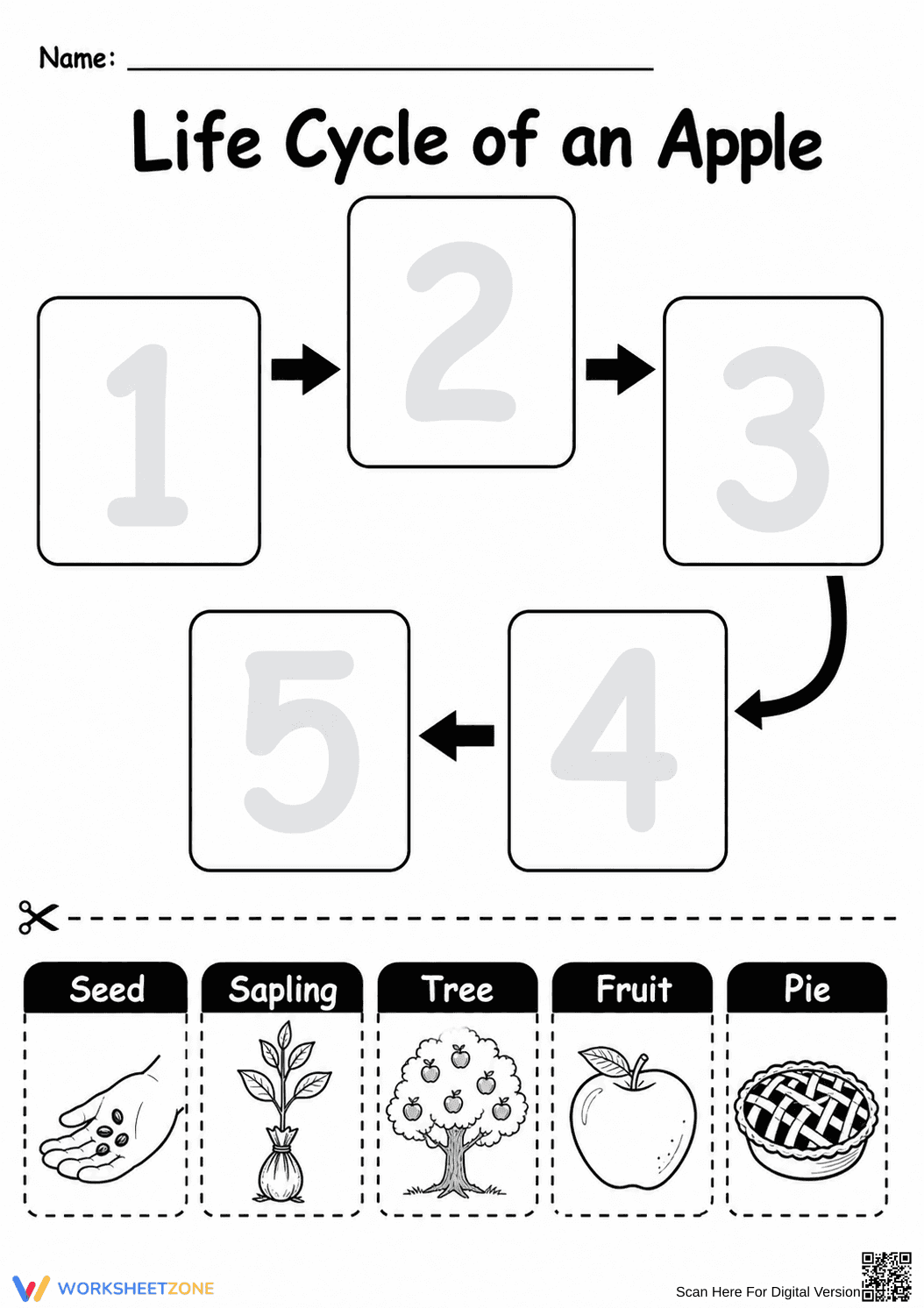
Students master the chronological stages of plant growth with this interactive apple tree life cycle worksheet. By organizing visual data into a logical sequence, learners develop a foundational understanding of biological patterns and the relationship between seeds, growth, and fruit production. This activity transforms abstract concepts into a concrete, hands-on learning experience.
At a Glance
- Grade: K-1 · Subject: Science
- Standard:
K-LS1-1— Use observations to describe patterns of what plants and animals need to survive- Skill Focus: Life cycle sequencing
- Format: 1 page · 5 problems · Answer key included · PDF
- Best For: Early elementary science centers and sequencing
- Time: 15–20 minutes
This single-page PDF features a circular flow diagram with five numbered landing zones. At the bottom of the page, students find five distinct, labeled illustrations: Seed, Sapling, Tree, Fruit, and Pie. The clear, high-contrast line art is designed for easy coloring and precise cutting, while the bold labels support early literacy and vocabulary acquisition in the science classroom.
The zero-prep workflow for this resource is designed for maximum efficiency. Teachers can print the required number of copies in less than 1 minute. Distribution takes approximately 30 seconds, as the worksheet is self-contained. Finally, the review process is instantaneous; the numbered diagram allows for a quick visual check of student work, making it an ideal choice for emergency sub plans or morning work.
This resource aligns with `K-LS1-1`, focusing on the observable patterns of plant growth. By identifying the progression from seed to fruit, students demonstrate an understanding of how organisms change over time. It also supports 1-LS1-2 by illustrating the developmental stages of a living thing. Both standard codes can be copied directly into lesson plans, IEP goals, or district curriculum mapping tools.
Use this worksheet during a unit on "Plants" or "Autumn" to reinforce direct instruction. It works best as a post-lesson activity where students apply what they learned about apple orchards. For a formative assessment, observe if students can explain why the "Seed" must come before the "Sapling." Completion typically takes 15 to 20 minutes depending on fine motor proficiency.
This activity is tailored for Kindergarten and 1st Grade students, particularly those developing fine motor skills through cutting and pasting. It serves as an excellent resource for English Language Learners (ELLs) due to the direct image-to-word association. Pair this worksheet with a non-fiction read-aloud about apple trees or a real-world apple tasting session.
Research from Fisher & Frey (2014) emphasizes the importance of scaffolding complex biological concepts through visual sequencing and hands-on manipulation. This apple tree life cycle worksheet applies these principles by requiring students to physically move information into a logical order, which strengthens cognitive retention of the `K-LS1-1` standard. By engaging in the "cut-and-paste" modality, learners utilize tactile-kinesthetic pathways that support the transition from concrete observation to abstract understanding of life cycles. Furthermore, the inclusion of the "Pie" stage provides a real-world connection to human interaction with plant life, a key component of early childhood science education. According to the NAEP science framework, early exposure to systematic patterns in nature prepares students for more advanced inquiry-based learning in later grades. This resource provides the structured practice necessary to bridge the gap between simple observation and scientific modeling.


