


























Views
Downloads
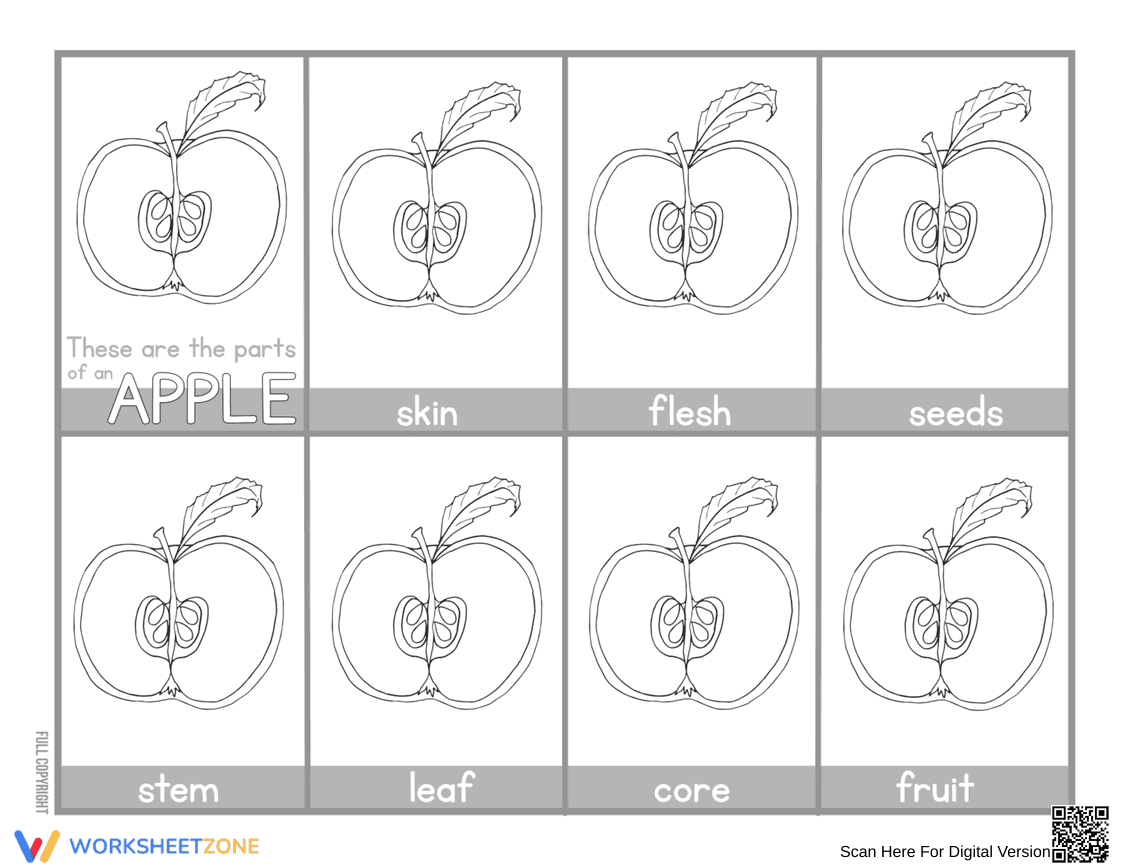

Apple Printable Worksheet | Grade K–5 ELA Ready
Paste this activity's link or code into your existing LMS (Google Classroom, Canvas, Teams, Schoology, Moodle, etc.).
Students can open and work on the activity right away, with no student login required.
You'll still be able to track student progress and results from your teacher account.
This printable apple worksheet builds early vocabulary and word-recognition skills across Kindergarten through Grade 5 by asking students to label and complete fill-in-the-blank prompts tied to apple-themed content. Students practice reading, identifying, and writing key terms, reinforcing foundational language skills in a focused, single-page format.
At a Glance
- Grade: K–5 · Subject: English Language Arts (ELA)
- Standard:
CCSS.ELA-LITERACY.L.1.6— Use words and phrases acquired through conversations and reading- Skill Focus: Vocabulary labeling and fill-in-the-blank completion
- Format: 1 page · 6 problems · Answer key included · PDF
- Best For: Independent practice or literacy center work
- Time: 10–20 minutes
Inside, students encounter 6 fill-in-the-blank and labeling tasks built around apple vocabulary. The single-page layout is clean and uncluttered, making it easy for early readers to stay on task. An answer key is included so teachers can check work quickly or allow self-correction. No word bank or sentence frames are required, though teachers may add one for below-grade support.
- Guided practice: Problems 1–2 present the most familiar vocabulary with visual cues, giving students a supported entry point before independent work begins.
- Supported practice: Problems 3–4 remove visual scaffolds and ask students to recall and write target words from memory, building retrieval strength.
- Independent practice: Problems 5–6 require students to apply vocabulary in context without prompts, reflecting the I Do, We Do, You Do gradual-release model.
This structure mirrors the gradual-release framework described by Fisher & Frey (2014), moving students from teacher-supported to fully independent production across six short tasks.
Standards AlignmentCCSS.ELA-LITERACY.L.1.6 — Students use words and phrases acquired through conversations, reading, and being read to, and responding to texts. Supporting standard CCSS.ELA-LITERACY.L.K.6 applies for Kindergarten users working on the same vocabulary acquisition goal. Both standard codes can be copied directly into lesson plans, IEP goals, or district curriculum mapping tools.
How to Use It
Use before direct instruction as a pre-assessment to surface prior vocabulary knowledge — observe which students leave blanks to identify gaps. Use after a read-aloud or shared reading on apples as a quick formative check; students who complete all 6 items correctly in under 15 minutes demonstrate solid word retention. Expected completion time: 10–20 minutes depending on grade level.
Who It's For
Best suited for Kindergarten through Grade 5 students in whole-class, small-group, or literacy center settings. Below-grade readers benefit from a teacher-provided word bank added to the margin. Pairs naturally with an apple life-cycle anchor chart or a nonfiction read-aloud such as Apples by Gail Gibbons to build content vocabulary before students complete the worksheet independently.
Research supports explicit vocabulary instruction as a driver of reading comprehension gains. Fisher & Frey (2014) identify structured word-practice tasks — including fill-in-the-blank and labeling — as high-leverage routines that accelerate vocabulary acquisition when embedded in content-rich contexts. This worksheet targets CCSS.ELA-LITERACY.L.1.6, the standard requiring students to use words and phrases acquired through reading and conversation. Across Grades K–5, apple-themed vocabulary tasks offer a concrete, familiar context that lowers affective barriers for emerging readers while still demanding precise word recall. Six discrete problems give teachers a quick 6-point data snapshot usable in progress monitoring, literacy center records, or informal IEP documentation without additional scoring tools.


