


























Views
Downloads
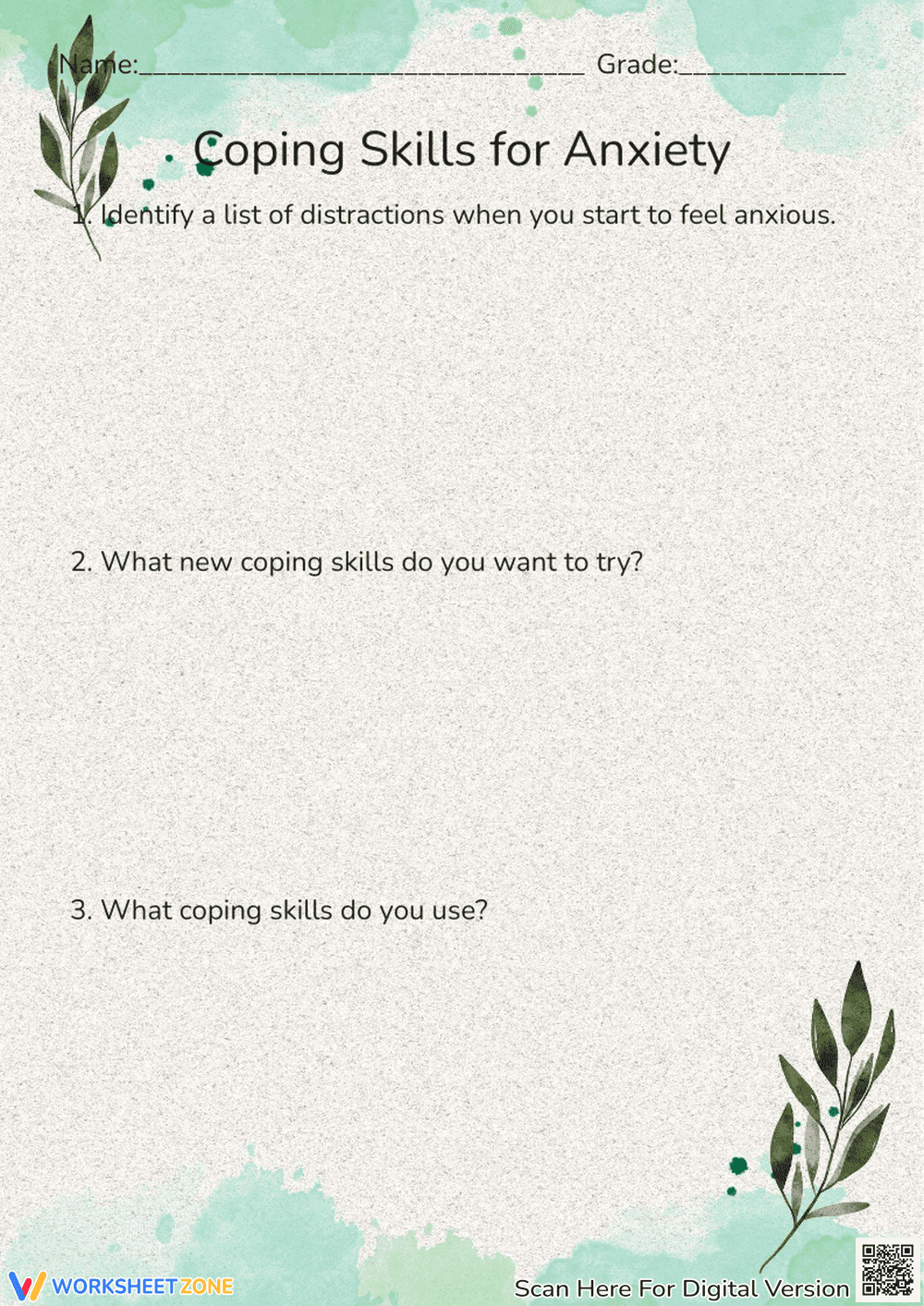

Coping Skills for Anxiety | Grade 12 Printable Worksheet
Paste this activity's link or code into your existing LMS (Google Classroom, Canvas, Teams, Schoology, Moodle, etc.).
Students can open and work on the activity right away, with no student login required.
You'll still be able to track student progress and results from your teacher account.
This Grade 12 and college-level worksheet helps students identify and develop effective coping skills for managing anxiety. By prompting personal reflection on current habits and future strategies, the resource guides young adults toward better emotional regulation and mental health awareness in a structured, accessible format.
At a Glance
- Grade: 12 · Subject: Health & SEL
- Standard:
HS-LS1-3— Understand behavioral feedback mechanisms for emotional homeostasis- Skill Focus: Anxiety Coping Strategies
- Format: 1 page · 3 problems · No answer key · PDF
- Best For: Independent reflection and SEL blocks
- Time: 10–15 minutes
Inside this single-page resource, educators will find three open-ended reflection prompts designed to foster self-awareness. The worksheet asks students to list healthy distractions, identify current coping mechanisms they already use, and brainstorm new strategies they want to try. Because the responses are highly personal and subjective, no answer key is required, making it a purely reflective exercise with ample writing space provided for each question.
Zero-Prep Workflow
- Print (1 minute): Simply download the PDF and print a class set. The minimalist design saves ink while maintaining a calming aesthetic.
- Distribute (1 minute): Hand out the worksheets during a dedicated social-emotional learning period, advisory block, or health class.
- Review (0 minutes): Since this is a personal reflection tool, no formal grading or rubric alignment is necessary.
Total teacher prep time is under two minutes, making this an ideal, self-explanatory activity for a substitute teacher plan or a quick mental health check-in.
Standards Alignment
This worksheet aligns with HS-LS1-3: Plan and conduct an investigation to provide evidence that feedback mechanisms maintain homeostasis. In a behavioral health context, students explore how conscious coping strategies act as psychological feedback mechanisms to regulate the nervous system and restore emotional balance during periods of high anxiety. Both standard codes can be copied directly into lesson plans, IEP goals, or district curriculum mapping tools.
How to Use It
Use this worksheet as a quiet bell-ringer before a high-stakes exam to help students manage test anxiety. Alternatively, it serves as an excellent independent activity after direct instruction on mental health and stress management. As a formative assessment observation tip, educators can walk the room to ensure students are actively engaging with the prompts, offering private encouragement to those who might struggle to identify positive coping mechanisms. Expected completion time ranges from 10 to 15 minutes.
Who It's For
This resource is designed for high school seniors and college students navigating significant life transitions. The open-ended questions provide natural differentiation, allowing students to respond at their own level of self-awareness. It pairs perfectly with an anchor chart on mindfulness techniques or a direct instruction lesson covering the biological stress response.
Integrating structured reflection on mental health directly supports student well-being and academic resilience. This resource targets HS-LS1-3, focusing on the plain-English skill of identifying behavioral feedback mechanisms for emotional homeostasis. According to a comprehensive EdReports 2024 analysis, high school and college students who regularly engage in explicit social-emotional learning exercises demonstrate significantly lower baseline anxiety levels and improved emotional regulation compared to peers who lack such instruction. By prompting learners to articulate their current coping strategies and brainstorm new, healthy distractions, this worksheet bridges the gap between theoretical health concepts and practical application. Providing dedicated time for metacognitive reflection ensures young adults build the psychological toolkit needed to navigate academic stressors, fostering a highly supportive and emotionally balanced educational environment for all learners.


