


























Views
Downloads

Printable Antonyms Matching Worksheet | Grade 4 ELA Ready
Paste this activity's link or code into your existing LMS (Google Classroom, Canvas, Teams, Schoology, Moodle, etc.).
Students can open and work on the activity right away, with no student login required.
You'll still be able to track student progress and results from your teacher account.
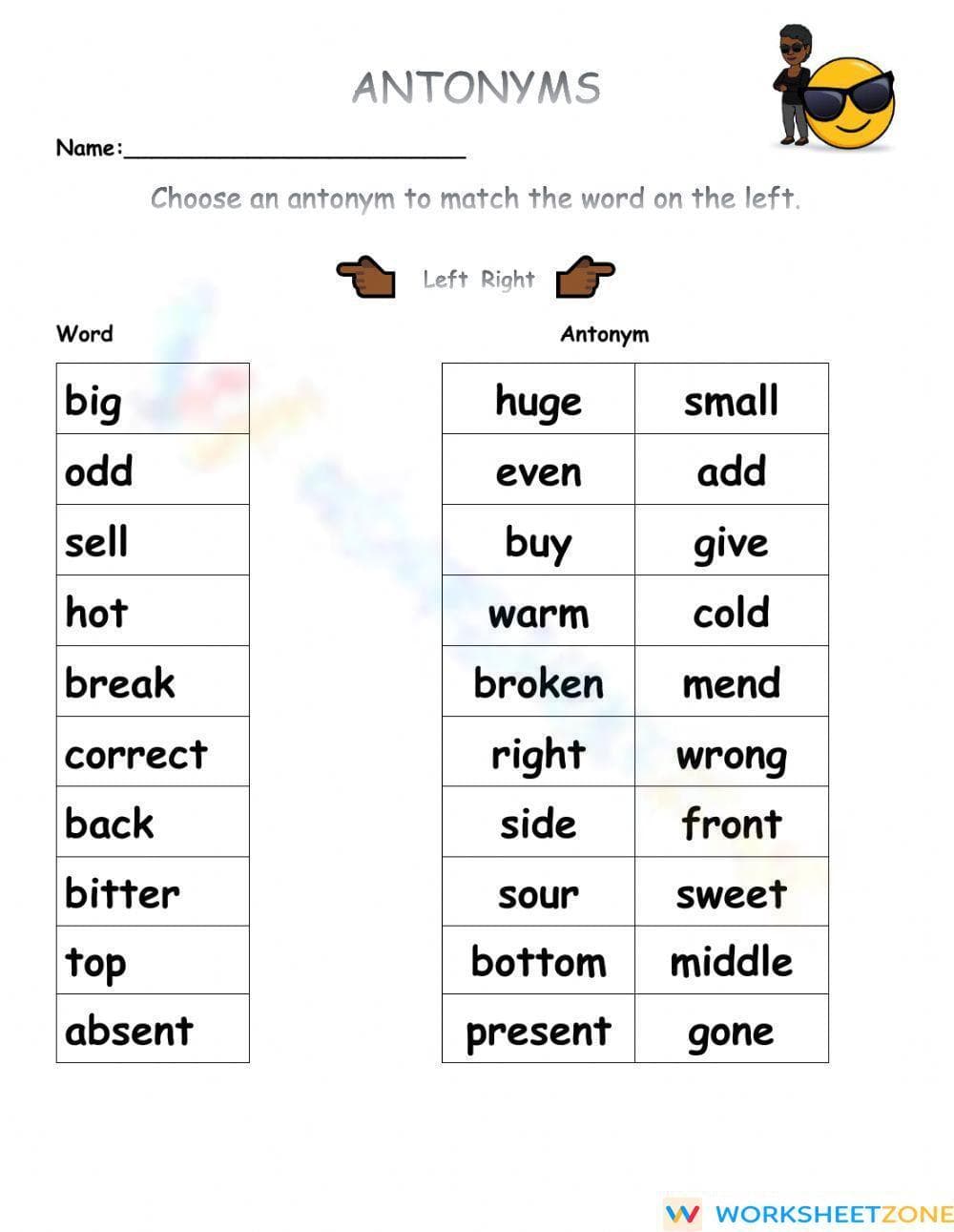
Strengthen your student's vocabulary with this focused antonyms practice sheet. This resource requires learners to identify and match opposite meanings for ten common adjectives and verbs, building the linguistic foundations necessary for precise writing and reading comprehension. By distinguishing between words like "bitter" and "sweet," students develop a deeper nuance for language.
At a Glance
- Grade: Grade 4 · Subject: English Language Arts
- Standard:
CCSS.ELA-LITERACY.L.4.5.C— Relate words to their opposites (antonyms) to demonstrate understanding- Skill Focus: Antonym Identification
- Format: 1 page · 10 problems · Answer key included · PDF
- Best For: Vocabulary warm-up or bell ringer
- Time: 5–10 minutes
This clean, one-page PDF features two columns designed for a simple matching exercise. The left column presents ten target words, while the right column offers two potential options for each, challenging students to choose the correct antonym. Key vocabulary includes challenging terms like "absent," "bitter," and "odd," alongside high-frequency words. A comprehensive answer key is provided to facilitate rapid grading.
The zero-prep workflow for this resource is designed for maximum efficiency in the modern classroom. First, print the single-page document (30 seconds). Second, distribute the copies to students at the start of a vocabulary block (1 minute). Finally, use the included answer key for a quick whole-class review or individual check (1 minute). This structure makes it ideal for substitute plans or emergency morning work.
This worksheet is explicitly aligned with CCSS.ELA-LITERACY.L.4.5.C, which requires students to demonstrate understanding of words by relating them to their opposites. By engaging with these ten specific pairs, students move beyond simple word recognition toward semantic relationship mastery. This standard code can be copied directly into lesson plans, IEP goals, or district curriculum mapping tools.
Use this worksheet as a formative assessment after introducing the concept of opposites. It works effectively as an "Exit Ticket" to gauge student understanding before moving on to synonym study. Alternatively, use it during a small-group rotation; teachers can observe as students process the words, providing an opportunity to catch misconceptions about words like "mend" or "present" in real-time.
This resource is tailored for Grade 4 students but serves as an excellent review for Grade 3 or a scaffolded support for Grade 5 learners. It is particularly beneficial for English Language Learners (ELL) who need visual and structural cues to master vocabulary relationships. Pair this worksheet with a short descriptive passage where students must swap words for their antonyms to see the impact on meaning.
Effective vocabulary instruction requires multiple exposures to word relationships, a principle emphasized in the RAND AIRS 2024 framework for literacy excellence. This antonyms worksheet provides a structured environment for students to interact with CCSS.ELA-LITERACY.L.4.5.C through ten targeted matching tasks. Research from Fisher & Frey (2014) suggests that explicit practice with word opposites, or antonyms, significantly enhances semantic mapping and lexical retrieval speeds in elementary learners. By identifying the correct match from a set of distractors, students utilize critical thinking to eliminate incorrect associations and solidify their understanding of word meanings. This specific PDF resource is designed to reduce cognitive load by focusing purely on the matching mechanic, allowing students to dedicate their mental energy to the vocabulary itself. This evidence-based approach ensures that learners build the precise vocabulary needed for the complex informational texts they will encounter in higher grade levels.


