


























Views
Downloads

Essential Who Questions Worksheet | Kindergarten ELA Ready
Paste this activity's link or code into your existing LMS (Google Classroom, Canvas, Teams, Schoology, Moodle, etc.).
Students can open and work on the activity right away, with no student login required.
You'll still be able to track student progress and results from your teacher account.
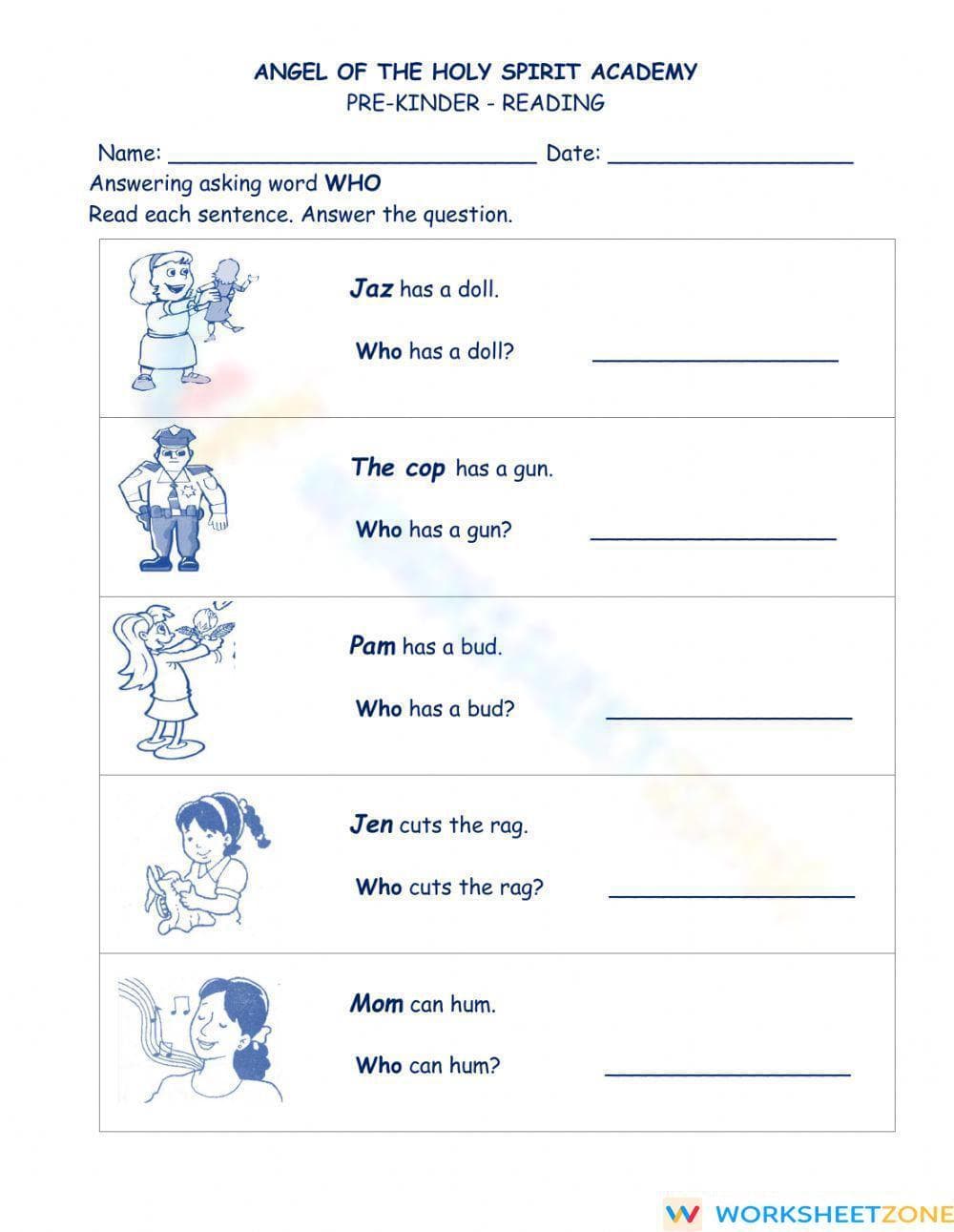
This printable reading comprehension worksheet helps Kindergarten students master the fundamental skill of identifying subjects by answering "who" questions. By connecting simple sentences with visual cues and direct inquiries, students build the essential literacy foundation required for more complex text analysis. It serves as a perfect introduction to identifying key details within short, accessible narratives.
At a Glance
- Grade: Kindergarten · Subject: ELA
- Standard:
CCSS.ELA-LITERACY.RL.K.1— Ask and answer questions about key details in a text- Skill Focus: Answering "Who" Questions
- Format: 1 page · 5 problems · Answer key included · PDF
- Best For: Small group reading or independent centers
- Time: 10–15 minutes
The worksheet features five distinct sections, each with a clear illustration, a short sentence, and a comprehension question. This single-page resource includes five reading tasks designed for a single session. The layout provides enough space for student answers, while the illustrations offer a visual scaffold for early readers. An answer key is included for rapid grading by teachers or parents.
This resource is built for efficiency in any instructional setting. First, print the single-page PDF (30 seconds). Next, distribute it during your literacy block or as morning work (1 minute). Finally, review the answers as a class using the provided key (1 minute). This workflow requires under three minutes of total teacher prep time, making it perfect for sub plans.
Standards Alignment
The primary focus is `CCSS.ELA-LITERACY.RL.K.1`, which requires students to "With prompting and support, ask and answer questions about key details in a text." This worksheet specifically addresses the answering component by providing direct questions linked to specific text evidence. This resource also supports Grade 1 transition via `CCSS.ELA-LITERACY.RL.1.1`. Both standard codes can be copied directly into lesson plans, IEP goals, or district curriculum mapping tools.
How to Use It
Use this worksheet during the guided practice phase of your reading lesson after modeling how to find the subject of a sentence. It works exceptionally well as a formative assessment; observe if students are looking back at the sentence or relying solely on the pictures to determine the answer. Expected completion time ranges from 10 to 15 minutes depending on the individual student's writing speed and reading level.
Who It's For
This resource is designed for Kindergarten and Grade 1 students, as well as English Language Learners (ELL) who are developing basic sentence structure comprehension. It pairs naturally with short CVC word passages or anchor charts that define the "5 Ws" of reading. The high-contrast illustrations also support students with visual processing needs.
Research indicates that explicit instruction in questioning strategies significantly improves reading comprehension for early learners. This worksheet aligns with the Fisher & Frey (2014) gradual release of responsibility model, providing a bridge between teacher modeling and independent application of the CCSS.ELA-LITERACY.RL.K.1 standard. By focusing on the plain-English skill of identifying who is performing an action, students internalize the mechanics of literal comprehension. According to the RAND AIRS 2024 report on elementary literacy, structured practice with "Who" questions in the early grades is a strong predictor of later success in identifying main ideas and summarizing informational texts. This self-contained module ensures that students move beyond word recognition into active meaning-making, providing a quantifiable task count of five successful comprehension events that can be used to track individual progress toward mastery of foundational reading standards in any educational setting.


