




























Views
Downloads
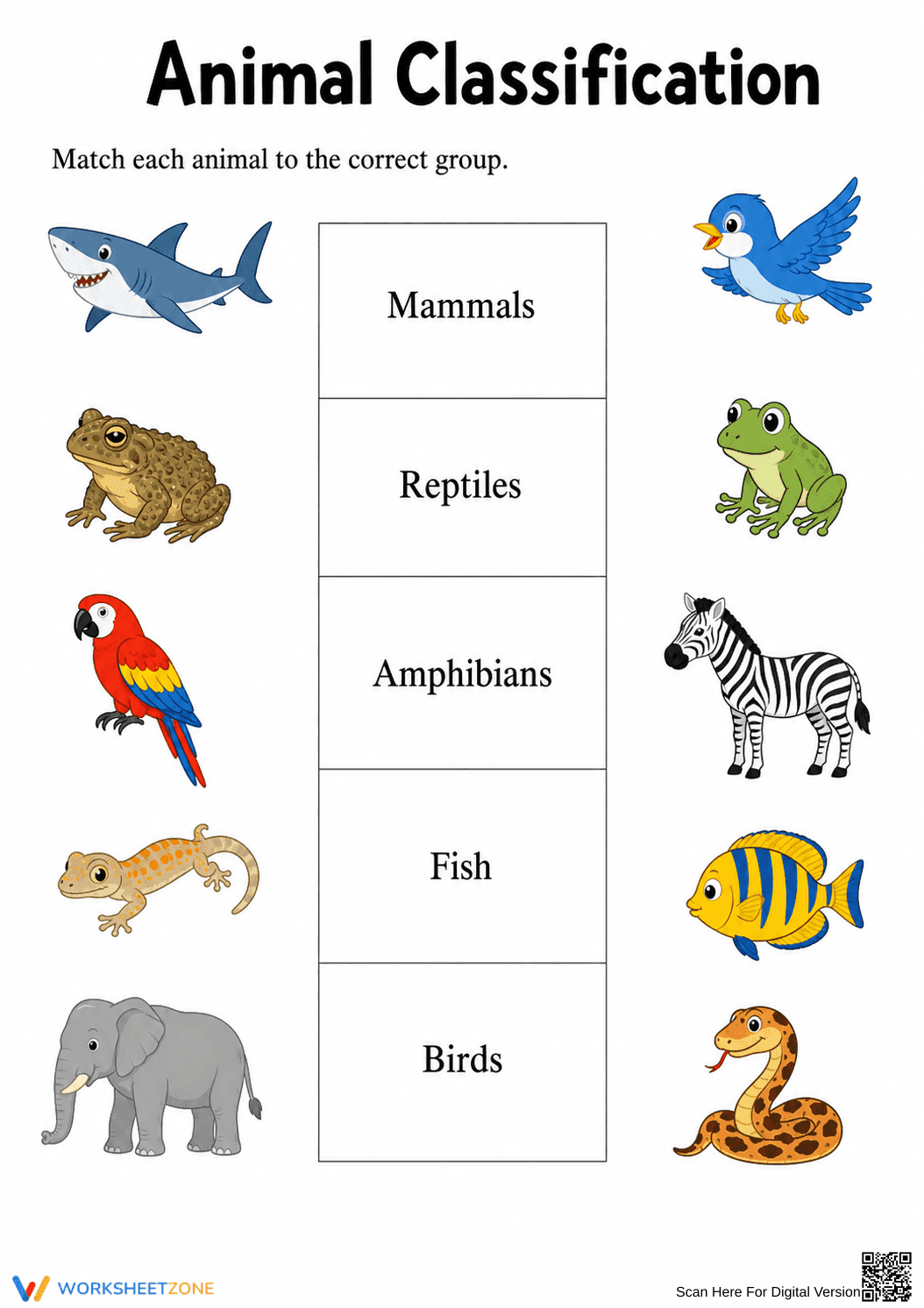

Grade 5 Animal Classification — Printable No-Prep Worksheet

Paste this activity's link or code into your existing LMS (Google Classroom, Canvas, Teams, Schoology, Moodle, etc.).
Students can open and work on the activity right away, with no student login required.
You'll still be able to track student progress and results from your teacher account.
This animal classification worksheet provides a visual matching activity where students identify the biological group for ten different species. By connecting images of sharks, elephants, and parrots to their scientific categories, learners reinforce their understanding of vertebrate traits and physical characteristics to achieve mastery.
At a Glance
- Grade: 5 · Subject: Science
- Standard:
3-LS4-2— Use physical characteristics to classify organisms into biological groups.- Skill Focus: Animal Classification
- Format: 1 page · 10 problems · Answer key included · PDF
- Best For: Quick review or formative assessment
- Time: 10–15 minutes
The worksheet features a clean, two-column layout with 10 high-quality animal illustrations and five central category boxes: Mammals, Reptiles, Amphibians, Fish, and Birds. Students draw lines to match each animal to its correct group. The single-page PDF format ensures easy printing, and the visual nature of the tasks supports diverse learners, including English Language Learners and students needing visual scaffolds. A complete answer key is included for accurate grading.
This resource is designed for a zero-prep workflow. Print: Select the single-page PDF and print enough copies for your class (30 seconds). Distribute: Hand out the sheets as a bell-ringer, exit ticket, or homework assignment (30 seconds). Review: Use the included answer key for immediate whole-class feedback or peer grading (1 minute). Total teacher prep time is under 2 minutes, making it an ideal sub plan addition.
Aligned to 3-LS4-2, this activity requires students to observe animal traits to determine classification. While the standard focuses on advantages, classification is the prerequisite skill for identifying trait variations. This also supports K-LS1-1 for younger learners exploring life cycles. Both standard codes can be copied directly into lesson plans, IEP goals, or district curriculum mapping tools.
Use this worksheet during the Explain phase of a 5E lesson model to check for understanding after introducing vertebrate groups. It also serves as an excellent independent practice activity following direct instruction. As a formative assessment observation tip: watch for students who struggle to distinguish between amphibians and reptiles, as this indicates a need for targeted instruction on skin texture and life cycles. The expected completion time is 10 to 15 minutes.
This resource is ideal for Grade 5 students needing a refresher on biological categories or younger students in Kindergarten exploring life sciences. It pairs naturally with an anchor chart showing the five vertebrate groups or a short video clip demonstrating animal movements and habitats. The clear imagery ensures that reading level does not become a barrier to scientific reasoning.
According to the Fisher & Frey (2014) framework for gradual release of responsibility, visual matching tasks like this animal classification worksheet serve as vital check-for-understanding points that bridge direct instruction and independent application. By requiring students to categorize ten distinct animals, the activity reinforces the 3-LS4-2 standard regarding physical traits and biological grouping. Students use physical characteristics to classify organisms into biological groups effectively. Research from the NAEP indicates that early mastery of classification systems predicts higher achievement in complex life science topics in middle school. This worksheet provides the structured practice necessary for students to internalize the defining characteristics of mammals, birds, fish, reptiles, and amphibians. Educators can reliably use this tool to gather data on student mastery of basic biological taxonomy, ensuring that all learners meet the foundational requirements for science curriculum goals.


