


























Views
Downloads

Printable Animal Homes Worksheet | Grade 2 Science
Paste this activity's link or code into your existing LMS (Google Classroom, Canvas, Teams, Schoology, Moodle, etc.).
Students can open and work on the activity right away, with no student login required.
You'll still be able to track student progress and results from your teacher account.
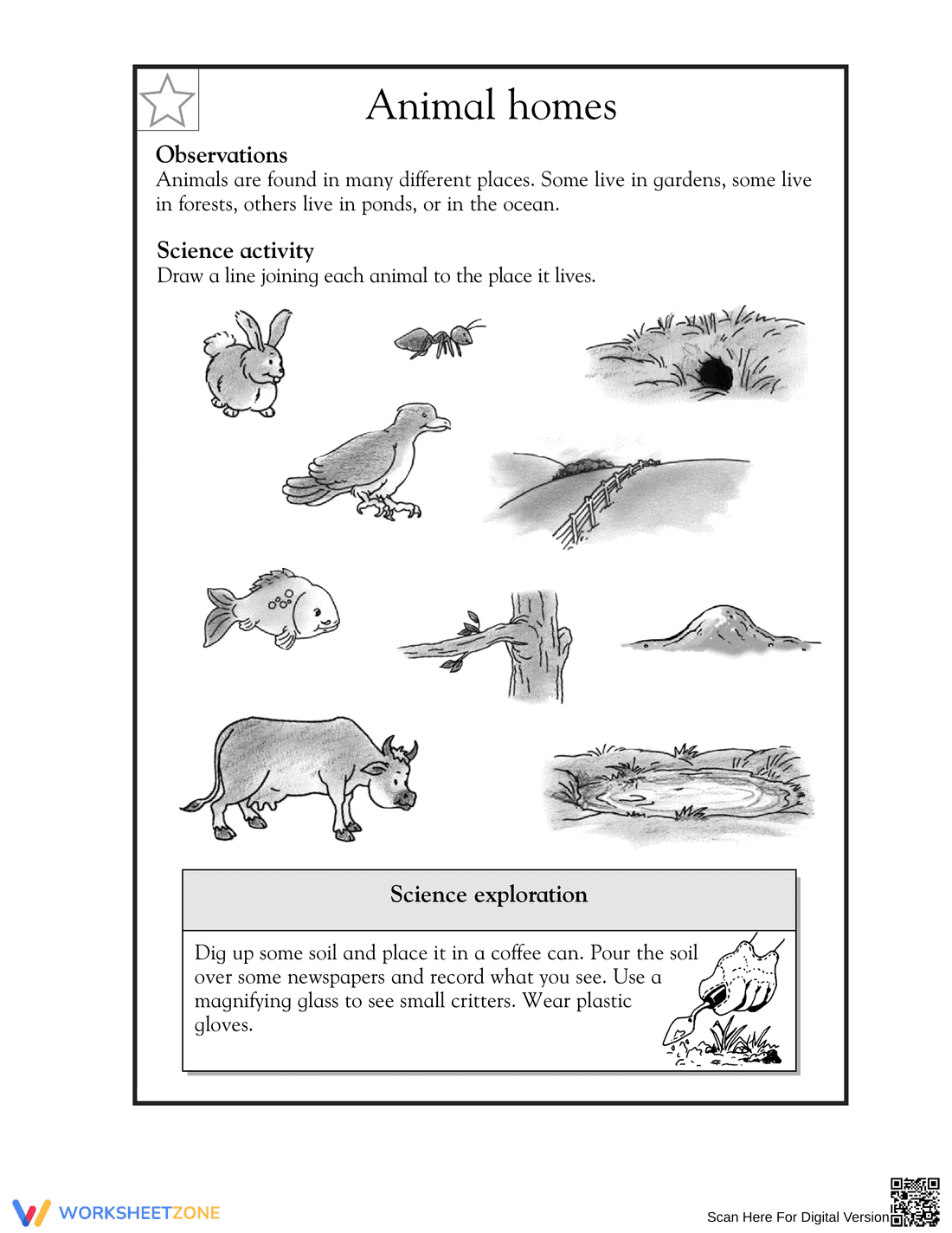
This Grade 2 science worksheet helps students identify where different creatures live by matching animals to their natural habitats. By connecting familiar animals like rabbits and fish to their specific environments, young learners build foundational knowledge of biodiversity and ecosystem dependence before moving on to complex life science concepts.
At a Glance
- Grade: 2 · Subject: Science
- Standard:
2-LS4-1— Observe animals to compare diversity in different habitats- Skill Focus: Matching animals to habitats
- Format: 1 page · 6 problems · Answer key included · PDF
- Best For: Independent practice or science centers
- Time: 15–20 minutes
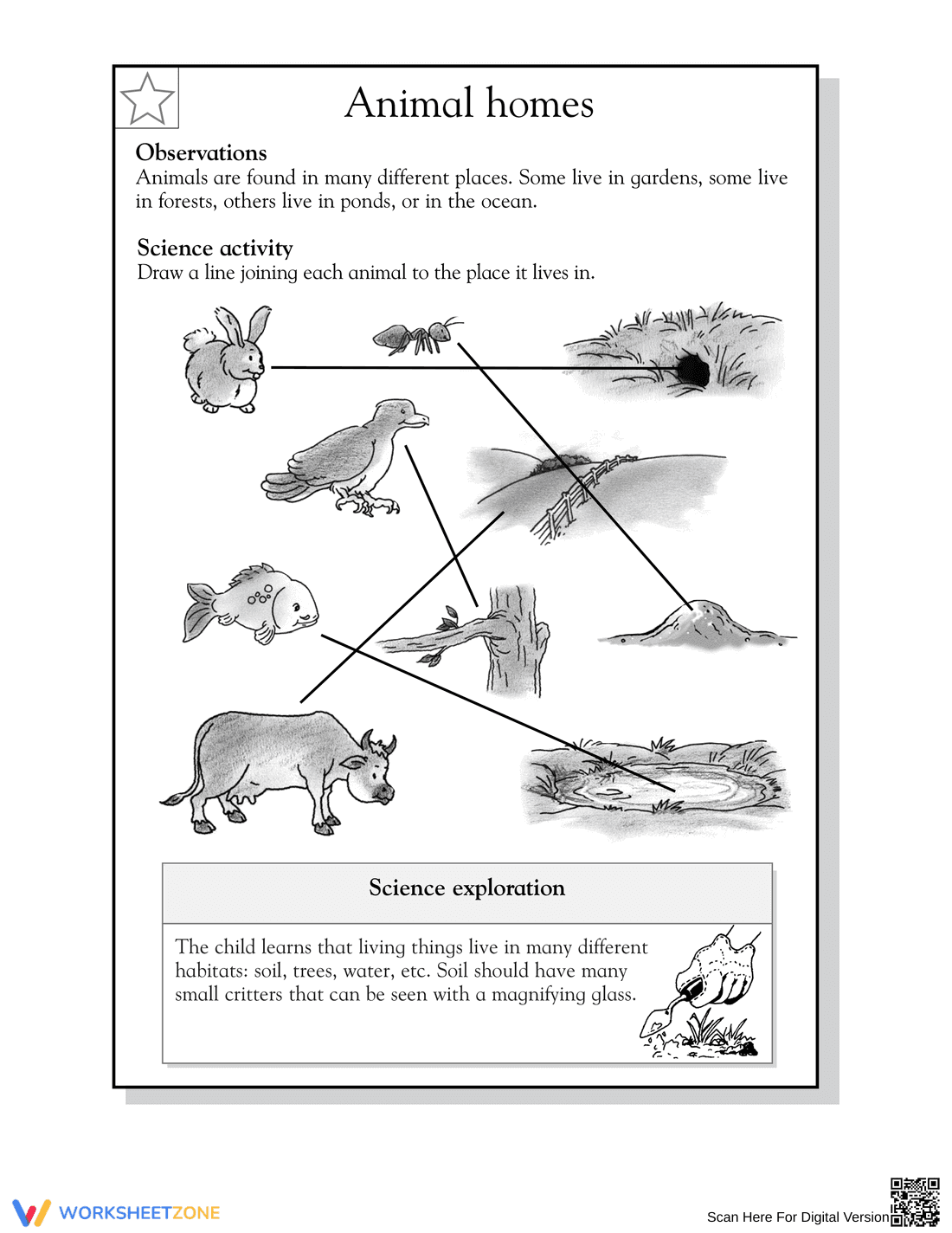
This single-page resource features a clear layout for early elementary students. It includes a brief observation text, followed by five visual matching tasks where students connect animals to their homes, like a bird to a tree. Additionally, it provides a hands-on "Science exploration" extension activity, prompting students to examine soil samples for small critters, bridging paper-based learning with real-world observation.
This resource requires minimal teacher preparation.
- Print (1 minute): The black-and-white illustrations are optimized for quick, ink-saving photocopying.
- Distribute (1 minute): Hand out the single page along with pencils; no scissors or glue required.
- Review (3 minutes): Quickly check the five matching lines as a whole class or collect for rapid grading.
With a total teacher prep time of under two minutes, this worksheet is an excellent addition to emergency sub plans or last-minute science center rotations.
This activity is aligned to the Next Generation Science Standards, specifically focusing on 2-LS4-1: Make observations of plants and animals to compare the diversity of life in different habitats. By identifying where specific animals thrive, students begin to understand how different environments support varying types of life. Both standard codes can be copied directly into lesson plans, IEP goals, or district curriculum mapping tools.
Use this worksheet during the core instruction phase of a life science unit. Introduce habitats using a read-aloud, then transition to this matching activity for independent practice. Alternatively, use it as a formative assessment; observe students as they draw lines to gauge their understanding of animal environments. The hands-on soil exploration task can be assigned as a guided outdoor lesson. Expected completion time is 15 to 20 minutes.
This resource is primarily designed for second-grade general education students, though it serves as an excellent review for third graders or a supported activity for advanced first graders. The heavy reliance on visual cues makes it highly accessible for English Language Learners and students requiring reading accommodations. For a comprehensive lesson, pair this worksheet with a vibrant anchor chart displaying various global biomes or a non-fiction picture book about animal adaptations.
Understanding the relationship between organisms and their environments is a critical stepping stone in early science education. When students engage with materials aligned to 2-LS4-1, they practice how to observe animals to compare diversity in different habitats. According to a recent ScienceDirect TpT Analysis, integrating visual matching tasks with hands-on exploration significantly increases knowledge retention in primary grade science learners. By physically drawing connections between an animal and its home, children solidify their conceptual understanding of ecosystem dependence. Furthermore, providing immediate, real-world extension activities—like the soil observation task included in this resource—encourages scientific curiosity and inquiry-based thinking outside the traditional classroom setting. This dual approach of structured paper-based practice and active environmental observation ensures that foundational life science concepts are both accessible and memorable for young students.


