


























Views
Downloads


Animal Action Words Tracing Sheet | Essential Grade 2 Ready
Paste this activity's link or code into your existing LMS (Google Classroom, Canvas, Teams, Schoology, Moodle, etc.).
Students can open and work on the activity right away, with no student login required.
You'll still be able to track student progress and results from your teacher account.
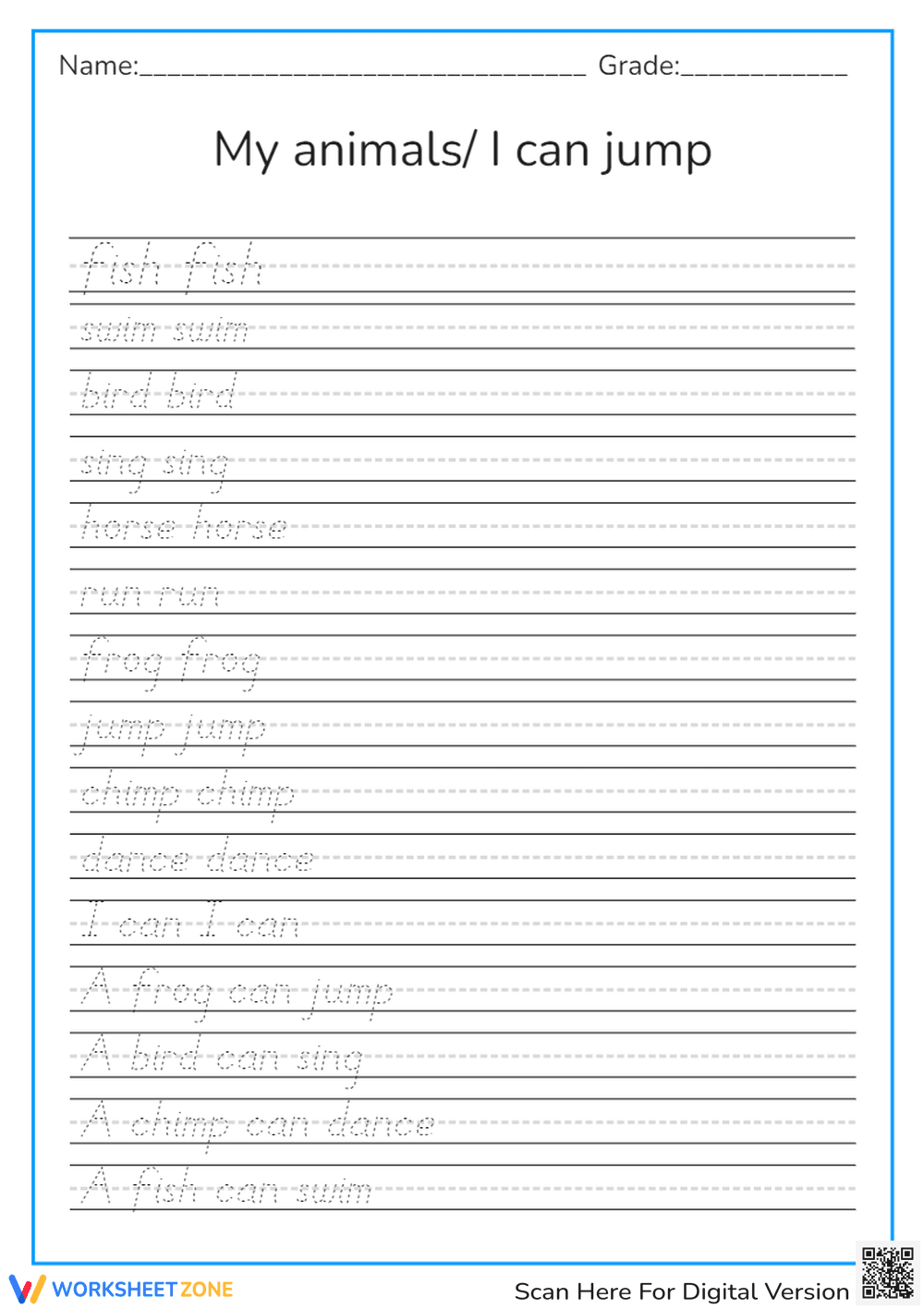
This Grade 2 handwriting worksheet helps students master fine motor control while learning essential animal vocabulary and action verbs. By tracing specific words and complete sentences, learners bridge the gap between letter formation and meaningful composition. It provides a structured environment for students to practice neatness and letter spacing through repetitive, guided motion.
At a Glance
- Grade: 2 · Subject: Handwriting
- Standard:
CCSS.ELA-LITERACY.L.2.1— Demonstrate command of the conventions of standard English grammar and usage when writing- Skill Focus: Animal action words and sentence tracing
- Format: 2 pages · 26 problems · Answer key included · PDF
- Best For: Morning work or independent handwriting practice
- Time: 15–20 minutes
What's Inside: This two-page PDF features 26 distinct tracing tasks. The first page focuses on word-to-sentence progression, including phrases like "A frog can jump" and "A fish can swim." The second page offers larger-format tracing for individual animal names and actions, such as "chimp" and "dance." Each line includes dotted-line guides to ensure proper letter height and alignment.
Zero-Prep Workflow: This resource is designed for immediate classroom implementation. First, print the two-page PDF (30 seconds). Next, distribute the sheets to students for independent work during literacy centers or as a quiet transition activity (1 minute). Finally, review the completed sheets for letter formation accuracy and line adherence (30 seconds). Total teacher preparation time is under two minutes, making it an ideal sub-plan component.
Standards Alignment: The primary focus is `CCSS.ELA-LITERACY.L.2.1`, which requires students to demonstrate command of the conventions of standard English grammar and usage when writing. By tracing complete sentences, students internalize capitalization and punctuation rules. Both standard codes can be copied directly into lesson plans, IEP goals, or district curriculum mapping tools.
How to Use It: Use this worksheet during the independent practice phase of a handwriting lesson. It is particularly effective after a direct instruction session on lowercase and uppercase letter relationships. Teachers can use the "A frog can jump" section as a formative assessment to observe if students maintain consistent spacing between words. Expect completion in 15 to 20 minutes.
Who It's For: This resource is tailored for Grade 2 and Grade 3 students who need additional support with legibility and fine motor endurance. It serves as an excellent differentiation tool for English Language Learners (ELLs) who are building basic verb-noun associations. Pair this worksheet with an animal-themed anchor chart or a short reading passage about animal movements.
According to the RAND AIRS 2024 report on foundational literacy, repetitive tracing exercises are vital for developing the muscle memory required for fluent, legible handwriting in early elementary grades. This worksheet targets CCSS.ELA-LITERACY.L.2.1 by integrating vocabulary acquisition with physical writing practice. Research from Fisher & Frey (2014) emphasizes that scaffolded writing tasks, such as tracing animal action words, allow students to focus on the mechanics of letter formation without the cognitive load of original composition. By practicing sentences like "A bird can sing," students reinforce their understanding of subject-verb agreement and sentence structure. This 26-task resource provides the necessary volume of practice to move students toward handwriting automaticity. Consistent use of such structured materials is linked to improved writing stamina and better performance on standardized assessments that require written responses, ensuring students meet grade-level expectations for neatness and grammatical convention.


