


























Views
Plays

Ancient Indus Valley Quiz | Essential Grade 6-8 History
Paste this activity's link or code into your existing LMS (Google Classroom, Canvas, Teams, Schoology, Moodle, etc.).
Students can open and work on the activity right away, with no student login required.
You'll still be able to track student progress and results from your teacher account.
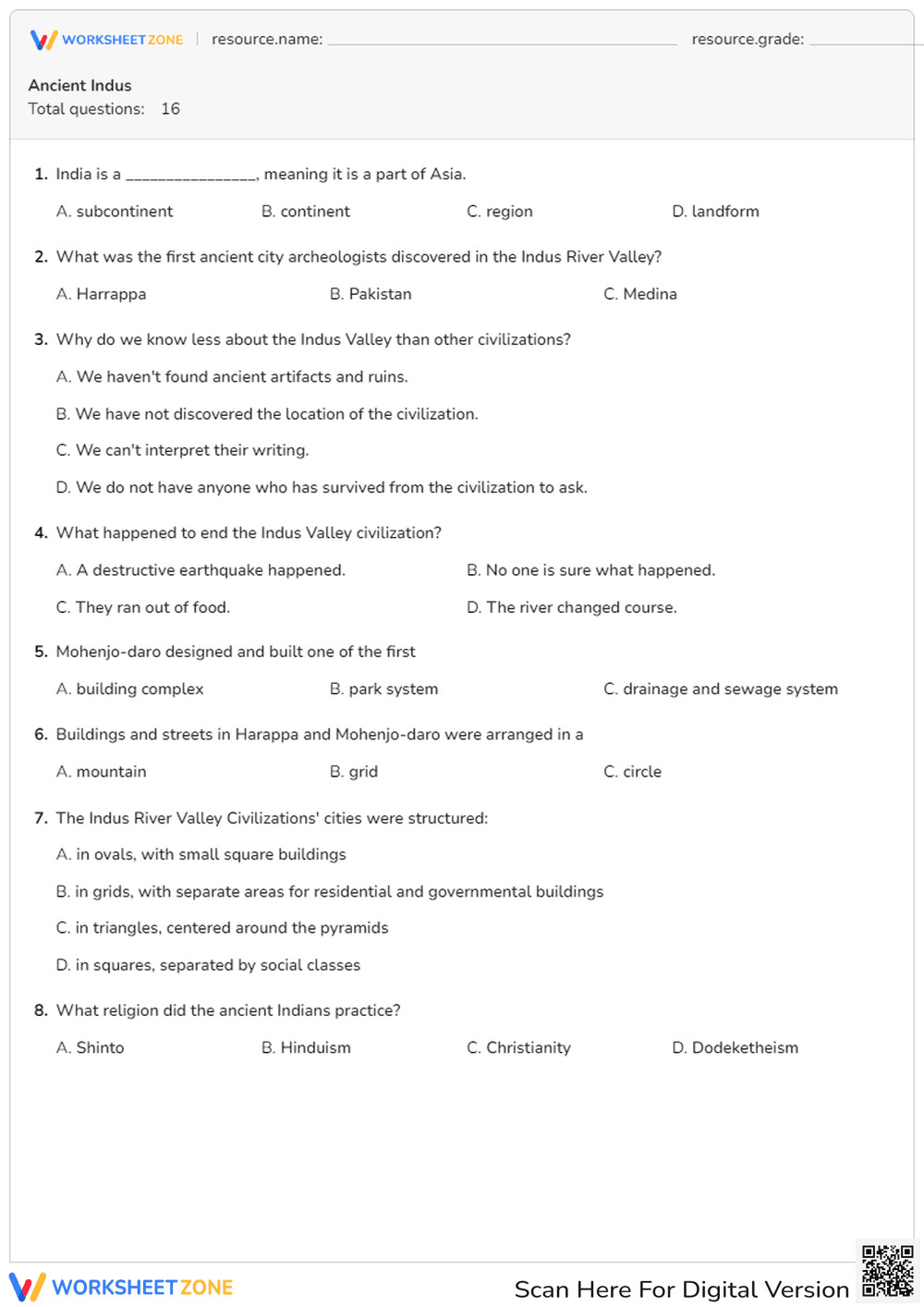
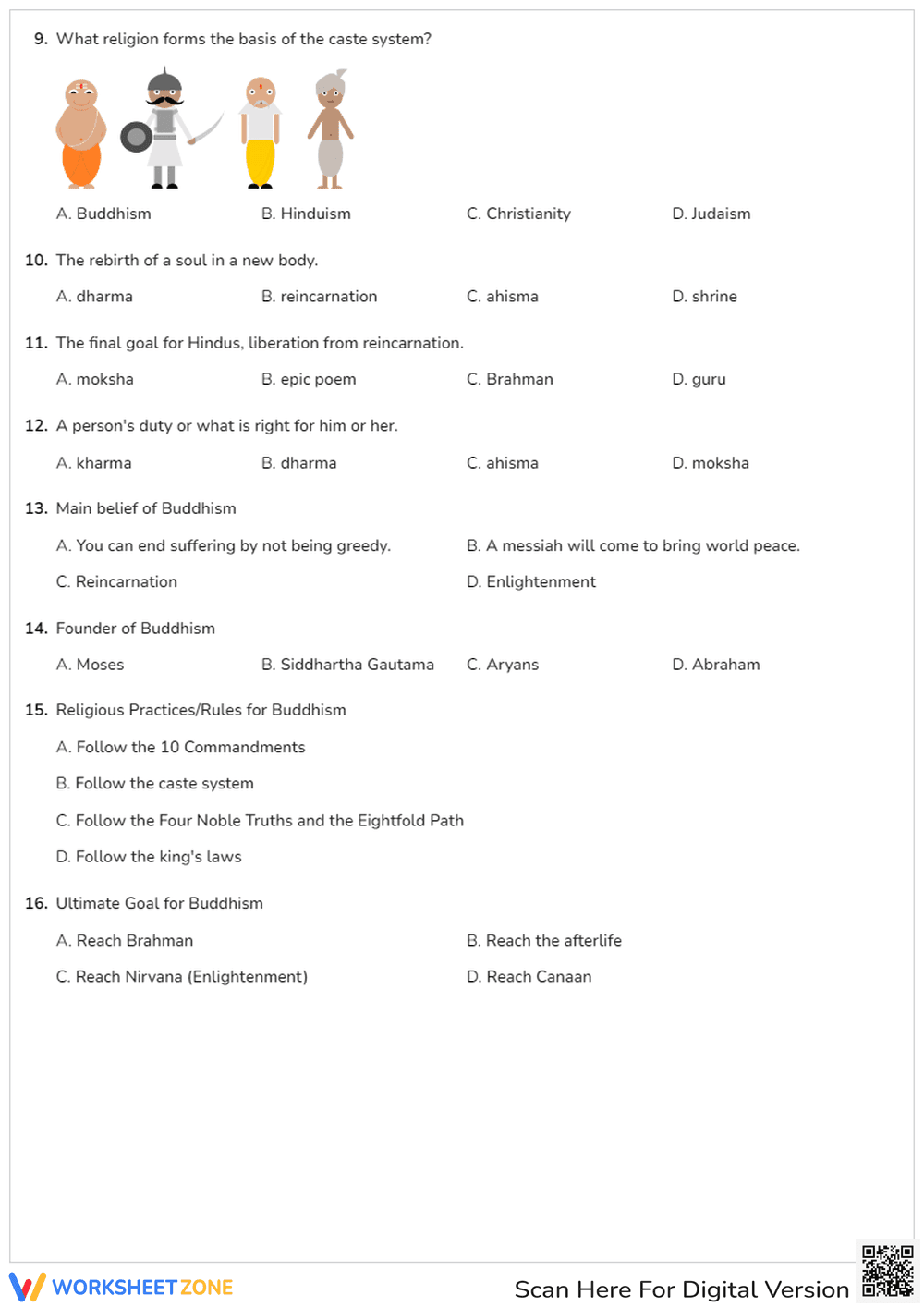
This comprehensive Ancient Indus Valley worksheet provides middle school students with a structured assessment of early South Asian civilizations. Students will demonstrate their understanding of geographic features, urban planning innovations in Harappa and Mohenjo-daro, and the foundational principles of Hinduism and Buddhism. It serves as a high-impact tool for verifying content mastery in world history units.
At a Glance
- Grade: 6-8 · Subject: Social Studies
- Standard:
CCSS.ELA-LITERACY.RH.6-8.4— Determine the meaning of domain-specific symbols and key history vocabulary- Skill Focus: Ancient Civilizations & World Religions
- Format: 2 pages · 16 problems · Answer key included · PDF
- Best For: End-of-unit summative assessment or review
- Time: 20–30 minutes
What's Inside: This two-page PDF features 16 carefully crafted multiple-choice questions. The first half of the assessment focuses on the physical geography of the Indian subcontinent and the architectural achievements of the Indus River Valley, such as grid-based city planning and advanced drainage systems. The second half transitions into cultural literacy, requiring students to define complex religious concepts including dharma, moksha, and the Four Noble Truths.
Zero-Prep Workflow: This resource is designed for immediate classroom implementation with three simple steps. First, print the two-page document for your class (approx. 1 minute). Second, distribute the assessment as a quiet, independent activity to gauge individual student progress (approx. 20 minutes). Third, use the included answer key to provide immediate feedback or facilitate a peer-grading session to reinforce correct concepts (approx. 5 minutes). This streamlined process makes it an ideal choice for emergency sub plans or busy grading periods.
Standards Alignment: This worksheet is primarily aligned to `CCSS.ELA-LITERACY.RH.6-8.4`, focusing on the acquisition of domain-specific vocabulary such as "subcontinent," "reincarnation," and "caste system." It also supports regional social studies standards regarding the development of early river valley civilizations and their lasting cultural impacts. Both standard codes can be copied directly into lesson plans, IEP goals, or district curriculum mapping tools.
How to Use It: Deploy this worksheet as a formative assessment midway through a unit on Ancient India to identify misconceptions about the transition from the Indus Valley period to the rise of major religions. Alternatively, use it as a pre-test to determine prior knowledge before starting a new chapter. Teachers should observe student responses to questions 5 and 7 specifically, as these indicate a deeper understanding of how physical infrastructure reflects societal organization. Expected completion time ranges from 20 to 30 minutes depending on reading speed.
Who It's For: This resource is tailored for students in Grades 6, 7, and 8 enrolled in World History or Ancient Civilizations courses. It is particularly effective for general education classrooms requiring clear, accessible language and for English Language Learners who benefit from the focused vocabulary practice. It pairs naturally with a primary source reading on the Buddha or a map-labeling activity of the Indus River system.
The use of structured multiple-choice assessments in history education is supported by Fisher & Frey (2014), who emphasize that checking for understanding through domain-specific vocabulary is critical for building disciplinary literacy. By isolating 16 key concepts ranging from the grid systems of Mohenjo-daro to the ultimate goals of Buddhism, this worksheet ensures that students possess the foundational schema necessary for higher-order historical analysis. Research from the NAEP indicates that students who can successfully categorize the social and religious structures of ancient societies are significantly better prepared for high school level comparative history. This assessment provides the necessary data points for teachers to adjust instruction, ensuring that no student falls behind in their understanding of the `CCSS.ELA-LITERACY.RH.6-8.4` requirements. It offers a reliable, research-backed method for documenting student growth in social studies.


