


























Views
Plays


Scientific Revolution Quiz | Grade 6-8 Essential
Paste this activity's link or code into your existing LMS (Google Classroom, Canvas, Teams, Schoology, Moodle, etc.).
Students can open and work on the activity right away, with no student login required.
You'll still be able to track student progress and results from your teacher account.
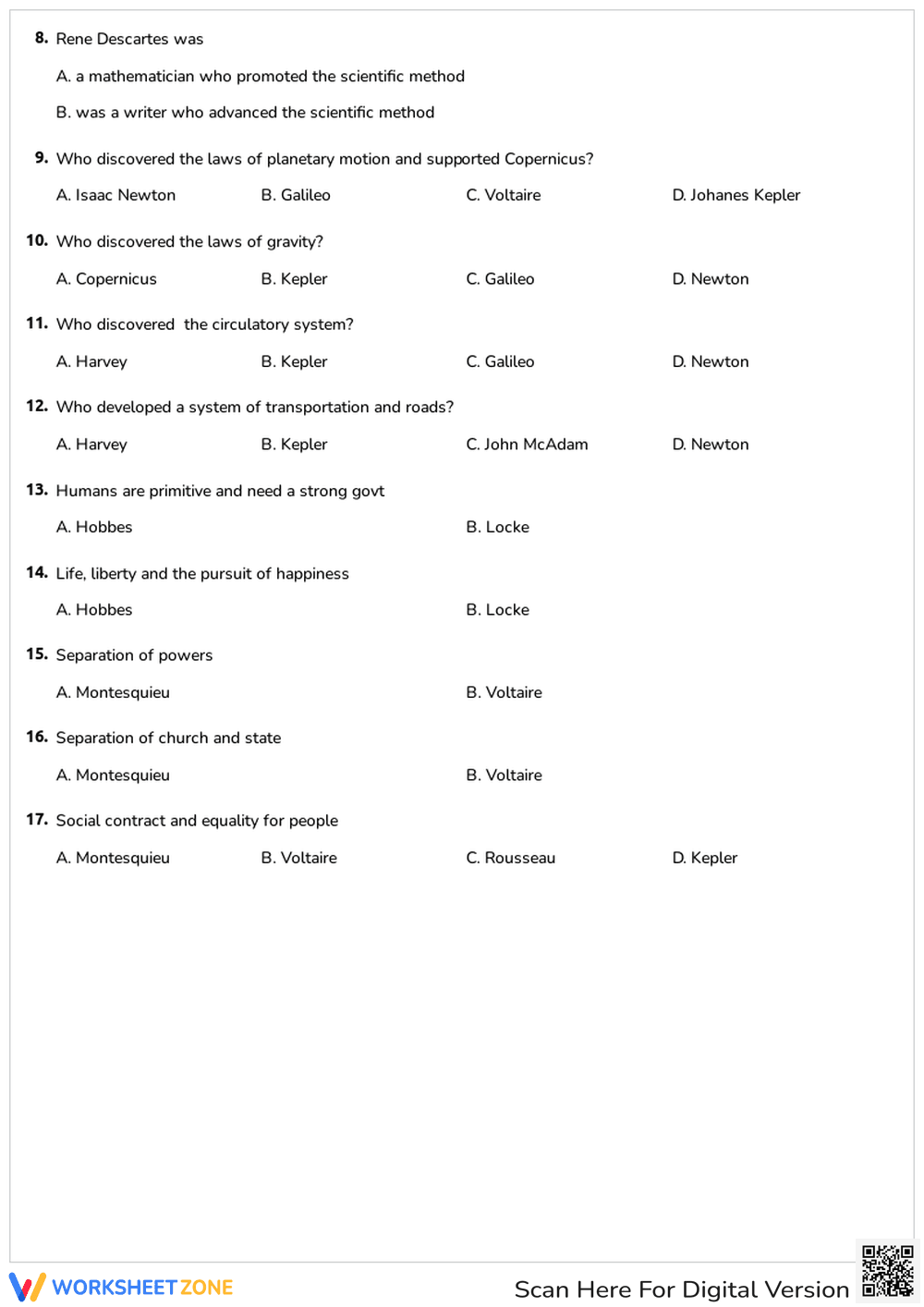
This Grade 6-8 science worksheet assesses student understanding of the Scientific Revolution and Enlightenment. Students identify key figures like Newton and Copernicus while distinguishing between geocentric and heliocentric models. It provides a clear evaluation of historical scientific progress and the development of the scientific method through structured multiple-choice questions.
At a Glance
- Grade: 6-8 · Subject: Science
- Standard:
MS-ESS1-2— Explain the role of gravity in the motions within galaxies and the solar system- Skill Focus: Scientific Revolution & Enlightenment
- Format: 2 pages · 17 problems · Answer key included · PDF
- Best For: Summative assessment or unit review
- Time: 20–30 minutes
The resource consists of a two-page PDF featuring 17 multiple-choice questions. It covers the scientific method, planetary motion, gravity, and Enlightenment philosophy. The layout is clean and professional, providing students with clear options to demonstrate their knowledge of historical scientific breakthroughs and the thinkers who led them, including Locke and Montesquieu.
Skill Progression
- Guided practice: The assessment begins with foundational definitions of the scientific method and basic theories to establish a baseline.
- Supported practice: It then moves into identifying specific contributions of astronomers and physicists like Galileo and Kepler using 10 targeted items.
- Independent practice: Finally, it challenges students to connect scientific reasoning to Enlightenment social theories, ensuring a comprehensive check for understanding.
This structure follows a gradual-release approach to ensure students can recall facts before applying them to broader historical contexts.
Standards Alignment
This worksheet aligns with `MS-ESS1-2`, which requires students to develop and use a model to describe the role of gravity in the motions within galaxies and the solar system. By identifying the work of Newton and Kepler, students ground their physical science knowledge in historical context. Both standard codes can be copied directly into lesson plans, IEP goals, or district curriculum mapping tools.
How to Use It
Use this as a summative quiz after completing a unit on the history of science or the solar system. It also serves as an excellent pre-assessment to gauge prior knowledge before introducing the laws of motion. Teachers should observe if students struggle with the distinction between geocentric and heliocentric models to target future remediation. Completion typically takes 20 to 30 minutes.
Who It's For
This resource is designed for middle school science students in grades 6 through 8. It is particularly useful for general education classrooms, though the multiple-choice format provides built-in support for English Language Learners. Pair this quiz with a primary source reading from Galileo or a direct instruction lesson on the Enlightenment.
According to the RAND AIRS 2024 report, structured assessments that link historical context to scientific principles significantly improve long-term retention of complex concepts like the laws of motion. This worksheet targets MS-ESS1-2 by requiring students to identify the foundational discoveries of gravity and planetary motion. By evaluating 17 specific points of knowledge, educators can pinpoint exactly where students lack clarity regarding the transition from geocentric to heliocentric models. Research from Fisher & Frey (2014) suggests that multiple-choice assessments, when used as part of a gradual release of responsibility, allow students to demonstrate mastery of academic vocabulary before moving to open-ended inquiry. This PDF provides a reliable, printable tool for measuring student progress in middle school science and history of science curricula.


