


























Views
Downloads


Essential Alphabetical Order Worksheet | Grades 1-3
Paste this activity's link or code into your existing LMS (Google Classroom, Canvas, Teams, Schoology, Moodle, etc.).
Students can open and work on the activity right away, with no student login required.
You'll still be able to track student progress and results from your teacher account.
This Grade 1-3 alphabetical order worksheet helps students master the foundational skill of sequencing letters and words. By practicing with both individual letter strings and complex word lists, learners build the dictionary skills necessary for independent reading and writing. It provides a clear, structured path from simple letter recognition to advanced word sorting.
At a Glance
- Grade: 1-3 · Subject: ELA
- Standard:
CCSS.ELA-LITERACY.L.2.2.E— Use alphabetical order to consult reference materials and check spellings- Skill Focus: Alphabetical Sequencing
- Format: 3 pages · 22 problems · Answer key included · PDF
- Best For: Independent practice or literacy centers
- Time: 15–25 minutes
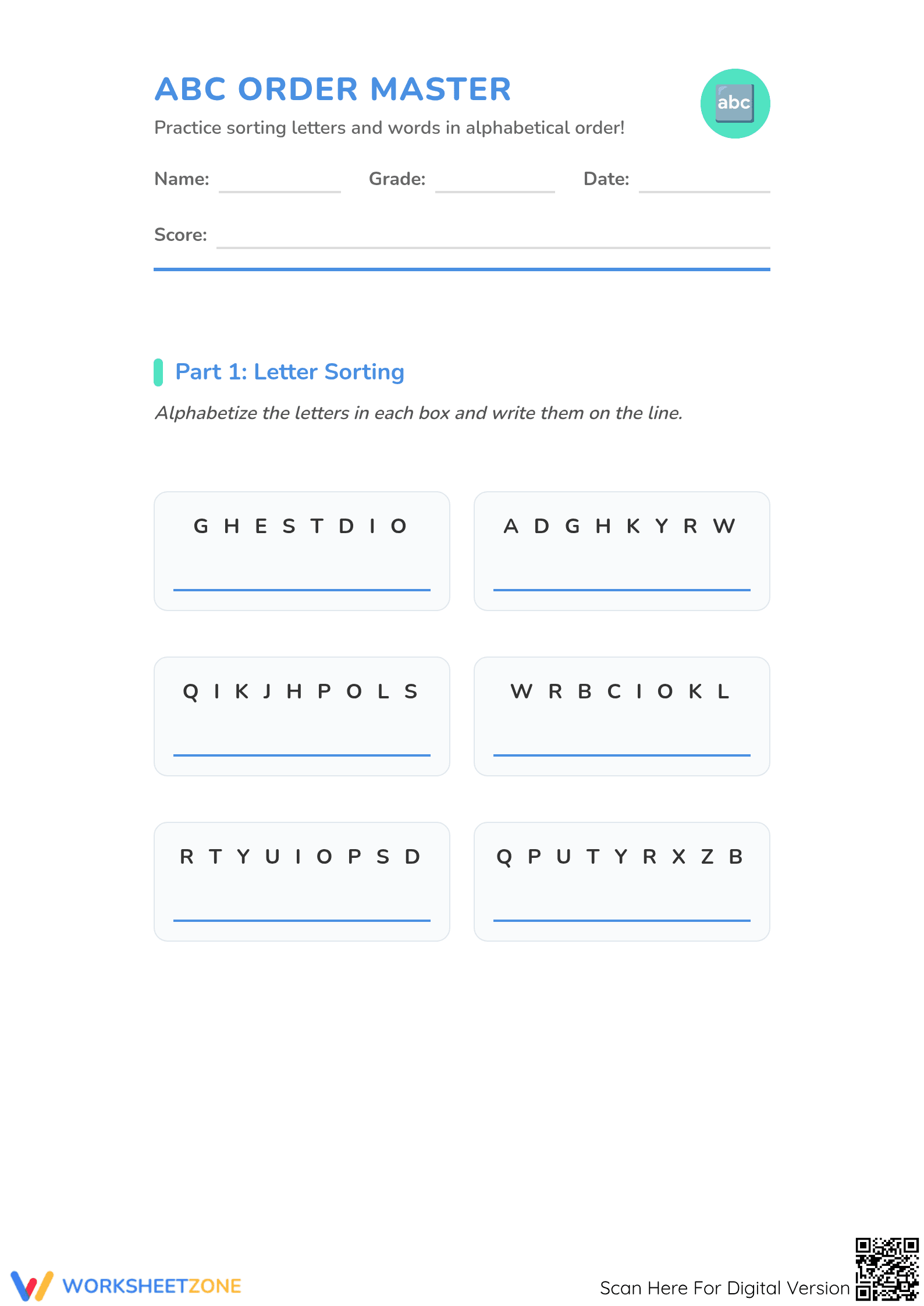
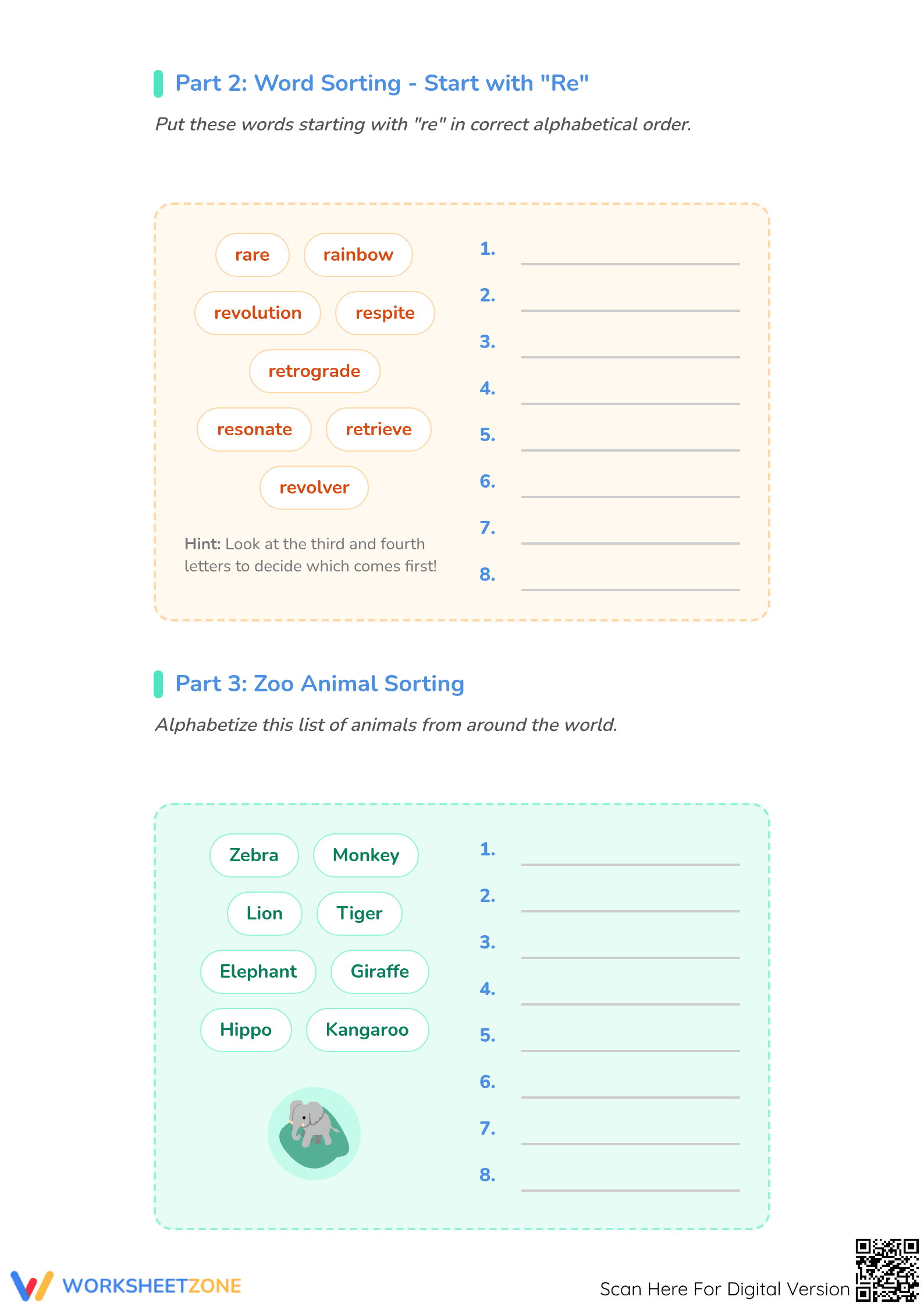
The resource contains three distinct sections across three pages. Part 1 focuses on letter-level sorting with six unique letter sets to help students visualize the sequence of the alphabet. Part 2 challenges students with eight words starting with the same prefix, requiring them to look at the third and fourth letters for correct placement. Part 3 features eight zoo animal names for general word sorting. A full answer key is provided for quick grading.
The zero-prep workflow is designed for busy educators. First, print the three-page PDF (30 seconds). Next, distribute the sheets to students for independent or small-group work (1 minute). Finally, use the included answer key to review student work or facilitate self-correction (1 minute). Total teacher preparation time is under two minutes, making this an ideal choice for sub plans or unexpected schedule changes.
This worksheet aligns with `CCSS.ELA-LITERACY.L.2.2.E`, which requires students to consult reference materials, including dictionaries, to check and correct spellings. It also supports `CCSS.ELA-LITERACY.L.3.2.G` regarding the use of reference tools. Both standard codes can be copied directly into lesson plans, IEP goals, or district curriculum mapping tools.
Use this as a formative assessment after introducing the concept of the "second letter rule" in alphabetizing. It works exceptionally well as a quiet morning work activity or a literacy center staple. Teachers should observe if students are physically reciting the alphabet or using a desk-strip reference while completing the 22 tasks to identify those who may need additional scaffolding. Expected completion time ranges from 15 to 25 minutes depending on the grade level.
This is ideal for first through third-grade students who are developing literacy independence. It is particularly helpful for English Language Learners (ELLs) building vocabulary through the zoo animal and "re-" word lists. Pair this with a classroom dictionary or an alphabet anchor chart for maximum support during the independent practice phase.
According to the RAND AIRS 2024 report, foundational literacy skills like alphabetical sequencing are critical precursors to effective information retrieval and dictionary usage in upper elementary grades. This worksheet provides the repetitive, structured practice necessary to move these skills from conscious effort to automaticity. By engaging with 22 specific sorting tasks, students reinforce their understanding of character hierarchy, which Fisher & Frey (2014) identify as a key component of word study and orthographic development. The inclusion of "re-" prefix words specifically targets the transition from simple first-letter sorting to the more complex multi-letter analysis required for academic success. This resource ensures that students meet the rigorous demands of CCSS.ELA-LITERACY.L.2.2.E through a gradual release of responsibility, moving from isolated letters to contextualized vocabulary lists.


