


























Views
Downloads
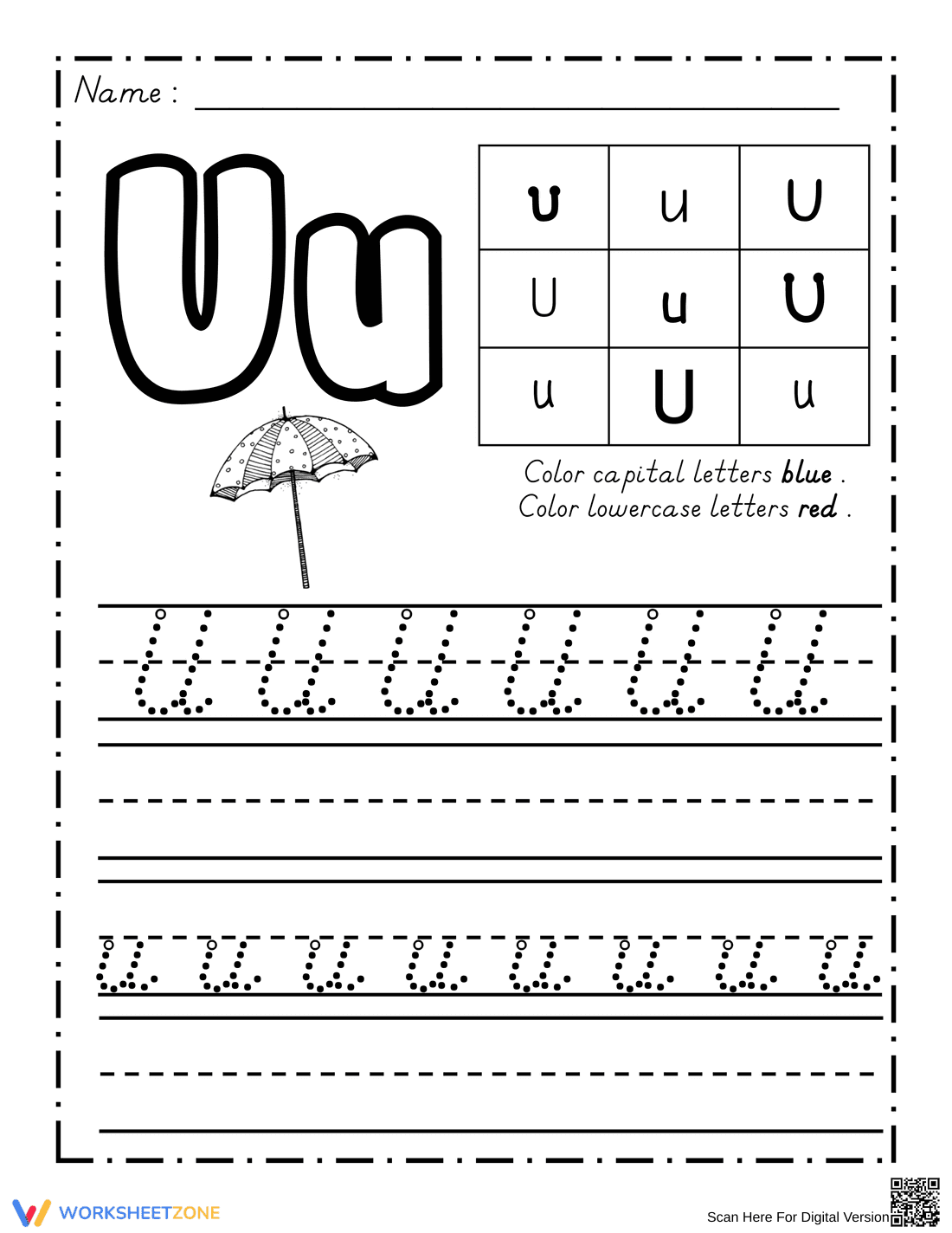

Printable Letter U Tracing Worksheet | Grade 1
Paste this activity's link or code into your existing LMS (Google Classroom, Canvas, Teams, Schoology, Moodle, etc.).
Students can open and work on the activity right away, with no student login required.
You'll still be able to track student progress and results from your teacher account.
This Grade 1 handwriting worksheet helps students master the letter U through targeted D'Nealian tracing and recognition activities. By combining letter formation practice with visual identification tasks, young learners develop essential fine motor skills and alphabet fluency required for early reading and writing success.
At a Glance
- Grade: 1 · Subject: English
- Standard:
CCSS.ELA-LITERACY.L.1.1.A— Print all upper- and lowercase letters- Skill Focus: Letter U Tracing and Recognition
- Format: 1 page · 3 tasks · No answer key · PDF
- Best For: Morning work or literacy centers
- Time: 10–15 minutes
This single-page resource features three distinct activity sections designed to reinforce letter knowledge. Students begin by coloring a large uppercase and lowercase U alongside an umbrella illustration. Next, a nine-square grid challenges them to distinguish between capital and lowercase forms using specific colors. Finally, four primary-lined rows provide guided tracing practice for both uppercase and lowercase D'Nealian letters, complete with directional starting dots.
Zero-Prep Workflow
- Print (1 minute): Simply download the PDF and print class sets directly from your computer. No special formatting or color ink is required.
- Distribute (1 minute): Hand out the worksheets along with pencils, a blue crayon, and a red crayon for the color-coding activity.
- Review (3 minutes): Briefly model the D'Nealian letter formation on the board and explain the color-coding instructions for the grid.
With under two minutes of prep, this worksheet is perfect for sub plans or independent morning work.
Standards Alignment
This resource aligns directly with CCSS.ELA-LITERACY.L.1.1.A, requiring students to print all upper- and lowercase letters. The structured tracing lines support the physical mechanics of handwriting, while the color-coding grid reinforces visual discrimination between letter cases. Both standard codes can be copied directly into lesson plans, IEP goals, or district curriculum mapping tools.
How to Use It
Use this worksheet during morning arrival to establish a quiet routine before direct instruction begins. It also functions perfectly as an independent literacy center station while the teacher conducts small reading groups. As a formative assessment tip, observe students while they complete the tracing lines to ensure they are starting at the top dot and following the correct directional path, rather than drawing letters from the bottom up. Expected completion time ranges from 10 to 15 minutes.
Who It's For
This worksheet is designed for first-grade students refining their handwriting skills, as well as kindergarteners ready for formal letter formation practice. The clear visual cues and starting dots provide built-in differentiation for students struggling with fine motor control or spatial awareness on lined paper. Pair this activity with an alphabet anchor chart or a read-aloud book featuring words that start with the short U sound to reinforce phonetic connections.
Effective handwriting instruction remains a critical component of early literacy development in primary classrooms. According to EdReports 2024, explicit letter formation practice directly supports reading fluency, word recognition, and spelling accuracy. This worksheet targets CCSS.ELA-LITERACY.L.1.1.A, helping students print all upper- and lowercase letters with proper mechanics. By integrating visual discrimination tasks—such as the color-coded recognition grid—with guided tracing, the resource addresses multiple modalities of learning simultaneously. The D'Nealian style tracing lines specifically aid in the eventual transition to cursive writing by establishing continuous stroke habits early on. Providing consistent, structured opportunities for fine motor practice ensures that cognitive resources are freed up for higher-level composition tasks later in the student's academic journey. This targeted approach builds the foundational automaticity necessary for long-term writing proficiency and overall academic confidence.


