


























Views
Downloads

Essential Homophones Worksheet | Grade 2 ELA Ready
Paste this activity's link or code into your existing LMS (Google Classroom, Canvas, Teams, Schoology, Moodle, etc.).
Students can open and work on the activity right away, with no student login required.
You'll still be able to track student progress and results from your teacher account.
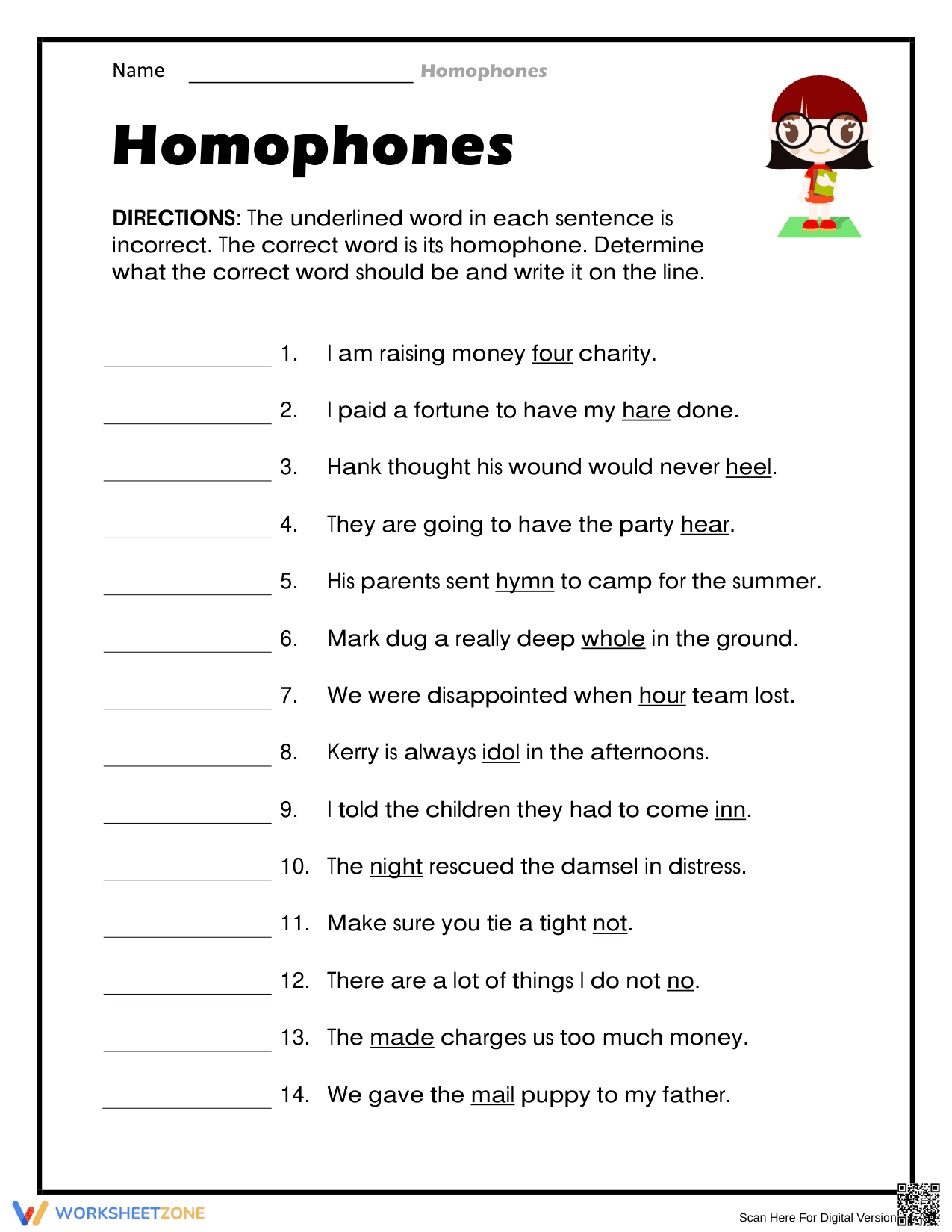
This essential homophones worksheet helps Grade 1 and 2 students master frequently confused words through 14 targeted sentence-correction tasks. By identifying incorrect word usage and providing the proper homophone, students strengthen their spelling and vocabulary skills. This resource is designed to produce immediate improvement in written clarity and reading comprehension for young learners across all primary levels.
At a Glance
- Grade: 2 · Subject: English Language Arts
- Standard:
CCSS.ELA-LITERACY.L.2.4— Use context to confirm the meaning of a word or phrase- Skill Focus: Homophone Identification and Correction
- Format: 1 page · 14 problems · Answer key included · PDF
- Best For: Independent practice or quick morning work
- Time: 15–20 minutes
This one-page PDF features 14 carefully crafted sentences where a homophone has been used incorrectly. Students are tasked with underlining the error, determining the correct spelling based on context clues, and writing the proper word on the provided line. The worksheet includes common pairs like "four/for," "whole/hole," and "night/knight," making it a comprehensive review tool for any grammar curriculum. A full answer key is provided for rapid grading.
Zero-Prep Workflow
The zero-prep design allows teachers to implement this lesson in under two minutes. Simply print the single-page document, distribute it to the class, and review the answers together or have students self-check using the included key. This streamlined workflow makes it an ideal choice for substitute plans, sudden schedule changes, or supplemental homework assignments without any additional teacher setup or materials required.
Standards Alignment
This resource is directly aligned with `CCSS.ELA-LITERACY.L.2.4`, which requires students to determine or clarify the meaning of unknown and multiple-meaning words and phrases. By analyzing sentence context to select the correct homophone, students demonstrate mastery of word relationships and nuances in meaning. This standard code can be copied directly into lesson plans, IEP goals, or district curriculum mapping tools.
How to Use It
Use this worksheet as a formative assessment after an initial lesson on homophones to gauge student understanding. It also serves as an effective "exit ticket" to confirm that learners can apply their knowledge to full sentences. During the activity, observe if students are reading the entire sentence for context or simply guessing based on the underlined word; this provides a valuable window into their decoding strategies.
Who It's For
This worksheet is primarily designed for Grade 2 students but is highly effective for Grade 1 learners ready for a challenge or older students requiring remedial grammar support. The clear formatting and repetitive task structure provide excellent scaffolding for English Language Learners (ELL) and students with IEPs who benefit from focused, predictable practice. It pairs naturally with a homophone anchor chart or a dedicated vocabulary lesson.
Research from Fisher & Frey (2014) emphasizes that the gradual release of responsibility is most effective when paired with structured practice on linguistic skills like homophones. This worksheet provides 14 opportunities for students to apply context-clue strategies (CCSS.ELA-LITERACY.L.2.4) to sentence structures. Mastery of homophones is a critical milestone that correlates with higher reading fluency on the NAEP. By isolating these frequently confused words, the resource ensures Grade 2 learners build the orthographic mapping skills necessary for writing success. Analysts at EdReports (2024) highlight the importance of high-quality, targeted supplements in bridging the gap between direct instruction and independent application in primary classrooms. This evidence-based approach ensures that student outcomes remain the central focus of every printable session.


