





























Aligned Text Structure Worksheet | Grade 9 English I
Paste this activity's link or code into your existing LMS (Google Classroom, Canvas, Teams, Schoology, Moodle, etc.).
Students can open and work on the activity right away, with no student login required.
You'll still be able to track student progress and results from your teacher account.
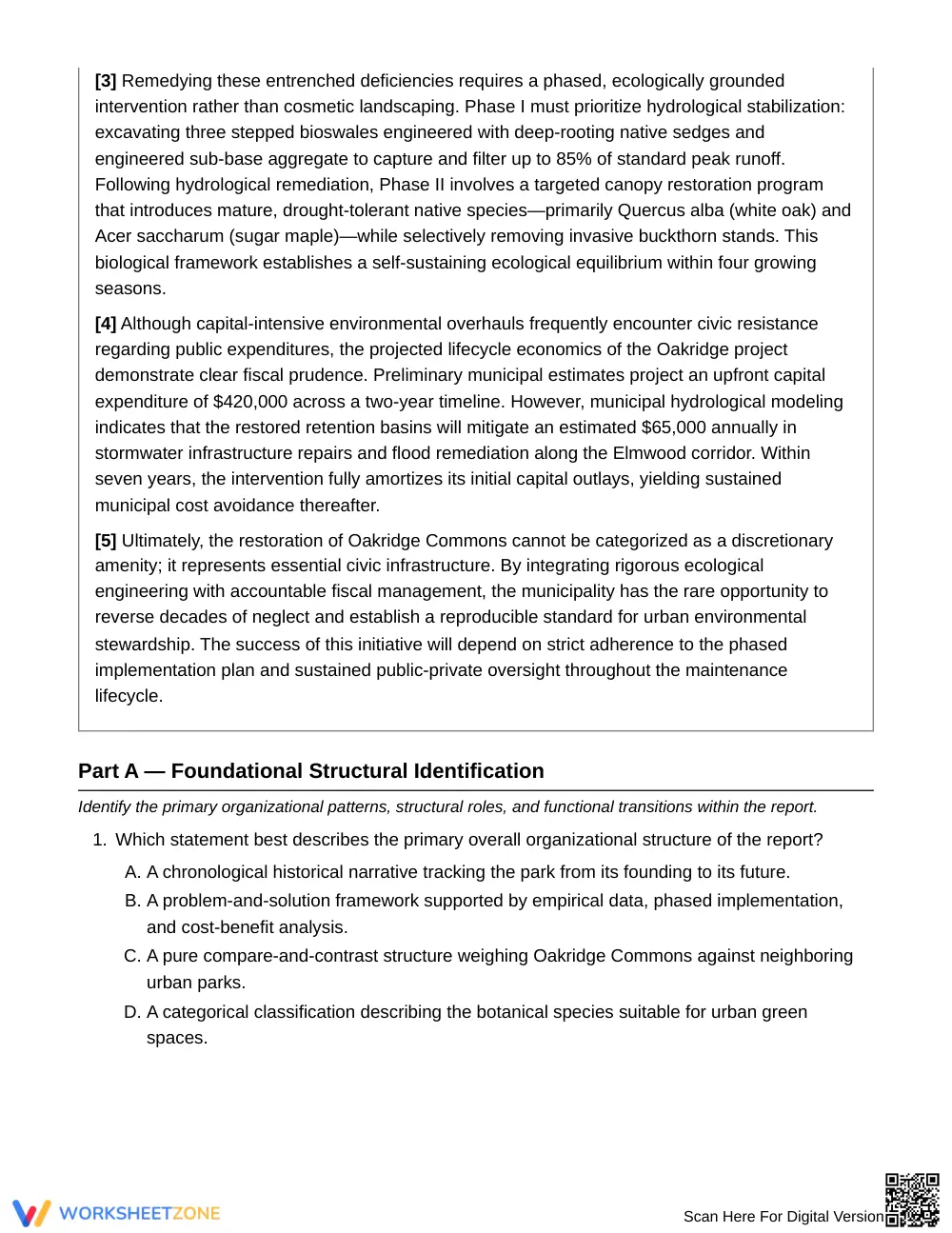
This informational text analysis worksheet guides Grade 9 students through an in-depth examination of organizational structure and authorial craft. Working with an authentic civic proposal on urban park revitalization, learners evaluate how individual paragraphs, technical data, and strategic transitions build an actionable, evidence-based argument that addresses complex environmental challenges.
At a Glance
- Grade: 9 · Subject: English I
- Standard:
RI.9-10.5— Analyze how sentences and paragraphs develop and refine an author's claims- Skill Focus: Informational Text Features and Structural Analysis
- Format: 6 pages · 12 problems · Answer key included · PDF
- Best For: Close reading and structural analysis mastery
- Time: 45–60 minutes
What's Inside
The 6-page printable packet centers on a substantive informational text titled "Revitalizing Oakridge Commons: An Ecological and Civic Assessment." It features a foundational structural reference guide, 12 rigorous analytical tasks distributed across three progressive tiers, an organizational function chart, and a comprehensive 3-page explanatory answer key containing targeted scoring criteria and sample exemplar responses.
Skill Progression
- Guided practice (Tasks 1–3): Students identify overarching organizational patterns, evaluate pivotal transitional phrases, and determine the structural role of specific sentences in establishing argumentative stakes.
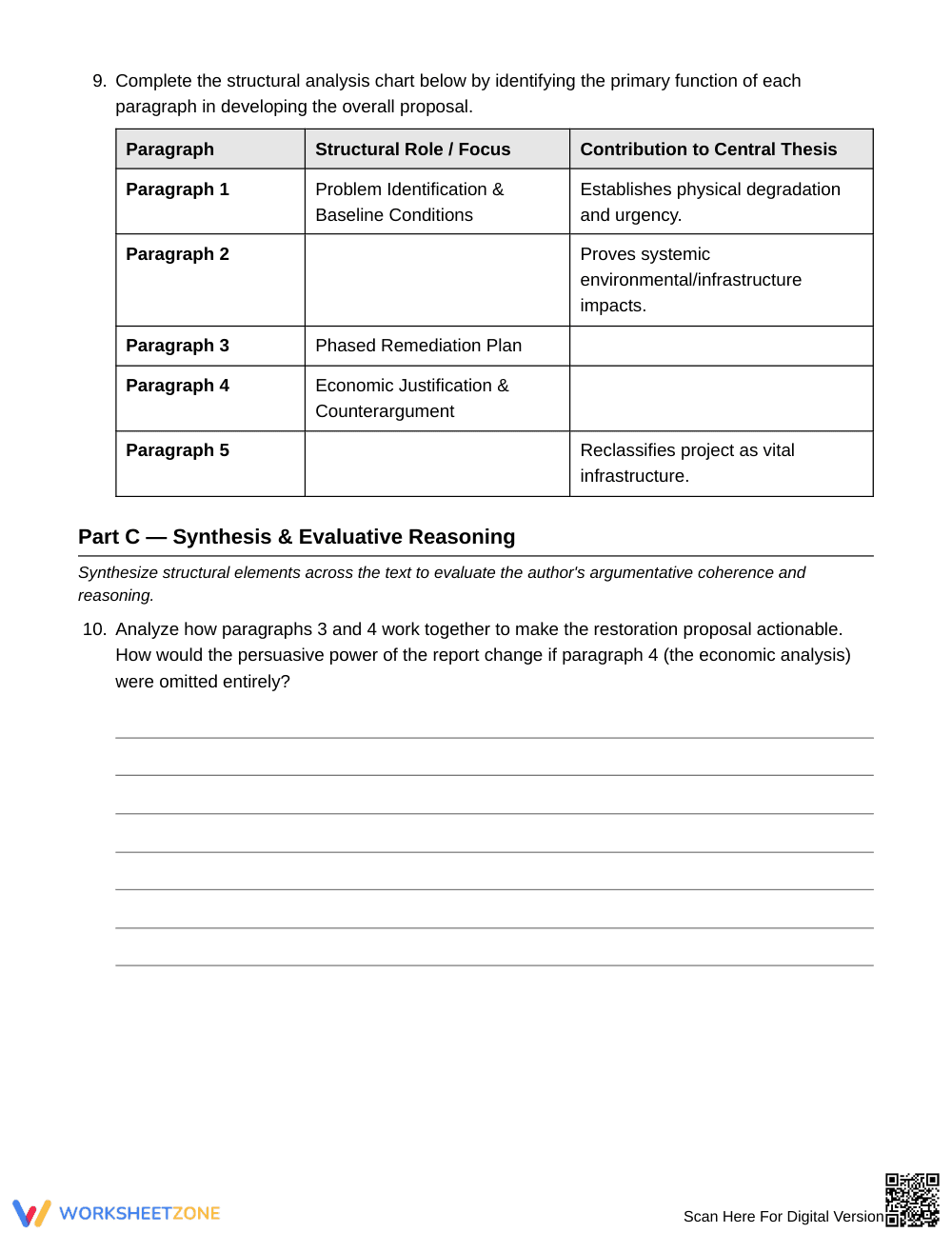
- Supported practice (Tasks 4–9): Learners analyze how technical data refines central claims, complete an organizational function chart for all five paragraphs, and evaluate counterarguments.
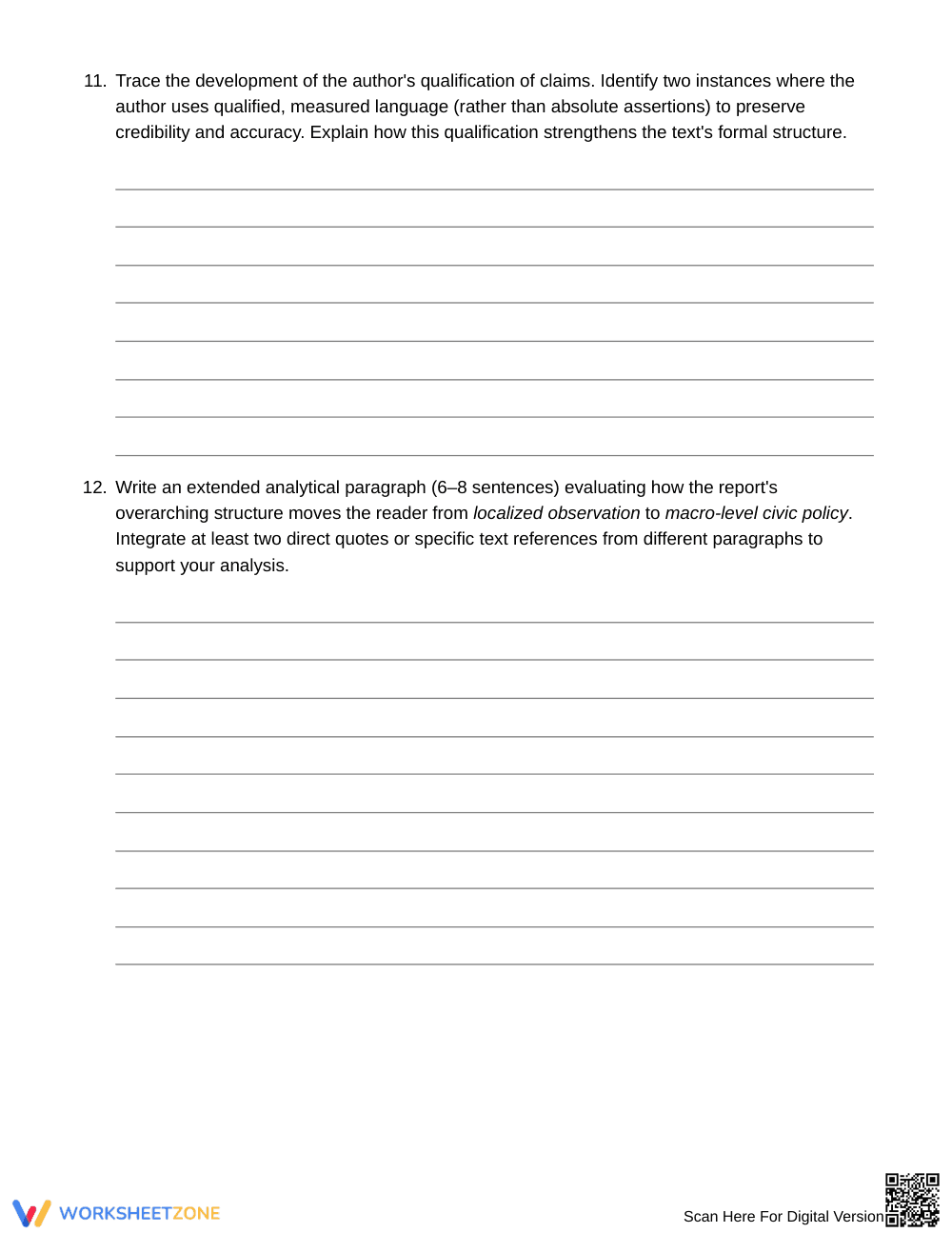
- Independent practice (Tasks 10–12): Students synthesize structural relationships across sections, trace qualified language, and compose an analytical paragraph evaluating macro-level policy shifts.
This scaffolded sequence enacts the gradual-release framework, moving learners methodically from foundational recognition to rigorous, independent rhetorical evaluation.
Standards Alignment
This worksheet directly targets `RI.9-10.5`: Analyze in detail how an author's ideas or claims are developed and refined by particular sentences, paragraphs, or larger portions of a text. It also reinforces `RI.9-10.1` by requiring explicit textual citations to validate structural observations. Both standard codes can be copied directly into lesson plans, IEP goals, or district curriculum mapping tools.
How to Use It
Deploy this resource following direct instruction on nonfiction organizational frameworks. During a 50-minute core English I block, facilitate Part A as paired collaborative practice before releasing students to complete Part B and Part C independently. Formatively assess students during Part B by checking if they can identify how paragraph 2 deepens paragraph 1 rather than simply repeating degradation claims.
Who It's For
Designed for Grade 9 English I learners, this activity supports on-grade analytical readers as well as students needing explicit frameworks for structural rhetoric. Pair this packet directly with an anchor chart on informational text structures or an introductory mini-lesson on rhetorical appeals in civic policy proposals.
Rigorous secondary literacy instruction demands that high school students move beyond identifying topical themes to scrutinizing how informational syntax and organizational architecture build meaning. According to Fisher & Frey (2014), gradual release instructional designs substantially accelerate student proficiency when navigating dense informational passages. Aligned directly to standard RI.9-10.5, this worksheet equips Grade 9 English I students to analyze how specific sentences and paragraphs develop and refine an author's claims. By examining an authentic ecological assessment of municipal park degradation, students investigate how problem-and-solution structures, empirical data, and phased remediation proposals interlock to construct persuasive civic policy. The multi-tiered sequence of 12 analytical tasks requires learners to evaluate transitional rhetoric, complete structural tracking charts, and synthesize text-wide argumentative progression. This focused practice transforms abstract structural analysis into concrete, measurable reading comprehension gains.


