































Aligned Quadratic Equations Worksheet | Grade 9 Algebra I

Paste this activity's link or code into your existing LMS (Google Classroom, Canvas, Teams, Schoology, Moodle, etc.).
Students can open and work on the activity right away, with no student login required.
You'll still be able to track student progress and results from your teacher account.
This Algebra I worksheet equips ninth-grade students to solve quadratic equations through factoring, completing the square, and using the quadratic formula. Progressing from foundational equation identification to real-world application problems, students develop strong procedural fluency across 16 structured exercises designed to build mastery.
At a Glance
- Grade: 9 · Subject: Algebra I
- Standard:
HSA-REI.B.4— Solve quadratic equations in one variable by inspection, square roots, factoring, and quadratic formula- Skill Focus: Solving Quadratic Equations
- Format: 5 pages · 16 problems · Complete answer key included · Printable PDF
- Best For: Mid-unit review and targeted skill intervention
- Time: 45–60 minutes
What's Inside
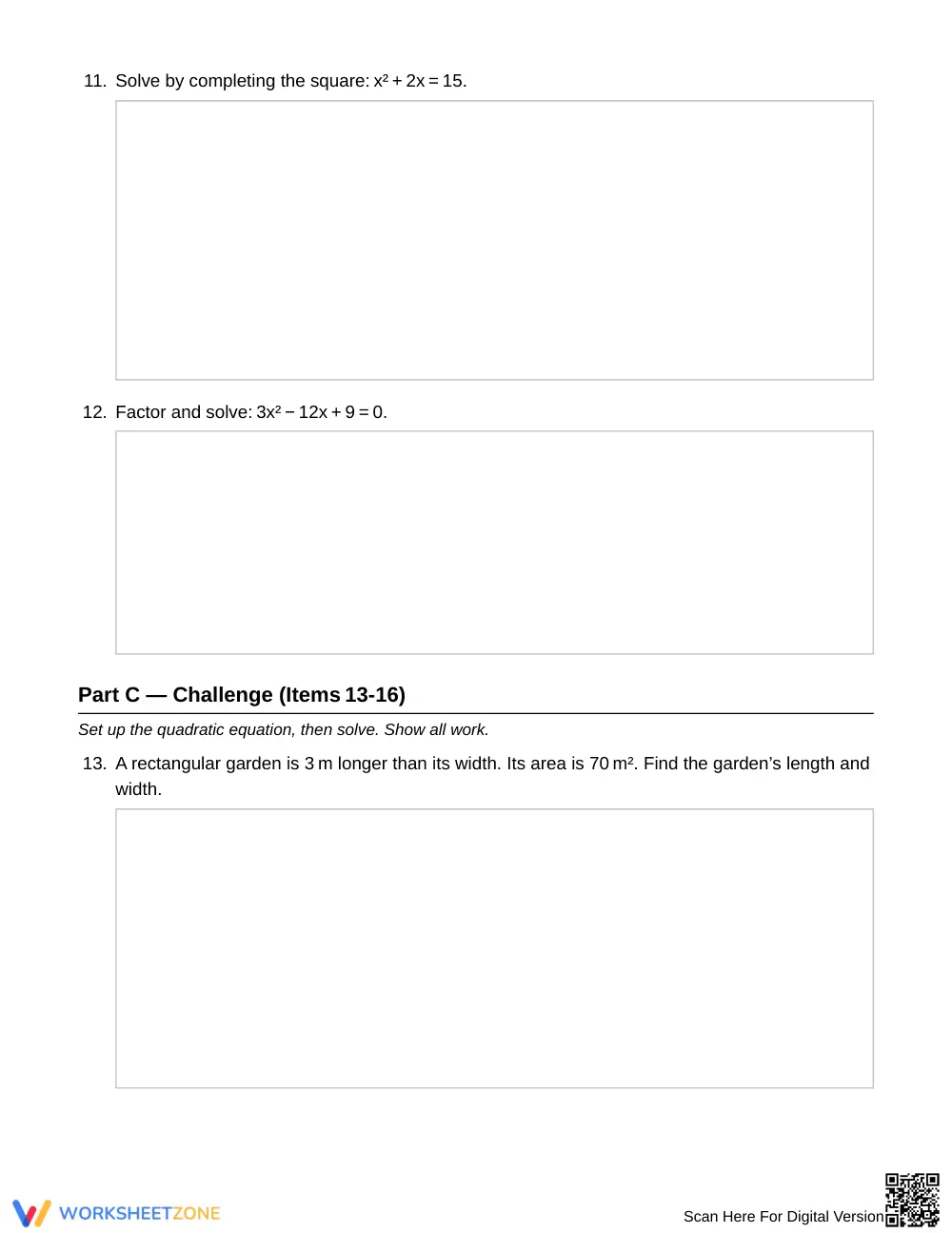
This 5-page worksheet includes 16 problems structured across three parts, beginning with a formula header displaying the quadratic formula. Students practice identifying quadratic forms, solving by square roots, factoring trinomials, completing the square, and solving word problems involving area, projectiles, and profit. A full 3-page answer key provides step-by-step solutions for every problem.
Skill Progression
- Guided practice (Part A, Items 1–4): Foundation items identify quadratic equations and solve basic forms using square roots and difference of squares with formula support.
- Supported practice (Part B, Items 5–12): Core exercises require factoring trinomials, completing the square, and using the quadratic formula across 8 procedural problems.
- Independent practice (Part C, Items 13–16): Advanced modeling items challenge students to formulate quadratic equations from contextual scenarios and solve for unknown values independently.
This sequence follows a gradual-release framework, moving learners directly from basic recall to unassisted mathematical modeling.
Standards Alignment
This worksheet aligns directly with primary standard `HSA-REI.B.4`, which requires students to solve quadratic equations in one variable using inspection, square roots, factoring, completing the square, and the quadratic formula. In support, items align with `HSA-CED.A.1` by prompting students to create quadratic equations from geometric and physics contexts. Both standard codes can be copied directly into lesson plans, IEP goals, or district curriculum mapping tools.
How to Use It
Administer this resource after direct instruction on factoring and the quadratic formula for guided partner practice or independent assessment. Alternatively, use Parts A and B as a mid-unit check while assigning Part C to fast finishers. Observe whether students recognize when taking square roots is more efficient than the quadratic formula. Expected completion time is 45 to 60 minutes.
Who It's For
This worksheet is tailored for Grade 9 Algebra I classes and high school students preparing for end-of-course exams. Support struggling learners with the formula reference and Part A foundation items, while challenging advanced students with the multi-step modeling in Part C. Pair this resource with a quadratic method decision flowchart or an introductory mini-lesson.
Mastering standard HSA-REI.B.4 requires high school students to develop procedural fluency and conceptual flexibility when solving quadratic equations using multiple algebraic methods, including factoring, completing the square, and using the quadratic formula. According to Fisher & Frey (2014), purposeful instructional sequences that transition from guided foundational exercises to independent contextual problem solving significantly strengthen cognitive retention and mathematical self-efficacy. This Algebra I worksheet exemplifies that progression by pairing formula cues with 16 tiered tasks, enabling students to recognize equation structures, select mathematically sound approaches, and apply solutions to authentic physical and economic models. By incorporating immediate scaffolding in the early items and gradually demanding independent equation formulation in the challenge tasks, the material supports rigorous standard mastery. Consequently, educators gain clear diagnostic evidence of student algebraic reasoning, allowing them to pinpoint procedural errors and reinforce strategic problem-solving competencies effectively across diverse classroom environments.


