































Aligned 4.NBT.B.6 Array Division Worksheet | Grade 4 Math

Paste this activity's link or code into your existing LMS (Google Classroom, Canvas, Teams, Schoology, Moodle, etc.).
Students can open and work on the activity right away, with no student login required.
You'll still be able to track student progress and results from your teacher account.
This Grade 4 cumulative assessment measures student mastery of division through visual arrays, area models, and multiplication connections. Students solve 21 structured items across five progressive sections, moving from basic equal sharing to multi-step word problems with remainders and written mathematical justifications. The resource evaluates conceptual understanding alongside procedural computation.
At a Glance
- Grade: 4 · Subject: Math
- Standard:
4.NBT.B.6— Find whole-number quotients and remainders using arrays, area models, and equations- Skill Focus: Array division, quotients with remainders, and contextual problem-solving
- Format: 2 pages · 21 problems · Answer key included · PDF
- Best For: End-of-unit cumulative summative assessment
- Time: 40–50 minutes
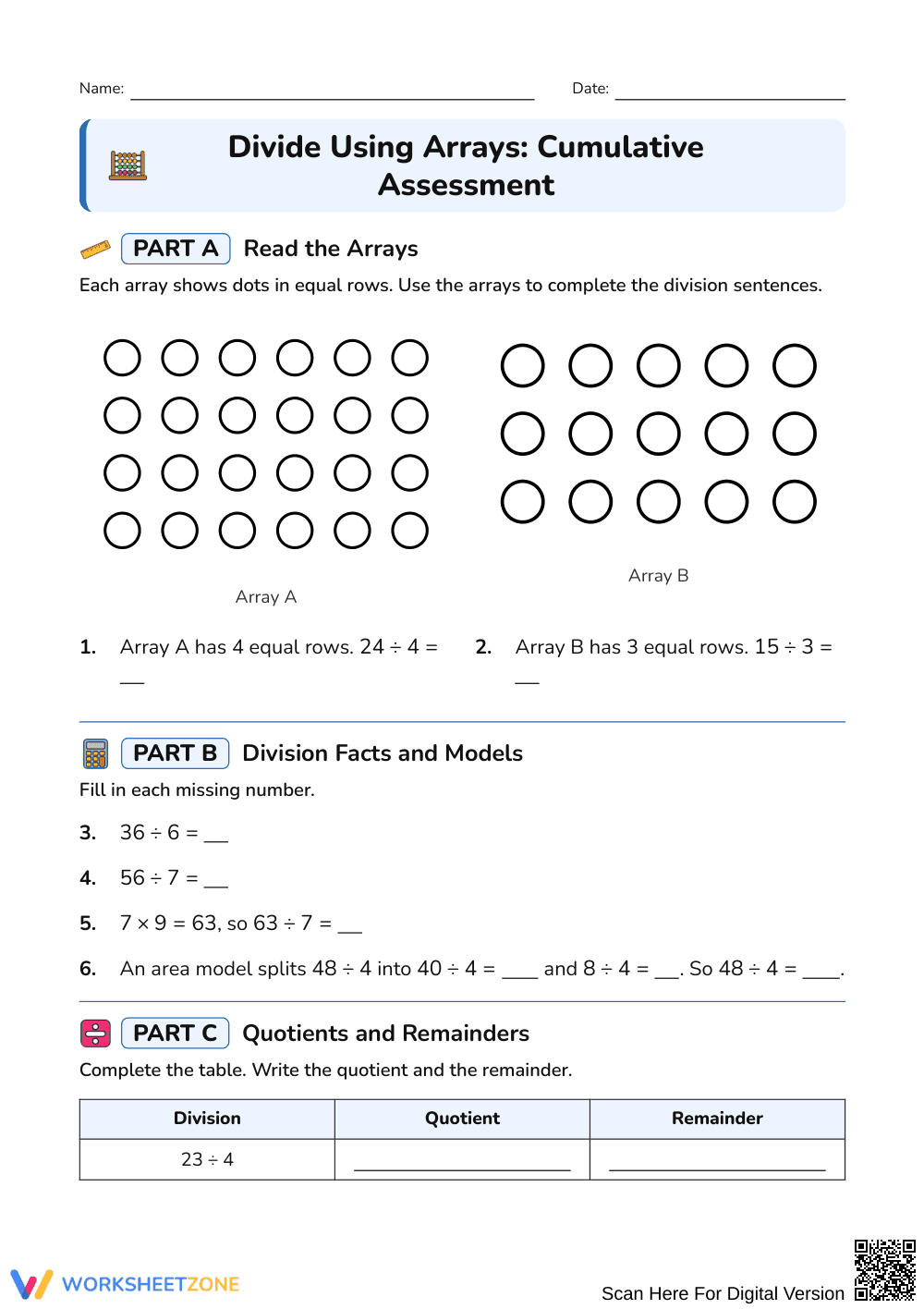
The two-page assessment contains 21 tasks divided across five distinct parts designed for comprehensive skill diagnosis. Students interpret dot arrays in Part A, fill missing factors and decompose dividend models in Part B, and determine quotients with remainders in Part C tabular sets. Parts D and E present real-world word problems and short-response explanation items. A complete two-page answer key provides worked solutions for fast evaluation.
Mastery Evidence & Evaluation
Each section maps directly to core sub-skills under standard 4.NBT.B.6 to support targeted standards-based grading:
- Approaching Mastery: Students accurately complete Parts A and B, demonstrating procedural familiarity with dot arrays, basic division facts, and partial-quotient area models.
- Meeting Mastery: Students successfully calculate quotients and remainders in Part C and correctly solve contextual grouping scenarios in Part D.
- Exceeding Mastery: Students analyze mathematical reasoning in Part E, constructing written proofs that explain multiplication-division inverse relationships and identifying conceptual errors.
Teachers can evaluate student responses against these performance bands, and scores can be entered directly into gradebooks or IEP progress notes to document standards attainment.
Standards Alignment
The primary focus aligns to `4.NBT.B.6`: Find whole-number quotients and remainders using strategies based on place value, properties of operations, equations, rectangular arrays, and area models. As a supporting standard, `4.OA.A.3` guides remainder interpretations in multi-step contextual word problems. Both standard codes integrate directly into lesson plans, IEP goals, or district curriculum maps.
How to Use It
Administer this assessment after instruction on array decomposition to evaluate unit mastery as a summative exam or pre-testing benchmark. During administration, observe whether students sketch physical groupings or use mental inverse multiplication for Part C remainders. Expected completion time is 40 to 50 minutes.
Who It's For
This assessment targets fourth-grade math classrooms finishing their division unit. For accommodations, provide grid paper or counters to construct physical arrays for Parts C and D. Pair this tool with an anchor chart showing how array rows correspond to quotients and leftover items to remainders.
This standards-aligned mathematics assessment targets 4.NBT.B.6 by measuring student proficiency in finding whole-number quotients and remainders through visual arrays and area models. Built for fourth-grade classrooms, the 21-task tool systematically diagnoses equal sharing, multiplication-division relationships, and remainder interpretations in multi-step word problems. According to RAND AIRS 2024, standards-based diagnostic assessments that integrate visual models alongside procedural tasks produce measurable improvements in elementary mathematics retention and conceptual understanding. By requiring students to interpret arrays, calculate remainders, and articulate reasoning in written explanations, this resource delivers actionable diagnostic data across distinct mastery tiers. Teachers receive clear evidence of procedural fluency and conceptual depth, enabling data-informed small-group interventions before district assessments. The self-contained structure includes a complete answer key, making it an efficient measurement tool for general education classes, remedial math interventions, and special education progress tracking.


