































Aligned 3.OA.A.2 Division Worksheet | Grade 3 Math

Paste this activity's link or code into your existing LMS (Google Classroom, Canvas, Teams, Schoology, Moodle, etc.).
Students can open and work on the activity right away, with no student login required.
You'll still be able to track student progress and results from your teacher account.
This Grade 3 division assessment measures student mastery of partitioning quantities into equal shares and determining quotient values. Designed for comprehensive evaluation, the resource assesses conceptual understanding, computational fluency, word problem application, and mathematical reasoning across seventeen targeted items so educators can accurately diagnose instructional readiness.
At a Glance
- Grade: 3 · Subject: Math
- Standard:
3.OA.A.2— Interpret quotients of whole numbers by finding equal shares or equal groups- Skill Focus: Balanced cumulative assessment of equal groups division
- Format: 2 pages · 17 structured problems · Full answer key included · PDF
- Best For: End-of-unit summative assessment and standard mastery evaluation
- Time: 30–45 minutes
What's Inside
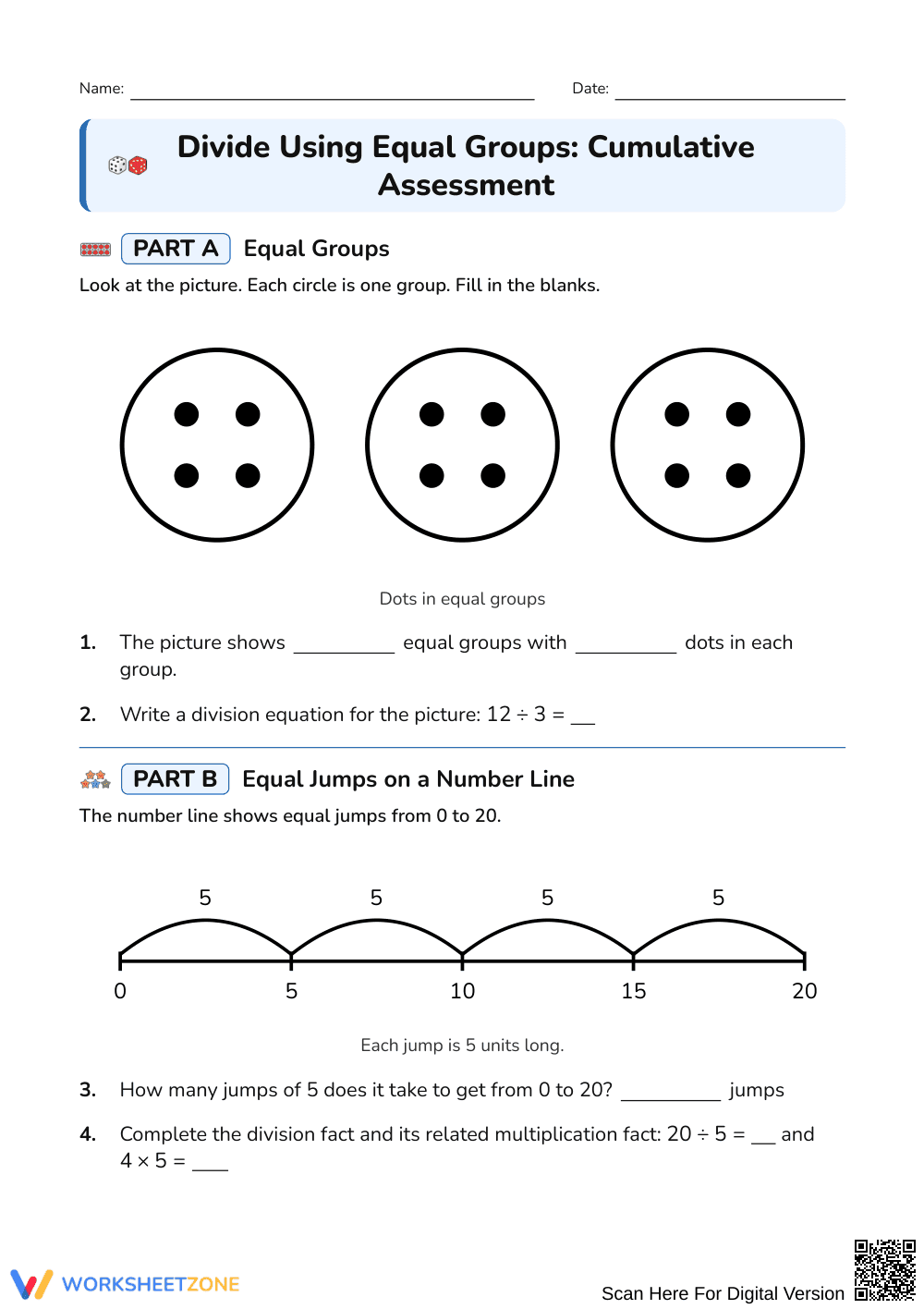
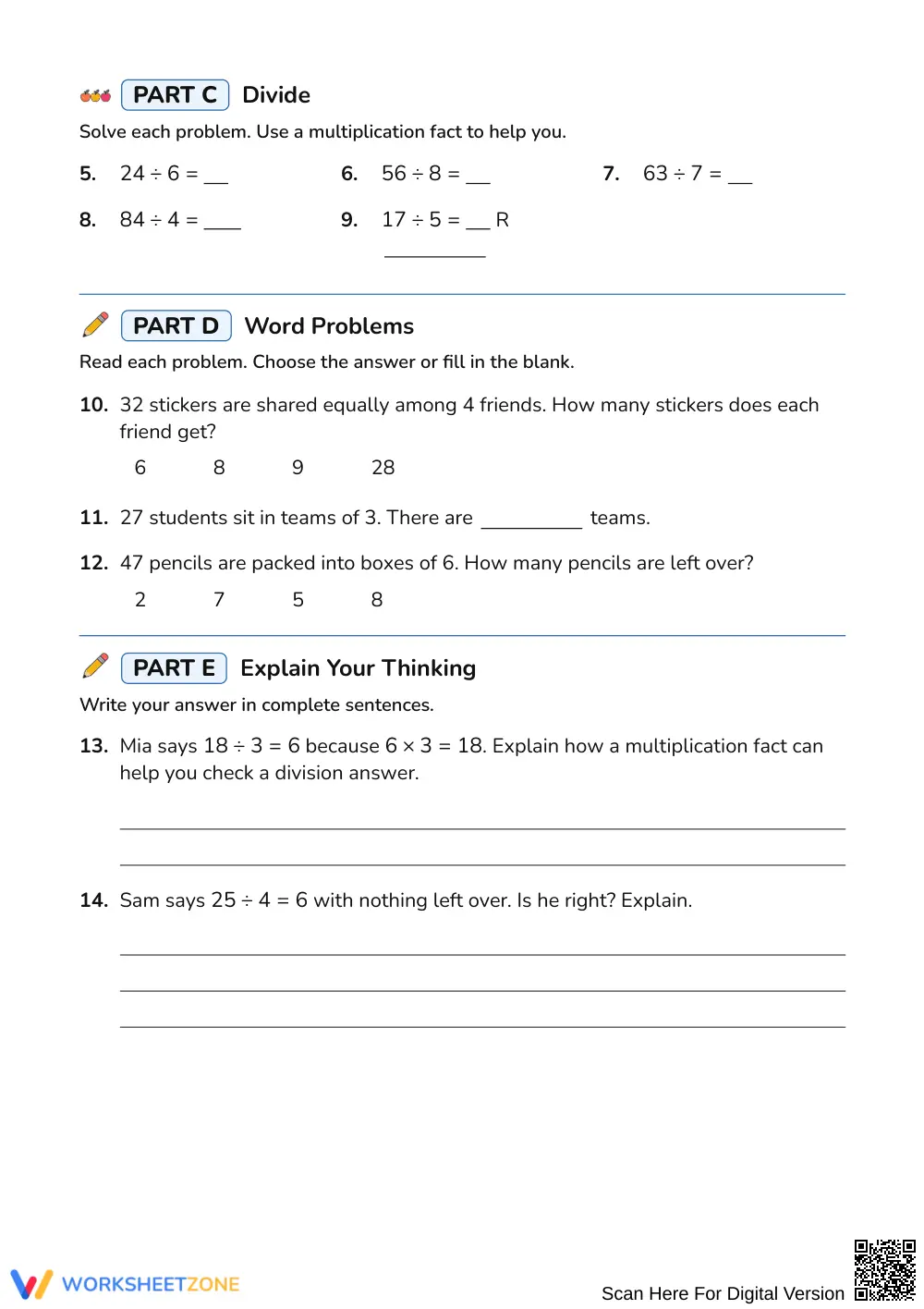
The 2-page assessment spans five structured parts assessing distinct cognitive demands. Part A checks concrete equal groups with visual dot models. Part B connects division to number lines and inverse multiplication equations. Part C tests procedural fluency, including remainders. Part D features multiple-choice and fill-in word problems. Part E concludes with written explanations evaluating conceptual reasoning, supported by a complete 2-page answer key.
Mastery Evidence
Student responses provide clear data across three performance tiers. Students at the Approaching level solve basic visual groupings in Parts A and B but struggle with remainders. Those Meeting standard demonstrate computational accuracy in Part C and solve word problems in Part D. Students at the Exceeding level justify mathematical relationships in Part E. Each task maps to standard sub-skills, allowing teachers to record scores directly into gradebooks or IEP progress notes.
Standards Alignment
This assessment aligns directly to primary standard `3.OA.A.2`: Interpret whole-number quotients of whole numbers as equal shares or groups. It also integrates supporting standard `3.OA.B.6` by requiring students to understand division as an unknown-factor multiplication problem. Both standard codes can be copied directly into lesson plans, IEP goals, or district curriculum mapping tools.
How to Use It
Administer this assessment after direct instruction on equal shares to evaluate summative post-unit performance within a 30- to 45-minute block. Alternatively, use specific parts during intervention to isolate procedural versus conceptual gaps. During administration, observe whether students sketch visual groups or use multiplication facts on Part C to guide follow-up instruction.
Who It's For
This resource serves general education Grade 3 students completing division units and Grade 4 students needing review. Differentiate by offering counters for concrete support on Part A or assigning Part E to challenge advanced learners. For optimal instruction, pair this assessment with an equal-sharing anchor chart or targeted review lesson.
Rigorous mathematics instruction requires multi-faceted evaluation tools that assess conceptual models alongside computational automaticity. Standard 3.OA.A.2 establishes that third-grade students must interpret whole-number quotients of whole numbers by modeling equal shares and groups. Research by Fisher & Frey (2014) highlights that comprehensive assessments must evaluate both procedural application and verbal reasoning to confirm durable mathematical comprehension. By structuring seventeen distinct items across visual models, number line representations, bare computation, contextual word problems, and written mathematical arguments, this two-page cumulative instrument operationalizes these evidence-based assessment principles. Students do not merely calculate answers algorithmically; they demonstrate representational transfer and explain arithmetic relationships between multiplication and division. The resulting diagnostic data allows educators to identify specific student misconceptions regarding remainders or sharing models before introducing multi-digit division concepts. This balanced architecture confirms that classroom evaluations align reliably with national standards and instructional research.


