


























Views
Downloads
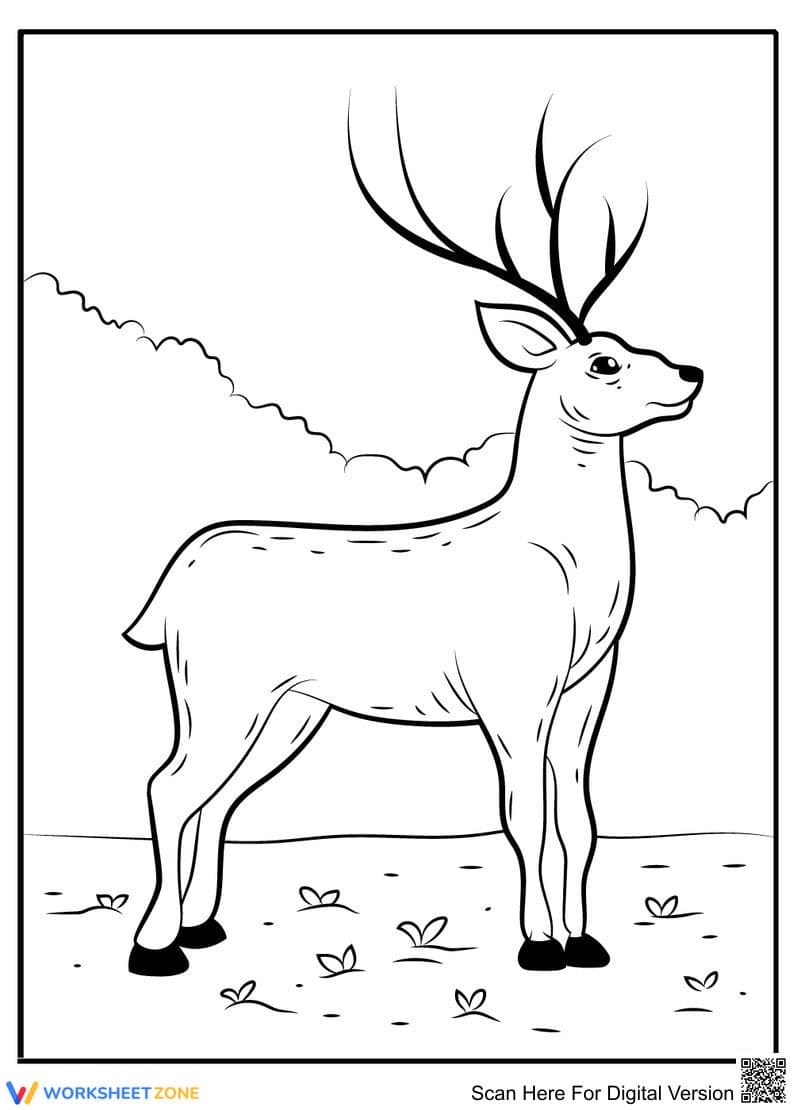

Adorable Deer Coloring Page | Essential Grade K-2 Art
Paste this activity's link or code into your existing LMS (Google Classroom, Canvas, Teams, Schoology, Moodle, etc.).
Students can open and work on the activity right away, with no student login required.
You'll still be able to track student progress and results from your teacher account.
This adorable deer coloring worksheet provides a high-interest creative outlet for early elementary students to develop essential fine motor control and artistic expression. By engaging with the detailed line art of a buck, learners practice hand-eye coordination and spatial awareness while exploring seasonal themes or biological characteristics of woodland animals in a fun, accessible format.
At a Glance
- Grade: K-2 · Subject: Arts & English
- Standard:
CCSS.ELA-LITERACY.SL.K.5— Add drawings or visual displays to descriptions to provide additional detail- Skill Focus: Fine motor control & creative expression
- Format: 1 page · 1 task · No answer key needed · PDF
- Best For: Morning work or early finishers
- Time: 15–20 minutes
Inside this resource, you will find a single-page, high-resolution PDF featuring a clean, professional illustration of a deer standing in a natural setting. The line art is designed with clear boundaries to support students developing their grip and coloring precision. There are no complex instructions, making it an ideal choice for independent student work or as a supplemental visual aid for science and nature units.
The zero-prep workflow for this worksheet is designed for maximum efficiency. First, print the single-page PDF (30 seconds). Second, distribute the sheets to students along with crayons, markers, or colored pencils (1 minute). Third, review the completed artwork or use it as a prompt for a short verbal description of the deer's habitat (30 seconds). Total teacher preparation time is under 2 minutes, making it perfect for sub plans.
This worksheet aligns with `CCSS.ELA-LITERACY.SL.K.5`, which encourages students to use visual displays to enhance their communication and descriptions. While primarily an artistic task, it supports language development by providing a concrete subject for descriptive adjectives and storytelling. Both standard codes can be copied directly into lesson plans, IEP goals, or district curriculum mapping tools.
Use this worksheet during a "Nature and Seasons" unit to discuss how animals like deer change throughout the year. It serves as an excellent formative assessment for fine motor development; observe how students handle coloring tools and their ability to stay within lines. It is best assigned after a read-aloud about forest animals, typically taking 15 to 20 minutes to complete.
This resource is perfect for Kindergarten through 2nd-grade students, including those requiring occupational therapy support for pencil grasp. It pairs naturally with a non-fiction passage about deer or a classroom anchor chart detailing forest habitats. It is also a reliable filler for unexpected teacher absences or transition periods between core subjects.
According to the RAND AIRS 2024 report, integrating creative visual tasks into early childhood education significantly improves student engagement and retention of thematic vocabulary. This worksheet targets CCSS.ELA-LITERACY.SL.K.5 by allowing students to create a visual representation that can accompany oral or written descriptions of the natural world. Research from Fisher & Frey (2014) emphasizes that fine motor activities like coloring are foundational for later writing stamina and dexterity. By providing a structured yet open-ended artistic task, educators can bridge the gap between creative play and academic standards. This 1-page printable ensures that even the youngest learners can participate in standards-aligned activities without the frustration of overly complex instructions. It remains a staple for developing the hand-eye coordination necessary for the NAEP-defined literacy milestones in early elementary grades, offering a low-stakes environment for students to master tool control while exploring biological themes.


