




























Views
Downloads

Printable Multi-Digit Addition Worksheet | Grade 3 Math

Paste this activity's link or code into your existing LMS (Google Classroom, Canvas, Teams, Schoology, Moodle, etc.).
Students can open and work on the activity right away, with no student login required.
You'll still be able to track student progress and results from your teacher account.
Mastering Multi-Digit Addition
This math worksheet provides focused practice on multi-digit addition for third graders. Through a structured set of problems, learners move from two-digit to three-digit and word-based calculations. The primary outcome is for students to develop fluency and accuracy when adding numbers within 1,000, particularly when regrouping is required.
At a Glance
- Grade: 3 · Subject: Math
- Standard:
CCSS.MATH.CONTENT.3.NBT.A.2— Fluently add numbers within 1000 using place value strategies.- Skill Focus: Multi-Digit Addition with Regrouping
- Format: 3 pages · 28 problems · Answer key included · PDF
- Best For: Independent practice, skill reinforcement, or homework.
- Time: 20–30 minutes
What's Inside
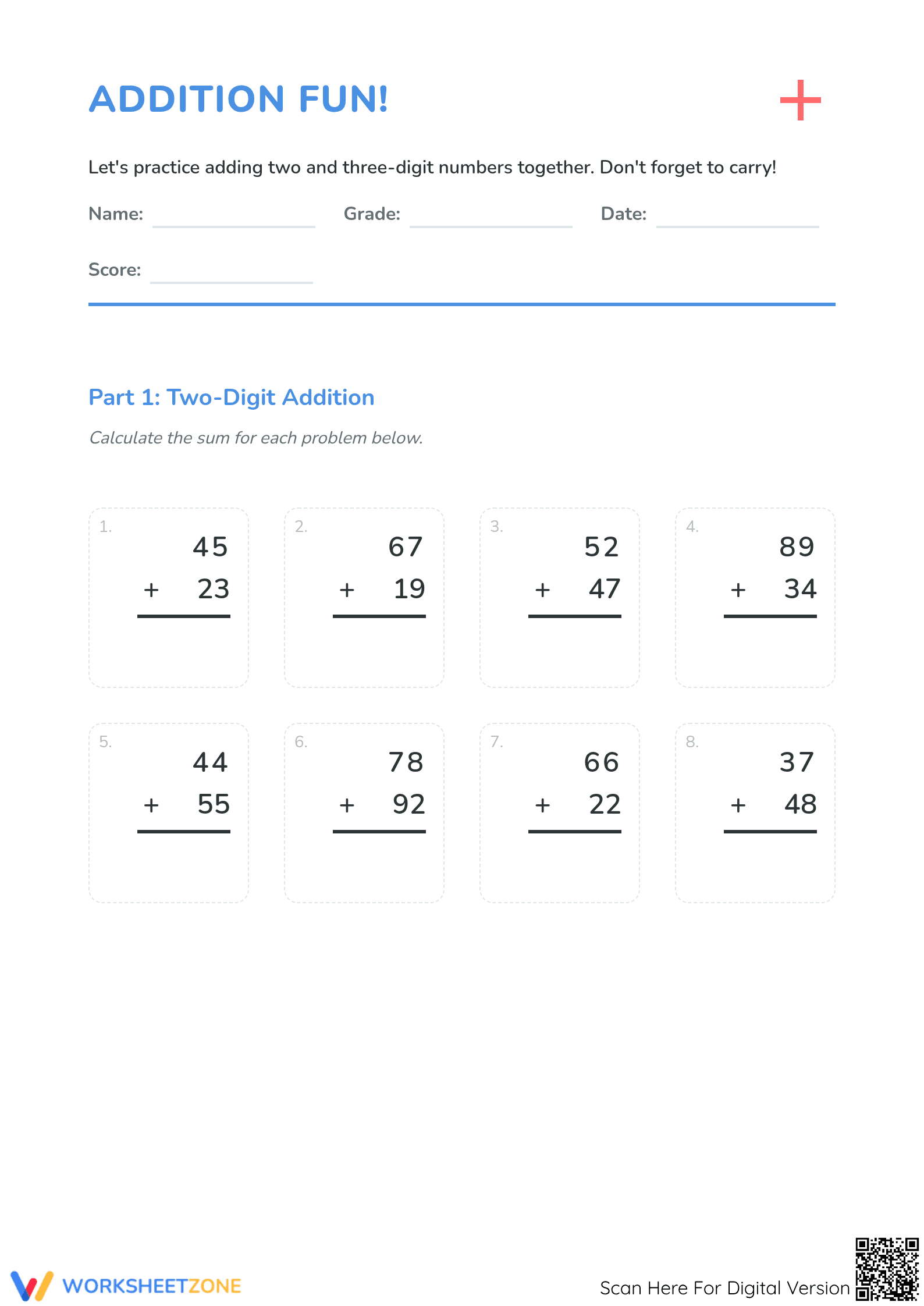
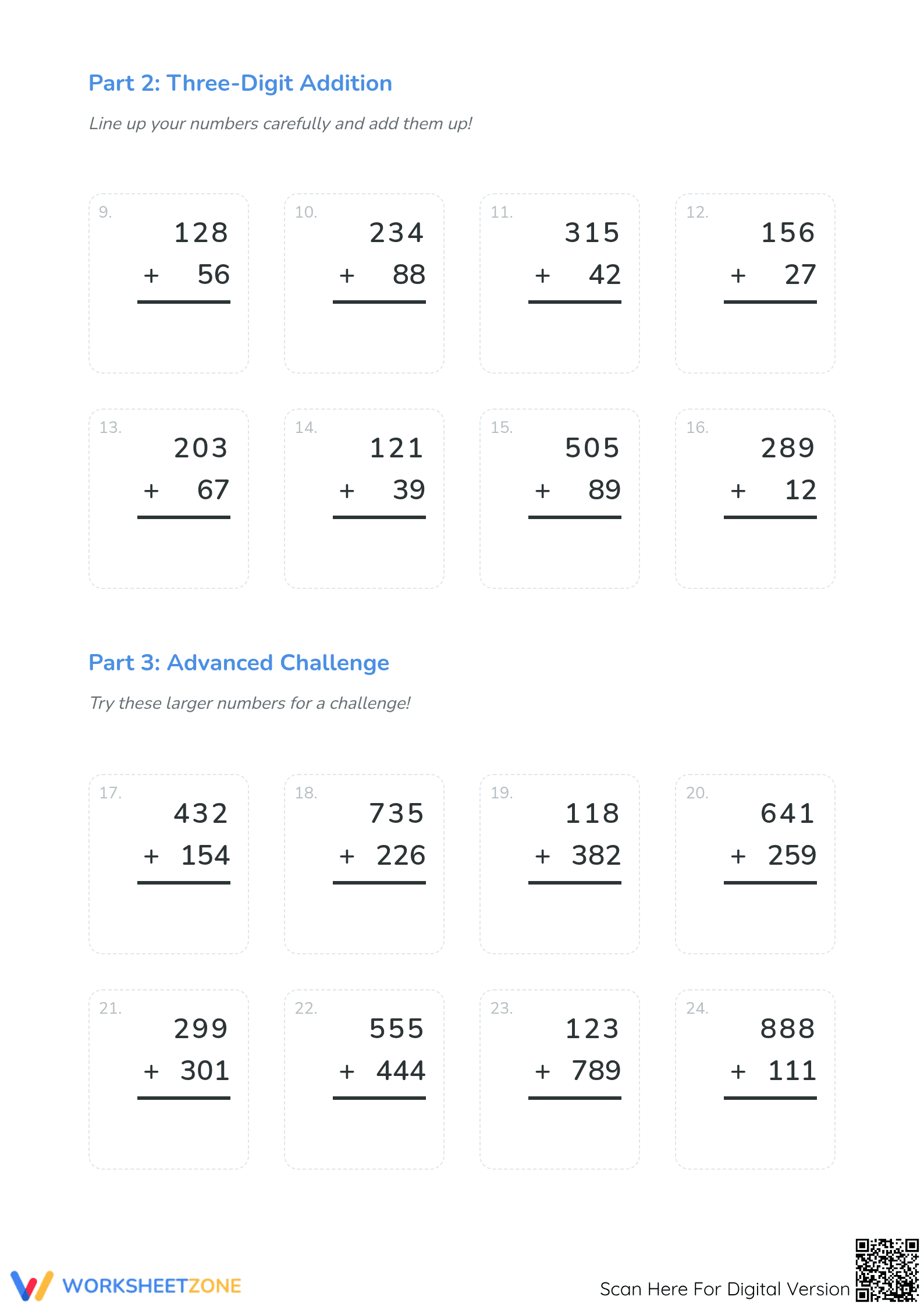
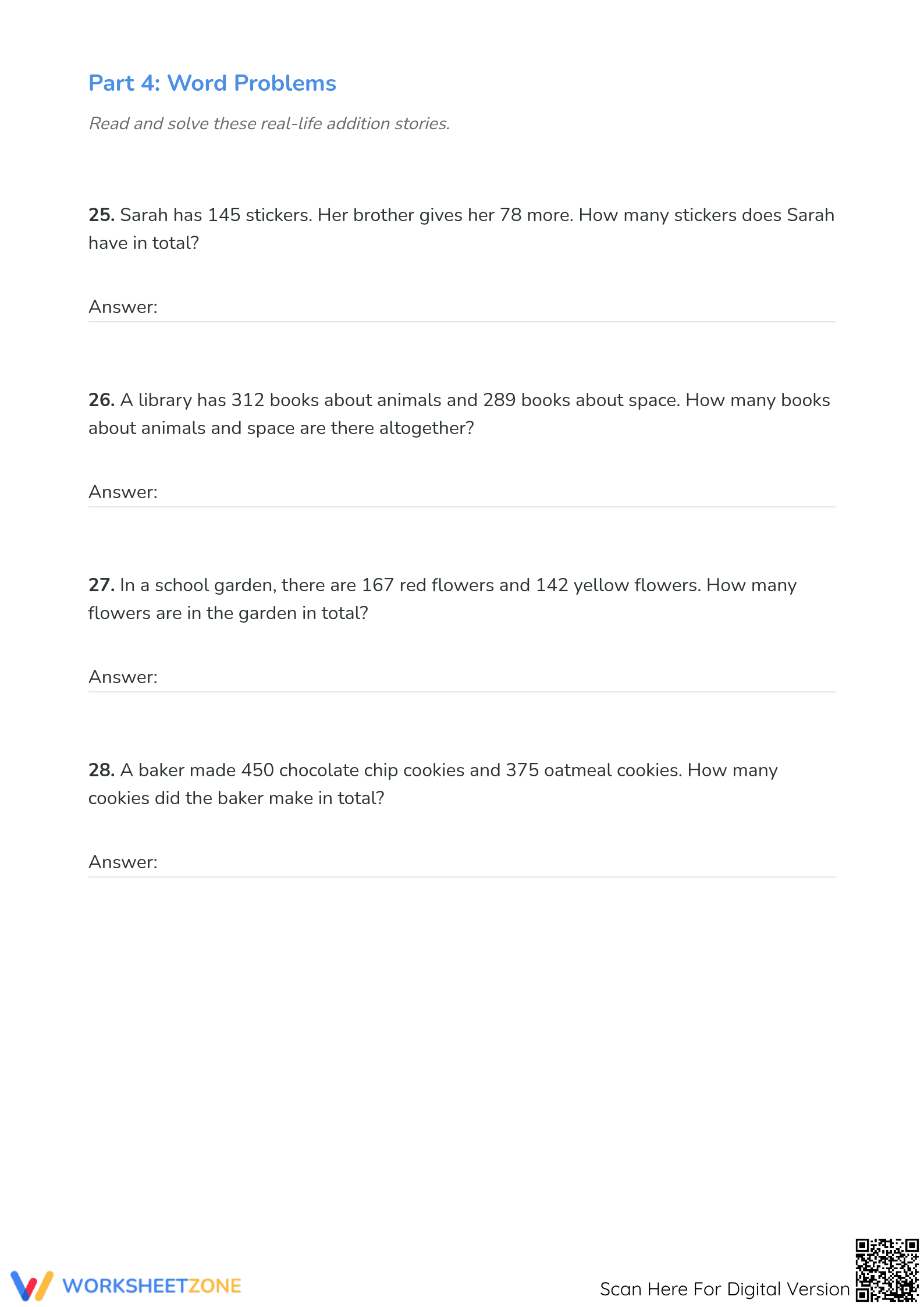
This three-page resource contains 28 addition problems in four parts. The worksheet progresses from two-digit to three-digit addition, an advanced challenge, and finally, word problems. A complete three-page answer key is provided showing the final sum for each problem, allowing for quick and easy grading.
A Structured Skill Progression
This worksheet follows a gradual release model to build confidence. The structure ensures students move from simpler to more complex tasks in a logical sequence.
- Guided practice: The first eight problems focus on two-digit addition, providing a warm-up and check for foundational understanding of regrouping.
- Supported practice: The next two sections increase the difficulty to three-digit addition, with 16 problems that demand regrouping and careful place value alignment.
- Independent practice: The final section has four word problems, requiring students to set up and solve the calculation from a real-world context.
This progression is ideal for reinforcing a lesson on addition strategies.
Standards Alignment
This worksheet directly aligns with Grade 3 standard CCSS.MATH.CONTENT.3.NBT.A.2, which requires students to "Fluently add and subtract within 1000 using strategies and algorithms based on place value." While focused on addition, it builds the procedural fluency needed for the full standard. Both standard codes can be copied directly into lesson plans, IEP goals, or district curriculum mapping tools.
How to Use It
This resource works well as in-class independent practice after a lesson on regrouping. As students work, you can make formative assessment observations, noting who struggles with place value versus calculation. Alternatively, it is an effective homework assignment to reinforce the day's learning. The entire worksheet should take most students between 20 and 30 minutes to complete.
Who It's For
Designed for third-grade students learning multi-digit addition, the clear progression provides a natural scaffold for all learners. For an extension, advanced students can write their own word problem using numbers from the worksheet. This resource pairs well with a classroom anchor chart displaying the steps for addition with regrouping.
This worksheet provides targeted practice for CCSS.MATH.CONTENT.3.NBT.A.2, a foundational skill for elementary mathematics, helping students fluently add numbers within 1000. Its design, combining procedural exercises and word problems, aligns with findings on effective instruction. Research highlights procedural fluency as a gateway to higher-order mathematical thinking. According to the RAND AIRS 2024 report, a balance of conceptual understanding, procedural fluency, and application is key to long-term student success. This resource directly supports the fluency component by offering structured practice that builds automaticity with addition algorithms. The inclusion of 28 distinct problems ensures students have ample opportunity to solidify their understanding of regrouping before moving to more complex multi-step problems.


