


























Views
Downloads

Addition and Subtraction within 20 | Complete Grade 1 Math
Paste this activity's link or code into your existing LMS (Google Classroom, Canvas, Teams, Schoology, Moodle, etc.).
Students can open and work on the activity right away, with no student login required.
You'll still be able to track student progress and results from your teacher account.
This Grade 1 math worksheet builds addition and subtraction fluency within 20 through systematic visual touch points. Students progress from concrete dot-counting scaffolds to independent computation across three matched forms. This structure helps learners build computational accuracy and master essential mental math strategies.
At a Glance
- Grade: 1 · Subject: Math
- Standard:
CCSS.MATH.CONTENT.1.OA.C.6— Add and subtract within 20 using counting on and back- Skill Focus: Touch-point addition and subtraction within 20
- Format: 4 pages · 36 problems · Answer key included · PDF
- Best For: Math intervention and small groups
- Time: 15–25 minutes
What's Inside
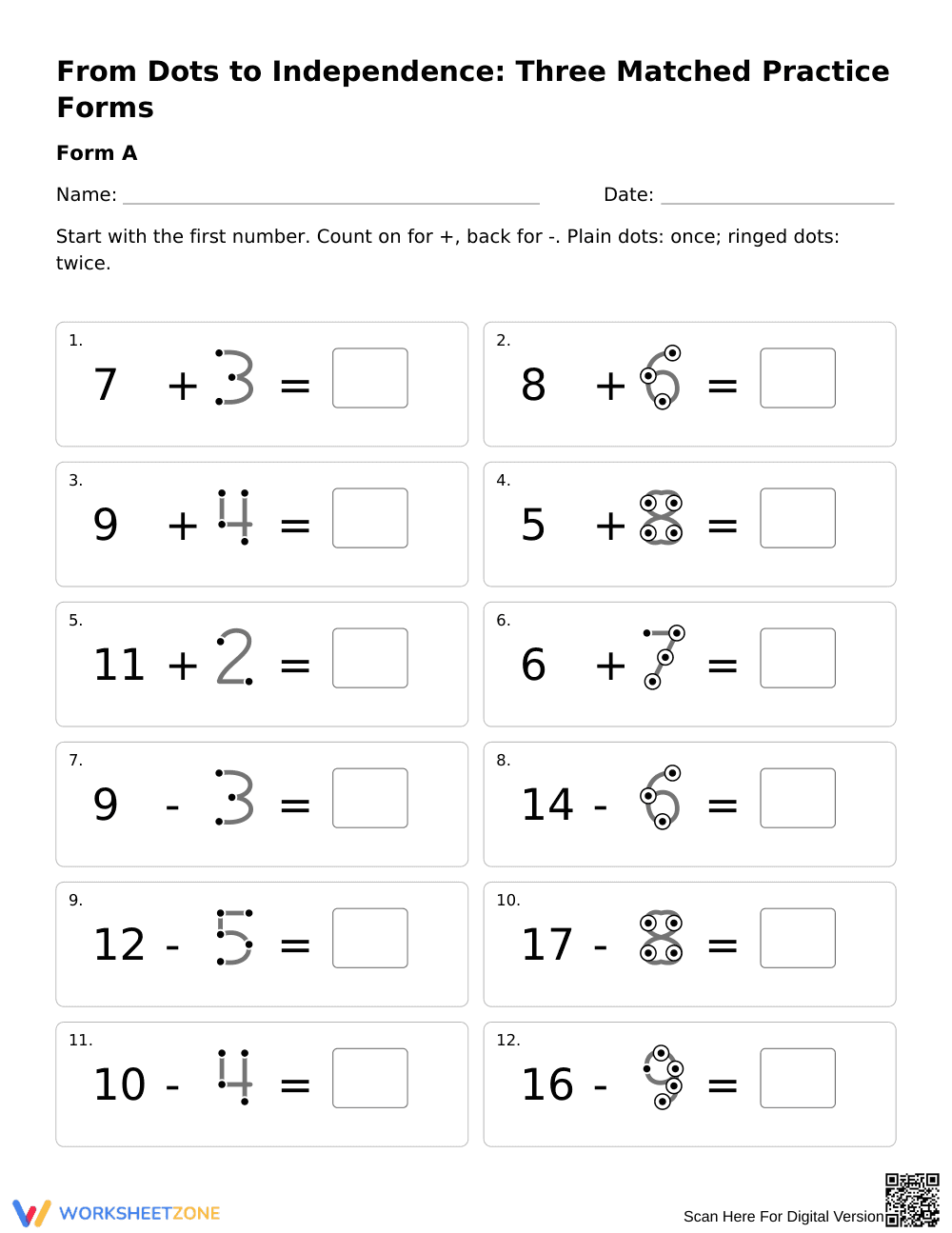
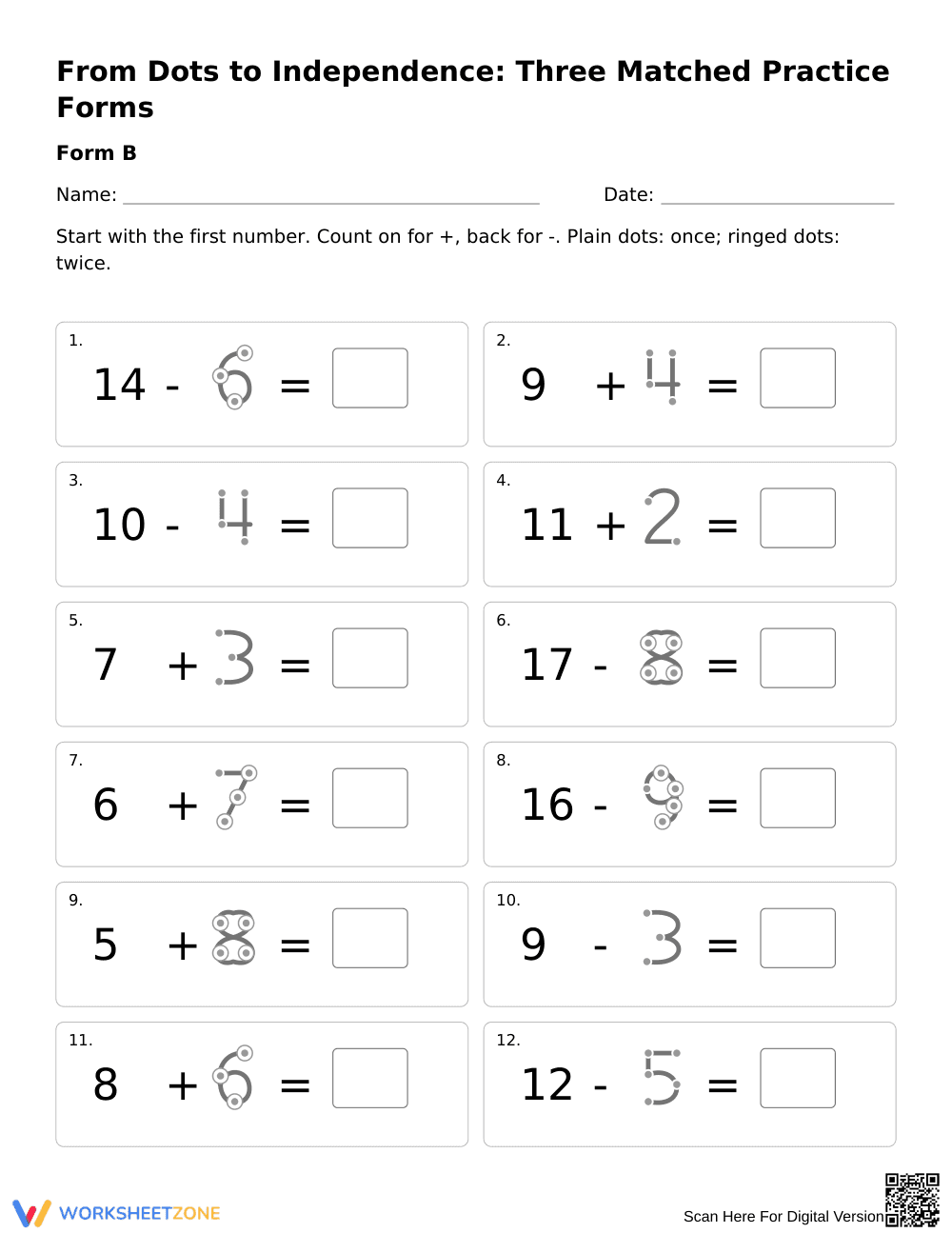
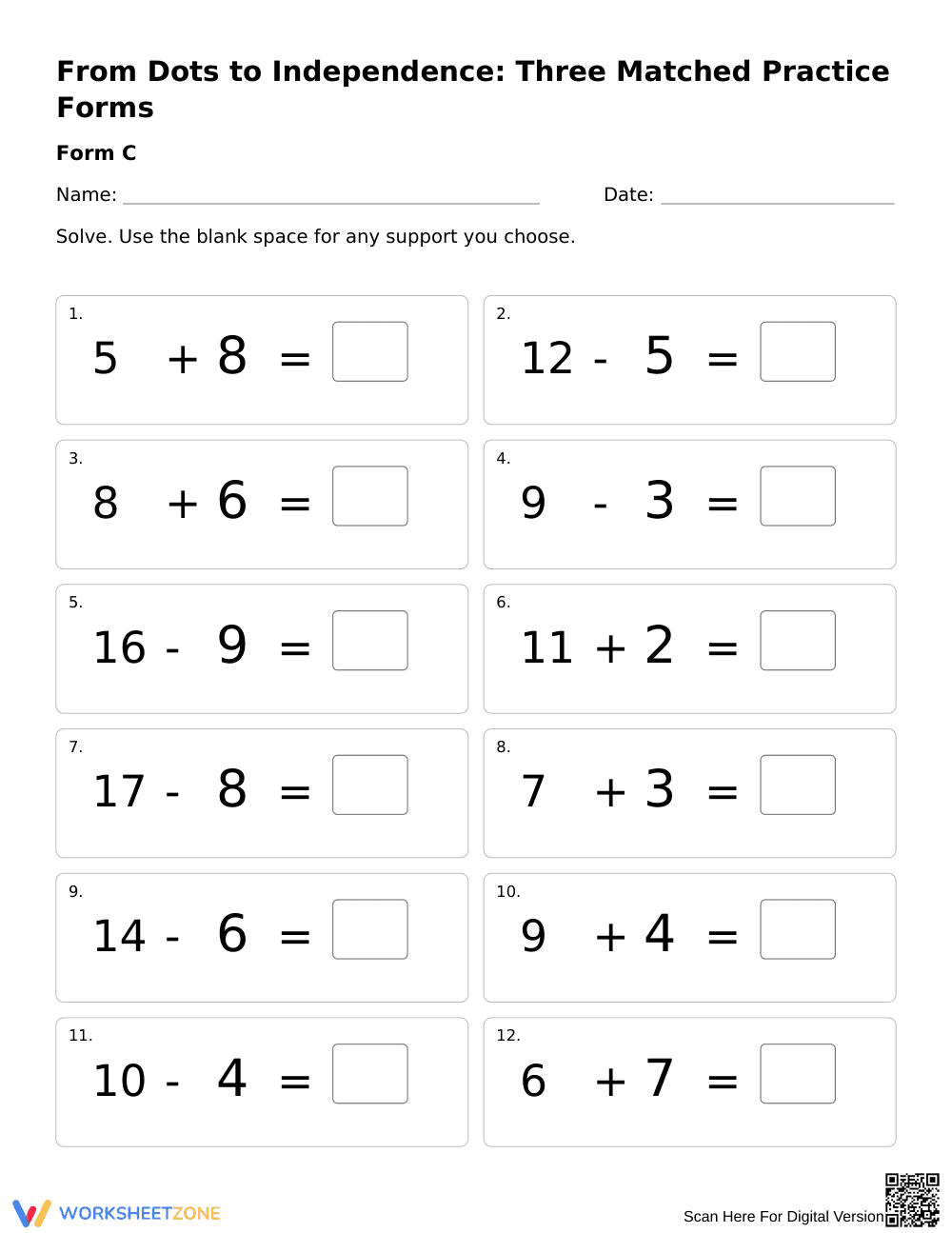
This resource includes three 12-problem practice forms (Forms A, B, and C) and a teacher tracking page. Form A uses single and double touch dots on the second numeral. Form B scrambles those same 12 facts while retaining dot supports. Form C removes all dots for independent practice. The teacher record sheet provides a cross-form answer matrix and accuracy tracker.
Skill Progression
- Guided practice: Form A provides 12 problems with full touch-dot scaffolding on each second addend and subtrahend.
- Supported practice: Form B offers the same 12 facts in randomized order with continued dot prompts to test strategy transfer.
- Independent practice: Form C presents the 12 facts without visual supports to verify unassisted fluency.
This sequence mirrors the gradual-release model (I Do, We Do, You Do) by methodically fading scaffolds.
Standards Alignment
The primary standard is `CCSS.MATH.CONTENT.1.OA.C.6`: Add and subtract within 20, demonstrating fluency within 10 using strategies such as counting on and counting back. Additionally, this supports `CCSS.MATH.CONTENT.1.OA.B.4` by linking addition and subtraction relationships. Both standard codes can be copied directly into lesson plans, IEP goals, or district curriculum mapping tools.
How to Use It
Deploy this worksheet during small-group intervention or after whole-class instruction on counting strategies. Introduce Form A to model tapping plain dots once and ringed dots twice. Assign Form B as partner practice the next day, and Form C as an exit ticket. During work time, observe whether students touch dots in order or confuse plus and minus signs. Students typically complete each form in 10 to 15 minutes.
Who It's For
This resource supports Grade 1 learners, Grade 2 intervention groups, and special education students working on arithmetic IEP goals. For students with motor challenges, pair the worksheets with tactile counters. Pair these forms naturally with a touch-point numeral anchor chart displayed in the math center.
According to research on scaffolded instructional design by Fisher & Frey (2014), gradual release models significantly increase student self-efficacy and procedural automaticity when working with foundational mathematics concepts. This four-page instructional packet operationalizes that evidence-based pedagogy for CCSS.MATH.CONTENT.1.OA.C.6, guiding first-grade learners through adding and subtracting within 20. By transitioning students across three matched 12-item sets—from heavily scaffolded touch-point numerals in Form A to unassisted computation in Form C—the material isolates operational mechanics while preserving problem structure. Teachers utilize the included record sheet to monitor individual student accuracy across each phase, gathering concrete data on where support can be successfully removed. This deliberate fading mechanism ensures that early elementary students and intervention learners develop durable mental arithmetic strategies without forming permanent dependencies on visual prompts, establishing measurable fluency across both addition and subtraction operations.


