


























Views
Downloads

Addition 1-5 Printable Worksheet | Kindergarten Math
Paste this activity's link or code into your existing LMS (Google Classroom, Canvas, Teams, Schoology, Moodle, etc.).
Students can open and work on the activity right away, with no student login required.
You'll still be able to track student progress and results from your teacher account.
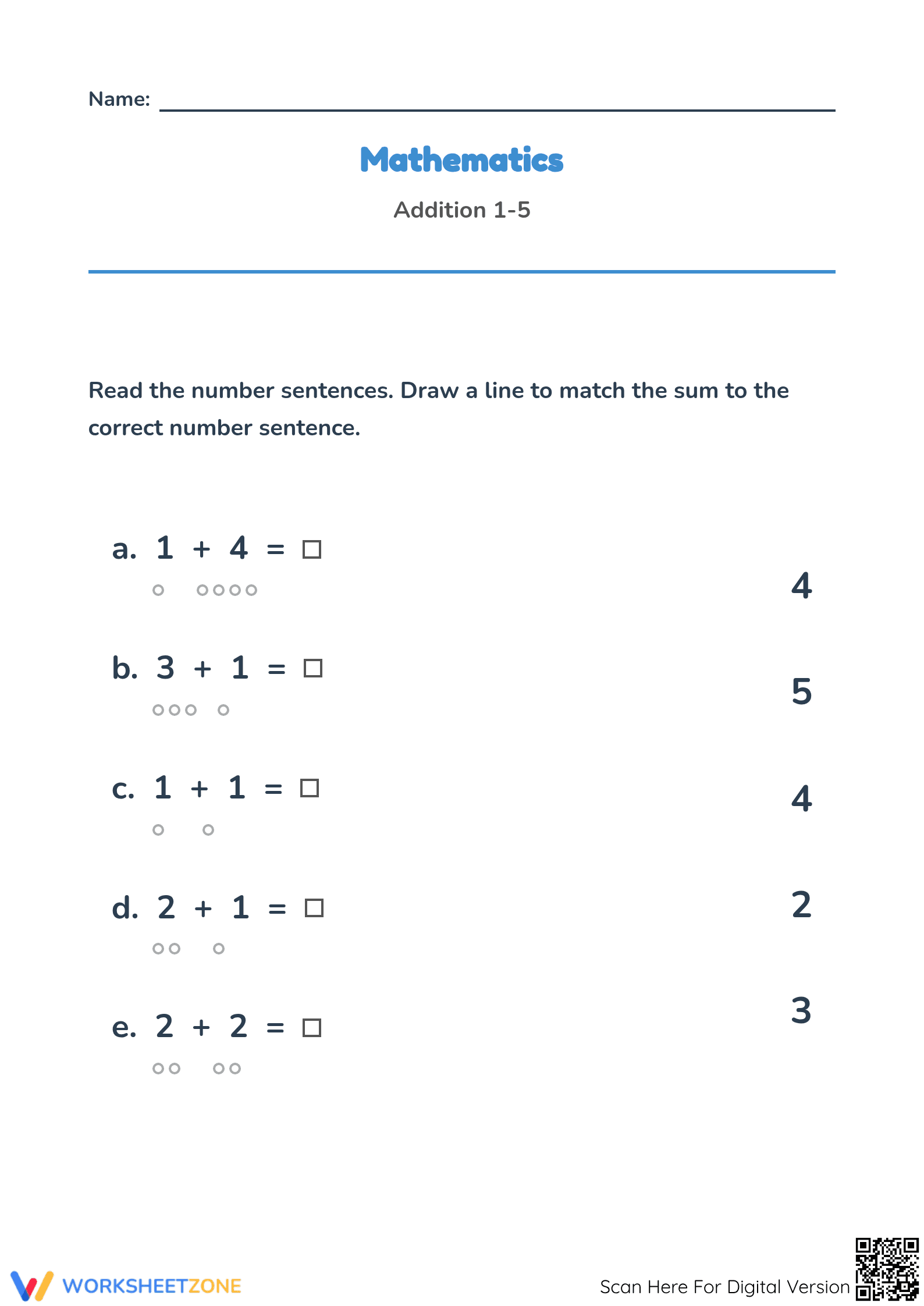
This Kindergarten addition worksheet helps students master basic sums through 5 by matching equations to their correct totals. By providing visual counters beneath each number sentence, the resource ensures that early learners can independently verify their calculations. Students develop fluency in composing numbers while practicing the essential motor skill of drawing lines to connect related mathematical concepts.
At a Glance
- Grade: Kindergarten · Subject: Math
- Standard:
CCSS.MATH.CONTENT.K.OA.A.5— Fluently add and subtract within 5 using visual supports- Skill Focus: Addition within 5
- Format: 1 page · 5 problems · Answer key included · PDF
- Best For: Independent practice or math centers
- Time: 5–10 minutes
The worksheet features five distinct addition problems labeled 'a' through 'e'. Each problem includes a clear number sentence and a corresponding set of visual circles to represent the addends. On the right side of the page, a column of sums (2, 3, 4, 5) provides the targets for the matching activity. This single-page PDF is designed for clarity, with ample white space to reduce visual distractions for young children.
The zero-prep design of this resource ensures it fits into any busy classroom schedule. Step 1: Print the single-page PDF (30 seconds). Step 2: Distribute to students during your math block or as a "fast finisher" activity (30 seconds). Step 3: Review the matching results using the provided answer key to identify students who may need additional support with one-to-one correspondence (1 minute). Total teacher preparation time is under 2 minutes, making it an ideal choice for emergency sub plans or daily warm-ups.
This resource is directly aligned with CCSS.MATH.CONTENT.K.OA.A.5, which requires students to fluently add and subtract within 5. It also supports supporting standards by reinforcing the relationship between numbers and quantities. Both standard codes can be copied directly into lesson plans, IEP goals, or district curriculum mapping tools to ensure instructional compliance and tracking.
Use this worksheet during the independent practice phase of a gradual release lesson on addition. It serves as an excellent formative assessment tool after a whole-group lesson using manipulatives. Teachers should observe if students are counting the visual circles one-by-one or if they are beginning to recognize the sums through subitizing. Completion typically takes between 5 and 10 minutes depending on student proficiency.
This resource is primarily designed for Kindergarten students but is also highly effective for Preschoolers ready for early math or Grade 1 students requiring remedial support. The visual scaffolds make it particularly useful for English Language Learners (ELLs) and students with IEPs who benefit from non-verbal cues. Pair this with a set of physical counting bears or an addition anchor chart for a complete learning experience.
This instructional resource targets CCSS.MATH.CONTENT.K.OA.A.5, focusing on the foundational skill of adding within 5. By utilizing a matching format paired with visual counters, the worksheet supports the concrete-representational-abstract sequence essential for early numeracy. According to Fisher & Frey (2014), the gradual release of responsibility is most effective when students are provided with clear, scaffolded tasks that bridge visual models with symbolic number sentences. This worksheet provides exactly that bridge, allowing learners to verify their mental math against physical representations before selecting the correct sum. The 5-task structure is designed to prevent cognitive overload in early learners while ensuring enough repetition to build fluency. Educators can use this tool to assess immediate recall and the ability to compose numbers. The inclusion of an answer key facilitates rapid feedback, a critical component in the formative assessment process for Kindergarten and Grade 1 mathematics.


