


























Views
Downloads

Adding and Subtracting Zero Worksheet | Grade 1 Essential
Paste this activity's link or code into your existing LMS (Google Classroom, Canvas, Teams, Schoology, Moodle, etc.).
Students can open and work on the activity right away, with no student login required.
You'll still be able to track student progress and results from your teacher account.
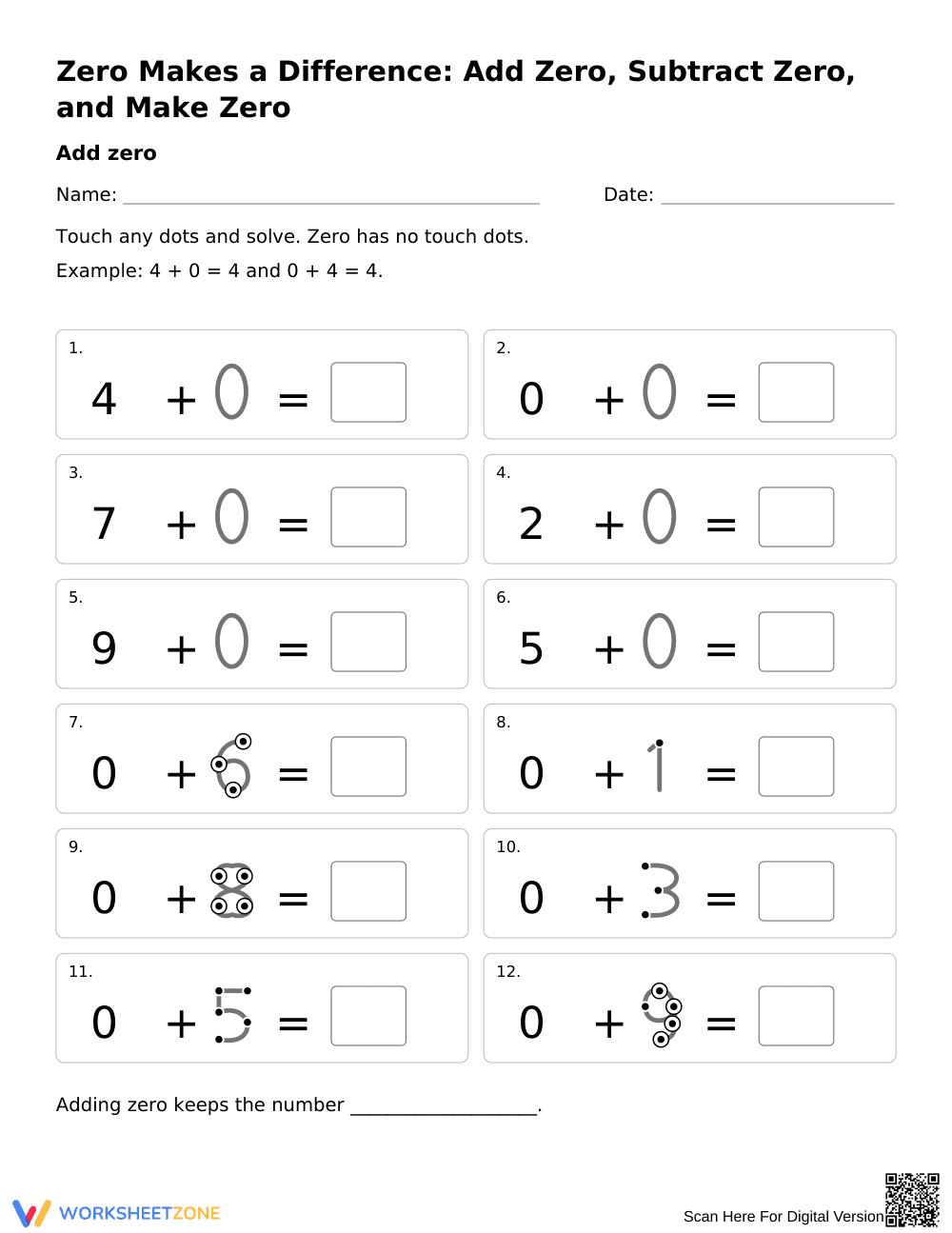
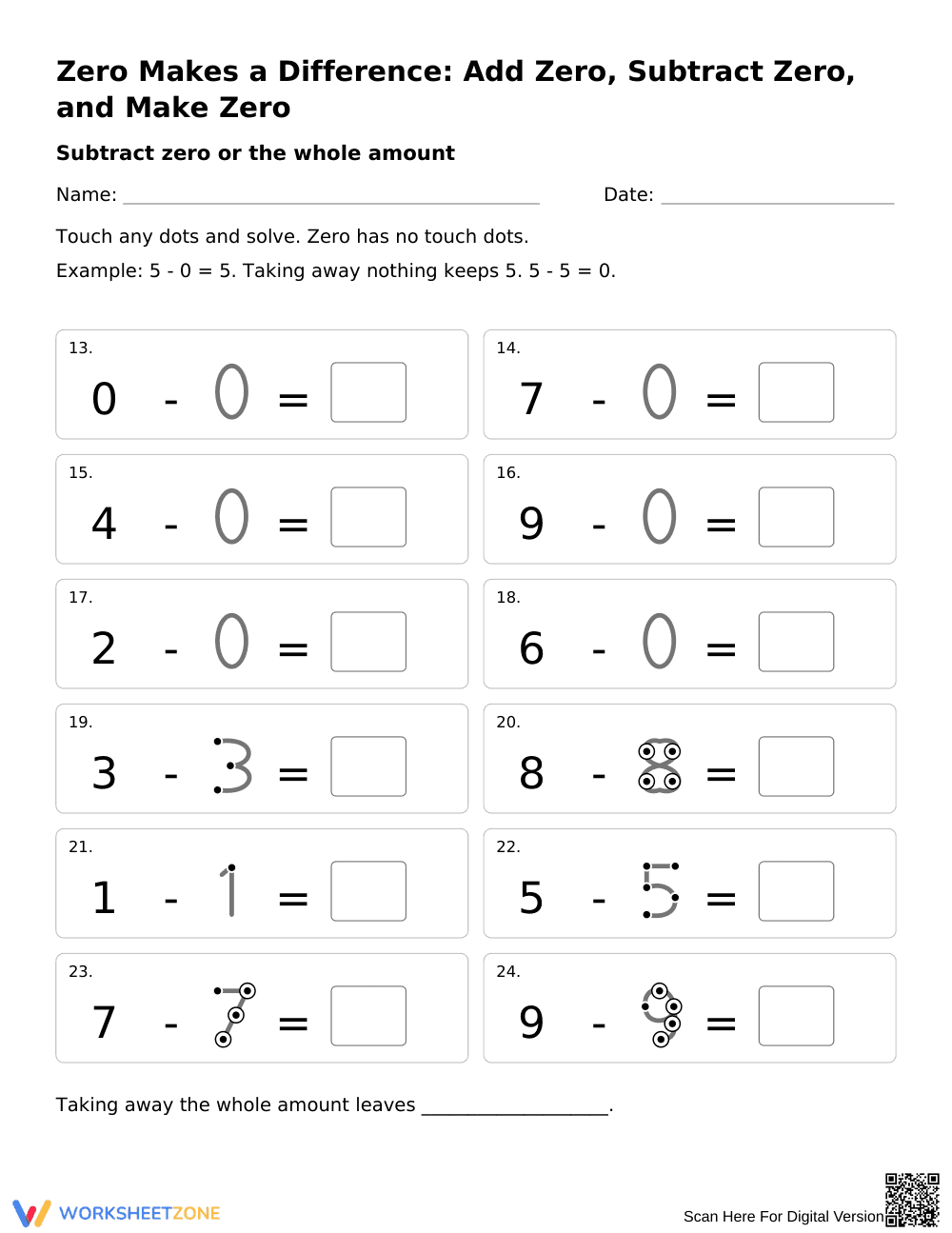
This foundational math worksheet helps first grade learners master the identity property of addition and subtraction concepts involving zero. Students solve 24 targeted arithmetic equations and complete conceptual summary prompts to understand how zero affects whole numbers, building essential computational fluency and number sense.
At a Glance
- Grade: 1 · Subject: Math
- Standard:
CCSS.MATH.CONTENT.1.OA.B.3— Apply operational properties to add and subtract zero from whole numbers- Skill Focus: Adding zero, subtracting zero, and subtracting whole amounts
- Format: 2 printable pages · 24 problems · Answer key included · PDF document
- Best For: Small-group intervention, math centers, and daily skill practice
- Time: 15–20 minutes
What's Inside
The resource includes a two-page printable activity set accompanied by a complete one-page answer key. Page 1 delivers 12 addition problems featuring zero, supported by TouchMath multi-sensory counting dots on items 7–12. Page 2 presents 12 subtraction problems covering subtracting zero and subtracting all. Both pages conclude with a guided fill-in-the-blank generalization prompt.
Skill Progression
- Guided practice (Problems 1–6 & 13–18): Direct computation items establish the baseline rule for adding and subtracting zero without extra visual cues.
- Supported practice (Problems 7–12 & 19–24): Multi-sensory TouchMath dots on numerals 1–9 provide visual-tactile scaffolding as equations invert or subtract equal amounts.
- Independent practice (Reflection Prompts): Fill-in-the-blank prompts require students to state the rules in their own words.
This sequence follows a gradual-release model, moving students from guided equation solving to conceptual independence.
Standards Alignment
This activity directly targets CCSS.MATH.CONTENT.1.OA.B.3: "Apply properties of operations as strategies to add and subtract." It also supports CCSS.MATH.CONTENT.1.OA.C.6 by reinforcing single-digit addition and subtraction fluency within 10 through targeted operational rules. Both standard codes can be copied directly into lesson plans, IEP goals, or district curriculum mapping tools.
How to Use It
Incorporate this worksheet during the guided practice phase of a direct instruction lesson on identity properties, or assign it during independent math rotations to verify fluency. As a formative assessment checkpoint, observe whether students immediately write the known number or pause to count on their fingers; instant recall signals conceptual fluency. The two-page exercise typically takes students 15 to 20 minutes to complete.
Who It's For
This resource is designed for first grade students developing operational fluency, kindergarten learners ready for early facts, and special education students who benefit from TouchMath visual counting points. Pair this activity with a whole-group number line demonstration or an identity property anchor chart to reinforce the mathematical concepts visually before students begin writing.
Early mastery of arithmetic properties involving zero establishes a vital bridge between basic procedural computation and abstract algebraic thinking. When first grade students practice identifying that adding zero preserves a quantity and subtracting an identical value yields zero, they internalize foundational properties of operations aligned with CCSS.MATH.CONTENT.1.OA.B.3. According to research synthesized by Fisher & Frey (2014) on effective gradual-release frameworks, combining multi-sensory supports such as TouchMath dot patterns with explicit generalization prompts significantly strengthens conceptual retention in primary numeracy. Structured practice sheets that feature 24 focused calculations alongside reflective sentence frames enable young learners to shift from counting strategies to automatic fact retrieval. This dual focus on procedural drill and linguistic formulation helps elementary educators identify misconceptions early and ensures that emerging mathematicians build durable fluency required for multi-digit arithmetic and algebraic problem solving.


